Department of Political Science Marburg
1. Information about the Institute
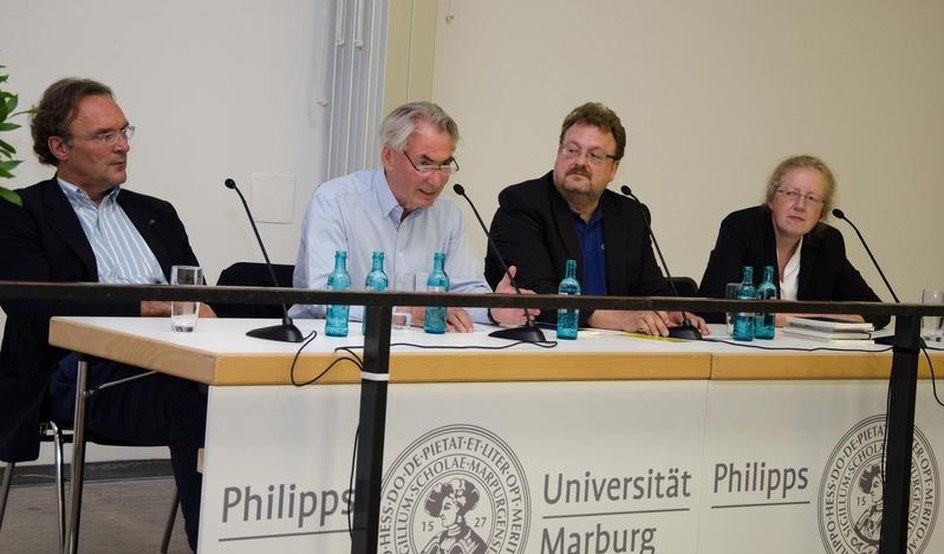
Professors teaching at the Department of Political Science
| Main fields in teaching and research |
|
| Berg-Schlosser, Dirk |
Comparative Politics, Political Analysis, Development Studies, Political Culture, Empirical Democracy Studies |
| Bieling, Hans-Jürgen |
Political Theory, main topics: European Integration, International
Political Economy, Theory of the State and the Society |
| Bredow, Wilfried von | International Relations, main topics: Tranatlantic Policies, German Foreign Policy, Security Studies |
| Henkenborg, Peter |
Political Education |
| Koch-Baumgarten, Sigrid |
Political System, History and Economy of the Federal Republic of
Germany |
| Kurz-Scherf, Ingrid | Political Theory, main topics: Political Sociology and Economy, Gender studies, Feminist theory, Labour Research |
| Noetzel, Thomas | Political Theory and Philosophiy, History of Ideas, Political System of the United Kingdom and Ireland |
| Schiller, Theo | Political Theory, Theories of Democracy, Political System of the Federal Republic of Germany |
| Westle, Bettina |
Political Sociology, Election and Participation, Empirical
Methodology |
Two more professors will be appointed soon. Other faculty includes research and teaching assistants, retired professors, guest-professors, tempory lecturers. For more information check the German page of the Department.
Degrees
In the course of the Bologna-Process, the Department of Political Science in Marburg has implemented two new degrees, the Bacheor of Arts in Political Science and the Master of Arts in Political Science. In addition to these two programs, the Department of Political Science also contributes to Master programs in cooperation with other Institutes and Faculties, such as the Master of Arts in Peace and Conflict Studies or the Master of Arts in Development Studies.The Bachelor of Arts is a first university degree. It usually will take three years and consists of basic compulsory modules for all students, optional modules which lead to a personal specialisation and a pratical part.
The Master of Arts should lead to a further specialisation. The Master pograms in Marburg usually are designed for a two year period.
2. Courses
Incoming students have to choose between different Modules:Undergraduates
1st and 2nd year students have to attend seminars and lectures as Basic Modules in the following fields:
- Political System of the Federal Republic of Germany / Politisches System der Bundesrepublik Deutschland
- International Relations / Internationale Beziehungen
- Analysis and Comparison of Different Political Systems / Analyse und Vergleich Politischer Systeme
- Gender Studies / Politik und Geschlechterverhältnis
- Political Economy / Politische Ökonomie der Bundesrepublik Deutschland
3rd year students can attend more advanced seminars and lectures as Optional Modules in the following fields:
- Political System of the Federal Republic of Germany / Politisches System der Bundesrepublik Deutschland
- International Relations / Internationale Beziehungen
- Analysis and Comparison of Different Political Systems / Analyse und Vergleich Politischer Systeme
- Gender Studies / Politik und Geschlechterverhältnis
- Political Economy / Politische Ökonomie der Bundesrepublik Deutschland
GraduateStudents
Graduated students are recommend to join seminars and lectures in modules of the different Master programs that are offered jointly by the Department of Political Science.
These are:
- M.A. in Political Science
- M.A. of Peace and Conflict Studies
- M.A. Development Studies
- M.A. Europe: Integration and Globalisation
3. Contact
For further Information please contact the Erasmus Coordinator:Susanne Löhr
Wilhelm-Roepke-Straße 6
35032 Marburg
Germany
Phone: +49 6421/282 4939
Office: Block B, 5th floor, 05B04
Office Hour: Monday, 15-16:45 h
4. Information on the academic year
The academic year in Germany is divided into two terms (Semester). The winter term begins on October 1st and ends on March 31st. Usually classes start in mid-October and end in mid-February. There is a vacation period of about two weeks around Christmas and the New Year.The summer semester begins on April 1st and ends on September 30th. Classes usually start after Easter, but not before mid-April. They run until the end of July. There is no longer vacation period in between except for some public holidays.