Skip to content
 
 
Emotionsfläche ISU
 
  Start  
 

Location

 Marburg in Deutschland

The town

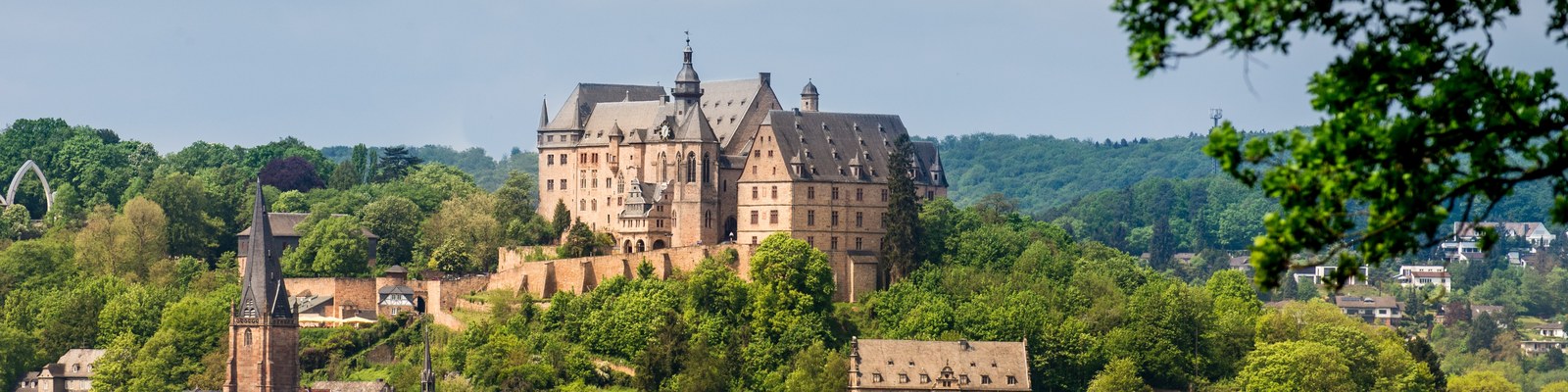
The university town Marburg on the Lahn lies in the heart of Germany in the federal state of Hessen. Marburg is famous for its medieval churches, especially the Elisabethkirche, one of the first purely Gothic churches, as well as for the castle.

Take the elevator to the old city ("Oberstadt", upper city) which is a labyrinth of narrow, cobblestone streets lined with pictorial well-preserved examples of 17th and 18th century frame houses. Walking through this part of Marburg takes you on a trip down the memory lane.

The city is stimulated by an endless and spirited source of creativity and ideas - and that in a broad range; from classical music to off-theatre, from museums and archives to open-air festivals, from literary circles and socio-cultural centres to the multiple prize-winning cinema programme.

Marburg is located in the middle of Germany and also in the middle of Hessen. Frankfurt am Main is just an hour away and with it´s numerous train connections it´s just a few hours away from Berlin, Hamburg and Munich. The Frankfurt am Main Airport is a major international airport. It´s by far the busiest airport by passenger traffic in Germany and the third busiest in Europe. It serves the most international destinations in the world so that Marburg is also just a few hours away from wonderful European cities like Prague, Barcelona, Paris, Brussel, London, Oslo, …


Have you already heard that ...

  • Marburg has more stairs in its alleys than in its houses?
  • Marburg does not have a university; Marburg is a university?
  • the most beautiful illustrations of the Fairy Tales of the Brothers Grimm were done in Marburg?
  • an elevator will take you in Marburg from "Modern Day" to "History"?
  • some of Marburgs houses can be reached only through a skylight?


Get to know Marburg with us … 


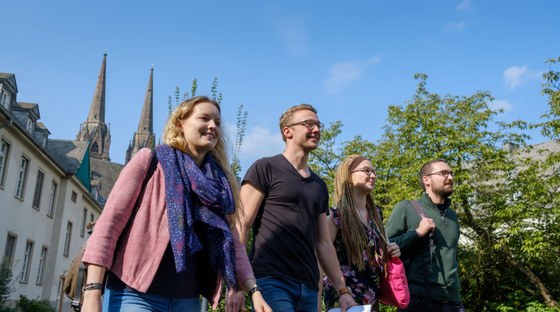
The University

The University of Marburg is one of the oldest German universities. In 1527, as part of the Reformation, 23-year-old Landgrave Philipp the Magnanimous founded the university as the first Protestant university. It has been a place of research and teaching for nearly five centuries. If you want to know more about the history of the university please read on here.

Marburg has approximately 86,000 residents. With 20,000 students and 6,000 people working for the university, the slogan of Marburg is: "Other cities may have a university, Marburg is a university."  The majority of students in Marburg come from all parts of Germany. There are also over 30 international partnerships and exchange programmes tie the Philipps-University to colleges worldwide. 2.000 scientists and scholars teach and research at the university in Marburg; within this number are over 400 professors and university lecturers.

Five Leibniz Prize recipients, a new clinic, as well as many notable research projects and prominent institutes and facilities across all disciplines vouch for an excellent scientific reputation.

Emil von Behring, who founded the Behring Works in 1904, was not only the first Nobel Laureate for Medicine (1901) but also a professor of Medicine at the Philipps-University.

Its broad range of arts and humanities, and its experimentally challenging scientific work, constitute an ideal platform for interdisciplinary cooperation. The university relies on innovative teaching methods (with short course durations) and networked research, and offers students from all over the world a broad range of courses.

And studying at Marburg is particularly easy for disabled people, especially for the visually impaired, due to a number of special aids. As a result, Marburg University has by far the greatest number of blind students. Recently, Philipps-Universität has also been concentrating on measures that provide an even more family-friendly work environment. These self-imposed commitments have been awarded the Family-Friendly University seal, which is very rare in Germany. And last but not least, Philipps-Universität also offers a wide range of leisure activities in the areas of sports, music and culture.

Famous Lecturers and Students
The names of Marburg scientists are associated with milestones in science and medicine as well as with important schools of thought in the history of ideas. Among these are the inventor of the steam engine, Denis Papin, the philosopher of the Enlightenment, Christian Wolff, whose lectures on all subjects drew many students to Marburg - including students from abroad, and the polymath Johann Heinrich Jung, also called Stilling, founding member of the Institute of Political Science. The law historian Friedrich Carl of Savigny started his career in Marburg, and others, such as the chemist Robert Bunsen, came to Marburg when they were already famous.
Other great thinkers include the neo-Kantian philosopher Hermann Cohen, the physicist Karl-Ferdinand Braun, inventor of the Brownian tube, and the geophysicist Alfred Wegener, who developed the theory of continental shift at Marburg. Emil von Behring, the inventor of serum medicine, was awarded the first Nobel Prize for Medicine (1901) as a Marburg professor and used the prize money to found the Behring works. Just as influential are the existential philosopher Martin Heidegger, and the New Testamentarian Rudolf Bultmann, the leading expounder of the demystification of Christianity (please also refer to the Gallery of Forebears of Philipps-Universität).

Marburg Students
From the great circle of Marburg students who have become famous, the most outstanding are the composer Heinrich Schütz, the Russian polymath and subsequent founder of Moscow University, Michail Lomonossow, who married a woman from Marburg in 1740, the brothers Grimm, the Spanish philosopher Ortega y Gasset, the poets Boris Pasternak and Gottfried Benn, as well as the architect of standard German spelling Konrad Duden. Furthermore, the chemist Otto Hahn, the surgeon Ferdinand Sauerbruch, the theologian Karl Barth and the politicians Wilhelm Liebknecht and Rudolf Breitscheid studied at Marburg as well as Gustav W. Heinemann, who was later a good friend of the world-famous political economist, Wilhelm Röpke. And among the first women who were admitted to study at university since 1908 was Gertrud von Le Fort.

Cultural Life
Life is not only work. For this reason Philipps-Universität also promotes other talents. The language centre offers qualified courses as well as a self-study centre. The university sports program offers more than 30 different disciplines including numerous water sports at the university boathouses on the Lahn river and Eder lake as well as martial arts and disease prevention with Yoga and Shiatsu. In addition, the sports and study guesthouse Hirschegg owned by the Marburg University Association, can be used for skiing and hiking trips in the Austrian Alps.

As in sports, so in music: students and staff sing together in the uniCHOIR or play music in the student symphony orchestra, the Young Marburg Philharmonic or the student Big Band. The music house in the botanical garden can be used for practice. And the eloquent members of the university gather in the Marburg debating club.
Those who prefer to enjoy culture passively can visit the university museums and exhibitions: the art museum, the antiques and casts collections, the mineralogical, religious and ethnological exhibitions as well as the "Anatomicum" museum. The main tourist attraction, however, is the palace. It is the largest still existing secular Gothic building in Germany and contains the University Museum of Cultural History.
The old and new botanical gardens do not only do not only attract visitors in the summer months. Tropical greenhouses and botanical exhibitions can be visited all year round.

Uni Marburg


Gebäude CNMS

The Hessen International Summer University

The ISU program of study will be held in the building of the  "Center for Near and Middle Eastern Studies" (CNMS). It is within easy reach by foot or by public transportation from your dormitory. Banks and university facilities such as libraries, computer rooms and the university cafeteria (Mensa) are only a few minutes away, as well as Marburg’s romantic and lively “Altstadt” with its boutiques, restaurants, pubs and movie theaters.

CNMS


Last modified: 26.03.2010 · Cornelia Janus


Internationale Sommeruniversität

Hessische Internationale Sommeruniversität, Biegenstraße 10, D-35032 Marburg
Tel. 06421 28-26191, Fax 06421 28-28998, eMail: isu@uni-marburg.de

URL dieser Seite: http://www.uni-marburg.de/isu/practical-information/location-1

Legal