Main Content
Collaborative Research Centre "Mechanisms of Cellular Compartmentalization and the relevance for disease" (CRC 593, 2003-2014)
Sonderforschungsbereich (SFB 593)
The biological research of the Collaborative Research Centre (CRC 593) was focused on the topic of how eukaryotic cells generate, maintain and alter their intracellular compartmentation in both healthy and diseased states. The overall aim of the basic research was twofold. First, several CRC groups were interested in the elucidation of the molecular mechanisms of cellular compartmentalization processes in eukaryotic cells. This included i) the transport of metals, metal complexes, nucleic acids, lipids and proteins to, within and out of various cell compartments such as mitochondria, ii) the assembly and activation of plasma membrane ion channels in the secretory pathway, and iii) the intracellular vesicle transport and protein sorting in (polarized) cells. Since many of the studied processes are of relevance for human disease, a particular focus of the research was on the investigation of pathogenic alterations of these processes. A second central goal of the CRC was on the impact of viruses (such as the highly pathogenic Marburg and Ebola viruses), intracellular parasites, and fungal pathogens on the intracellular compartmentalization. Several groups studied how these pathogens exploit and alter the existing intracellular compartmentation to ensure their own survival. Overall, the investigations within the CRC 593 comparing healthy and pathogenically altered states have gained numerous new molecular insights into the functioning and malfunctioning of intracellular compartmentalization processes. The highly successful work of the CRC 593 groups has improved the mechanistic understanding of many biochemical and cell biological pathways.
The Collaborative Research Centre CRC 593 was funded by the German Research Foundation (Deutsche Forschungsgemeinschaft "DFG") from January 2003 through December 2014 with a total of 25,3 million Euros. On average the CRC contained ca. 16-18 research groups (altogether 28 groups including junior groups) from the Philipps Universität Marburg (Faculties of Medicine, Biology and Pharmacy) and the Max-Planck Institute for Terrestrial Microbiology. These groups combined their multi-disciplinary expertise in Biochemistry, Cell Biology, Genetics, Microbiology, Molecular Biology, Parasitology, Physiology, and Virology for collaborative work. The biological research was conducted with a wide spectrum of model organisms such as yeast, filamentous fungi, various pathogens, cell culture systems and transgenic animals using state-of-the-art instrumentation including three core facilities in Proteomics, Protein Spectroscopy, and Bioimaging. The research results were published in numerous papers in leading international journals (including Science, Nature, Nature Medicine, Cell, Molecular Cell, Nature Chemical Biology, Nature Cell Biology, Cell Metabolism, PNAS, EMBO Journal, Genes and Development). Brief summaries of the results of the individual groups are found in a special issue of European Journal of Cell Biology published in 2015 (https://www.sciencedirect.com/journal/european-journal-of-cell-biology/vol/94/issue/7).
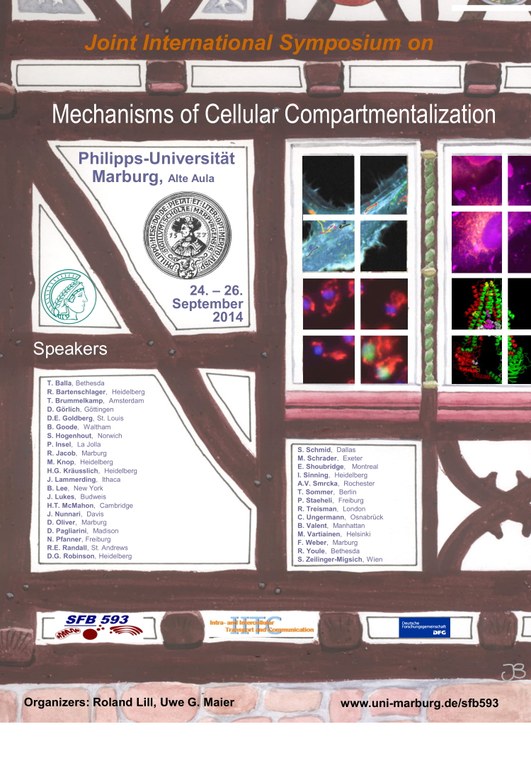
Four international symposia were organized bringing numerous world-renowned experts of the CRC research field to Marburg (see Figure: Poster of the International Symposium 2014 on ‘Mechanisms of Cellular Compartmentalization’). Several research prizes (including the Gottfried-Wilhelm-Leibniz prize, the Heinz Maier-Leibnitz price, the Feldberg award, the Robert-Koch medal, and the Emil-von-Behring prize) were awarded to CRC 593 members during the funding period.
Coordinator: Prof. Dr. Roland Lill, +49 6421 28-66449, lill@staff.uni-marburg.de
Executive Board: Proff. Dres. Jürgen Daut, Regine Kahmann, Klaus Lingelbach (†), Hans-Dieter Klenk