Hauptinhalt
First Principles Approaches and Concepts to Simulate Electrochemical Interfaces
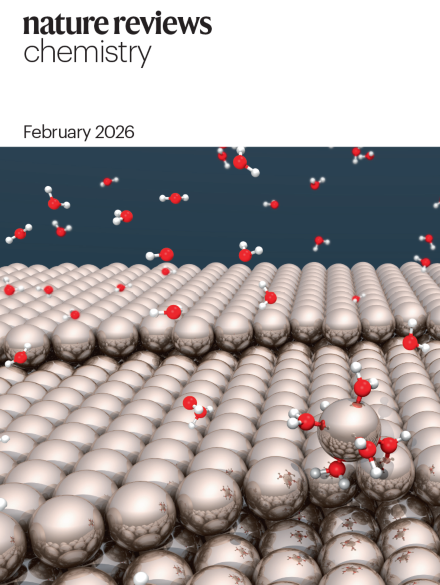
Electrochemistry under bias remains one of the grand challenges for first-principles modelling. Although electrochemical interfaces govern key technologies from corrosion protection to energy conversion, their realistic simulation has long defied ab initio approaches. The reason is fundamental: electrochemical systems are thermodynamically open, operate under controlled electrode potentials and exhibit strong, intrinsically fluctuating electric fields on atomic length and time scales. In a new Review published in Nature Reviews Chemistry 10, 133 (2026), Mira Todorova, Stefan Wippermann and Jörg Neugebauer develop a unified conceptual framework for the first-principles description of electrified solid–liquid interfaces. The article analyses how surrogate models of the electrochemical double layer, consistent electrostatic boundary conditions and thermodynamically open ensembles must be combined to capture not only the mean electrode potential but also its fluctuations, which can reach the order of ±1 V and directly affect reaction barriers and rates. By explicitly linking electrochemical potential control to the fluctuation–dissipation framework familiar from thermostats in molecular dynamics, the Review provides a clear roadmap for next-generation ab initio studies of electrochemical reactions. The work is featured on the Cover of Nature Reviews Chemistry, Vol. 10