Hauptinhalt
Excitons in Epitaxially Grown WS2 on Graphene: A Nanometer-Resolved Electron Energy Loss Spectroscopy and Density Functional Theory Study
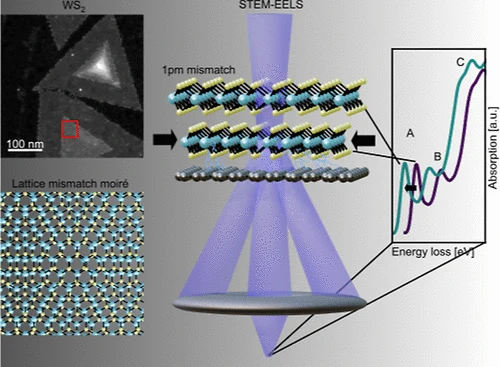
Understanding excitons in realistic two-dimensional heterostructures is a key prerequisite for next-generation optoelectronic and quantum devices. Yet in epitaxially grown 2D materials, subtle structural distortions introduced during growth often remain invisible to conventional optical spectroscopy. In a recent article published in ACS Nano, Max Bergmann, Kerstin Volz, Stefan Wippermann and collaborators combine nanometer-resolved electron energy-loss spectroscopy with ab initio simulations to uncover the microscopic origin of excitonic shifts in epitaxial WS₂ grown on graphene. The study reveals a systematic redshift of the A and B excitons with increasing layer number and demonstrates that this shift is not primarily caused by dielectric screening, as commonly assumed, but by minute lattice-constant mismatches between WS₂ layers induced by heteroepitaxial alignment to the graphene substrate. High-resolution STEM measurements directly visualize the resulting lattice-mismatch moiré pattern, while Bethe–Salpeter calculations establish a quantitative link between strain, electronic structure and excitonic response. By connecting nanoscale structural distortions to excitonic properties in scalable, gas-phase-grown heterostructures, the work provides new insight into the design of realistic 2D material platforms for exciton-based optoelectronic devices. The work is published in ACS Nano.