Main Content
Research
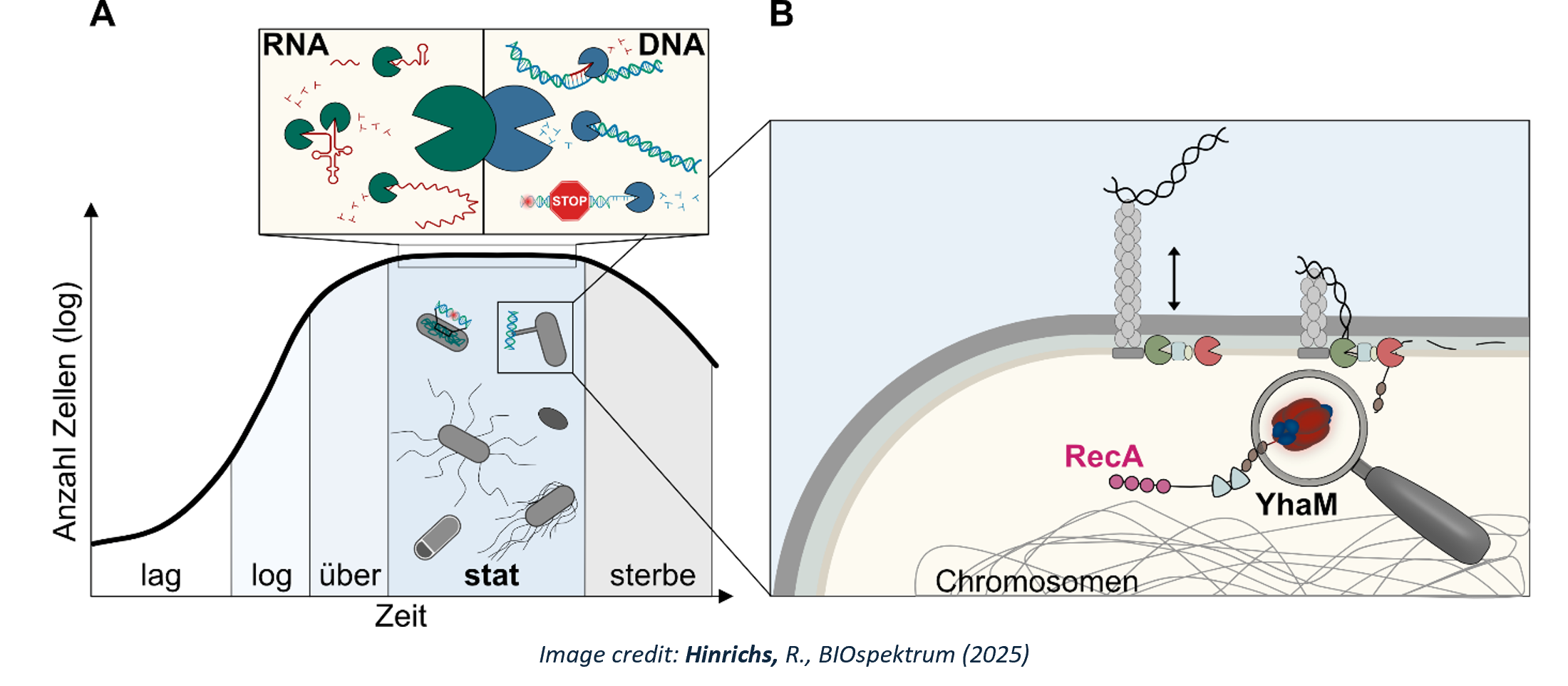
We investigate how nucleases control DNA and RNA metabolism in bacteria and thereby govern central cellular adaptation processes. Our focus is on identifying which nucleases are particularly active in the stationary phase, where bacteria spend most of their time in natural environments, and how they regulate the stability, processing, and exchange of nucleic acids. We are also interested in how imported environmental DNA is processed by nucleases, which steps are critical for its successful integration into the genome, and how these processes are linked to the SOS response and other cellular stress reactions.
To address these questions, we combine microbiological and biochemical approaches. We use genetic manipulations and phenotypic analyses in model bacteria to dissect the functions of individual nucleases across growth phases, during DNA uptake, and under stress conditions. In parallel, we perform biochemical experiments to characterize the activity, specificity, and regulation of these enzymes at the molecular level, both in mRNA processing and in the processing of imported DNA. In this way, we aim to develop a mechanistic understanding of how nucleases enable bacterial adaptation during the transition to and within the stationary growth phase, and how DNA uptake, SOS response, and genome stability are interconnected. Our long-term goal is to build an integrative model that connects the roles of nucleases in DNA uptake, mRNA stability, and stress responses into a coherent mechanistic picture of bacterial adaptation (Hanßmann et al., 2025; Hinrichs, 2025).
Hanßmann, J., Pane-Farre, J., Meiser, M., Girbig, M., Fu, L., Madej, M. G., Sendker, F. L., Tholken, C., Lechner, M., Ziegler, C., Hochberg, G. K. A., Bange, G., Thanbichler, M., & Hinrichs, R. (2025). A conserved nuclease facilitates environmental DNA uptake. Nucleic acids research, 53(10). https://doi.org/10.1093/nar/gkaf443
Hinrichs, R. (2025). Nukleasen als Regisseure bakterieller Anpassung. BIOspektrum, 31(5), 575-575. https://doi.org/10.1007/s12268-025-2539-0