08.07.2026 Marburg researchers decode one of nature's largest enzymes
Nature study reveals how a massive enzyme complex powers energy production in methane-producing microorganisms
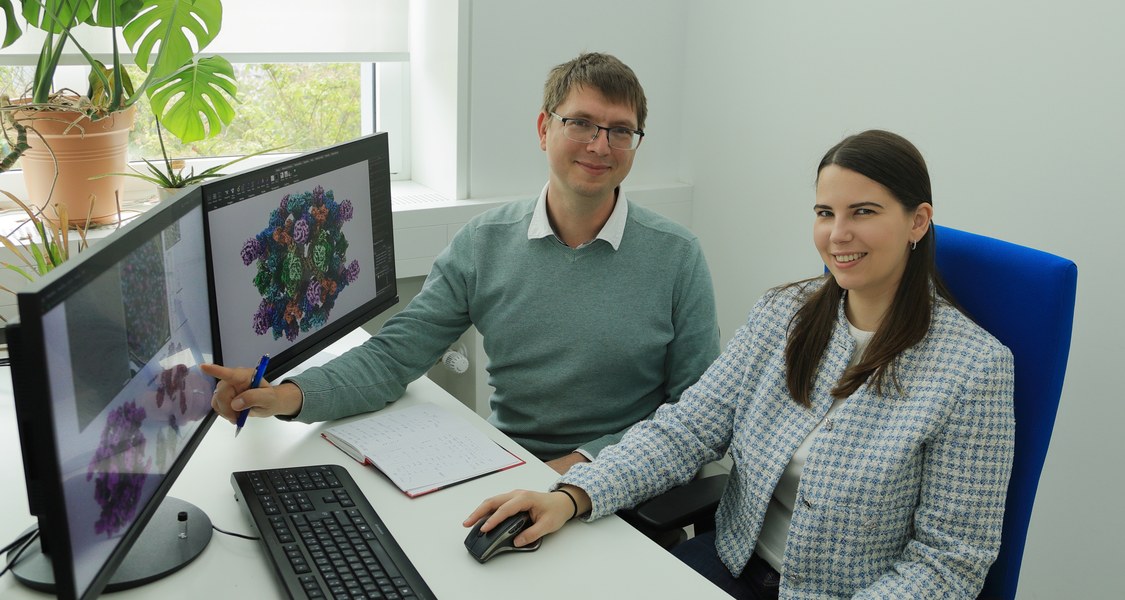
A research team at Marburg University has investigated one of the largest enzyme complexes found in nature to date and deciphered its remarkable structure. Under the supervision of Prof. Dr. Jan Schuller, PhD student Sophia Paul from the Centre for Synthetic Microbiology (SYNMIKRO) was able to characterise the so-called heterodisulfide reductase super-assembly in detail. The results of the study are now being published in the journal Nature. They show how a molecular ‘giant’ comprising hundreds of building blocks enables energy production in microorganisms.
“This enzyme complex impressively demonstrates how nature has constructed complex molecular machines to efficiently generate energy under extreme conditions. What is particularly exciting for us is that we have not only been able to elucidate the structure of this enormous system, but also to see how flexibly microorganisms adapt their energy metabolism to their environment,” says Prof. Dr Jan Schuller.
The investigated enzyme complex is impressively large: it has a molecular mass of around eight mega-daltons and a diameter of approximately 50 nanometres. This makes it one of the largest known enzyme complexes. For comparison: many enzymes, such as those that provide energy for cells by metabolising sugar, are significantly smaller, at around 120 kilo-daltons. The super-assembly consists of a total of 252 protein subunits and contains more than 600 so-called cofactors – small molecular components that are crucial to the enzyme’s function.
Through the complex structural organisation of its numerous components, the enzyme complex is able to efficiently link several reaction steps together. This enables a rapid and targeted transfer of electrons – a key process for energy production in certain microorganisms.
A molecular key to methane formation
The complex is isolated from the microorganism Methanococcus maripaludis. This belongs to the group known as methanogenic archaea – single-celled organisms that can live without oxygen and are found in extreme environments. Their habitats range from hot springs and deep sediments to saline ecosystems such as the salt marshes of the German North Sea coast.
These microorganisms use hydrogen to convert carbon dioxide (CO2) into methane (CH4). Alongside carbon dioxide, methane is one of the most significant greenhouse gases and contributes to global warming. A better understanding of biological methane production therefore helps to better assess the role of such microorganisms in global carbon cycles and in the context of climate change.
Surprising adaptability discovered
Using cryo-electron microscopy, the Marburg team was not only able to visualise the structure of the enzyme complex, but also to identify an unexpected feature: in around 18 per cent of the particles examined, a formate dehydrogenase was incorporated in place of a hydrogen-utilising hydrogenase.
This observation demonstrates the high adaptability of anaerobic microorganisms. If their environment changes – for example, due to limited availability of hydrogen – they can specifically replace components of the complex and thereby adapt their energy production.
In addition to studying isolated complexes in the laboratory, the research group also used cryo-electron tomography to analyse the enzymes directly in their natural environment within the cell. The results show that the super-assemblies occur in high density within the cells and presumably play a central role in electron flow and energy production in the metabolic pathway.
The study thus provides new insights into the functioning of an exceptionally large biological system and demonstrates how microorganisms are adapted to extreme living conditions through highly complex molecular machines.
Further information: https://www.nature.com/articles/s41586-026-10744-9
Contact person:
Prof. Dr. Jan Schuller
Center for Synthetic Microbiology (SYNMIKRO)
Marburg University
Phone: 06421 28-22584
E-Mail: jan.schuller@synmikro.uni-marburg.de
Sophia Paul
Center for Synthetic Microbiology (SYNMIKRO)
Marburg University
Phone: 06421 28-22581
E-Mail: sophia.paul@chemie.uni-marburg.de