27.03.2026 Rebecca Hinrichs is a new research group leader at the Microcosm Earth Center (MEC) in Marburg
The microbiologist investigates how bacteria regulate their responses to environmental conditions
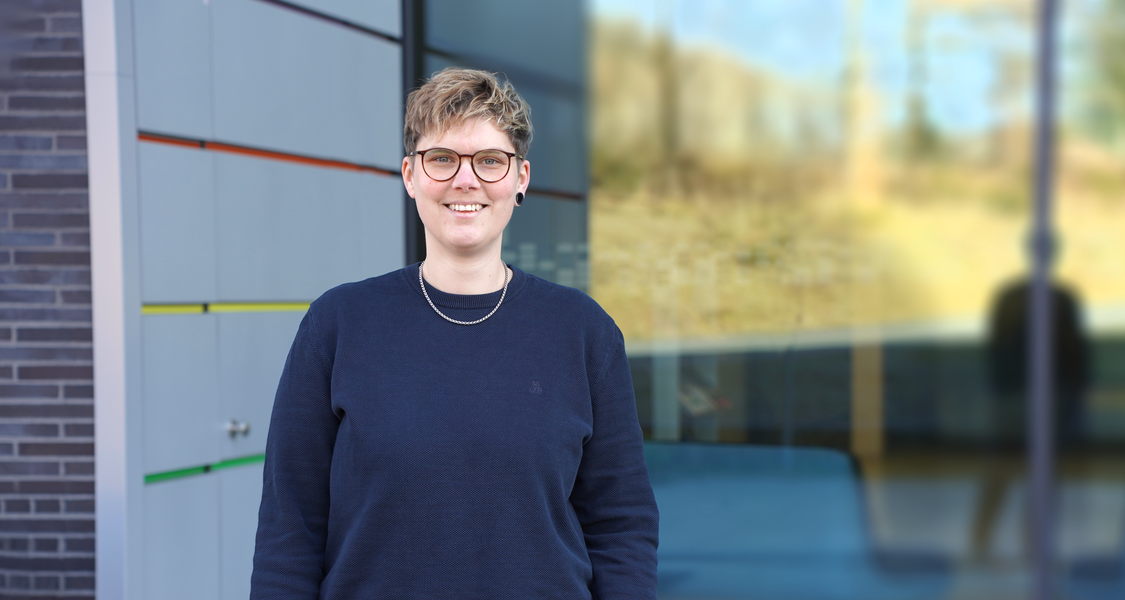
Rebecca Hinrichs is the new research group leader at the Microcosm Earth Center (MEC) in Marburg. She is investigating how bacteria switch to survival mode in stressful conditions, such as food scarcity or exposure to antibiotics, and the role of nucleases in this process. A deeper understanding of bacterial strategies could, in the long term, help prevent the development of antibiotic resistance.
Bacteria in survival mode
Not only are bacteria small, they are also extremely adaptable. When faced with stressful conditions such as food scarcity, drought or antibiotic exposure, they switch to survival mode. During this so-called stationary phase, they either slow down or stop growing entirely. Unlike in laboratory conditions, where bacteria grow strongly in optimal nutrient solutions, this phase is normal in nature, where resources are limited and environmental conditions can be suboptimal or even life-threatening.
Rebecca Hinrichs is investigating how the transition to the stationary phase is regulated at the molecular level. Bacteria employ various strategies in response to unfavourable environmental conditions: they form biofilms, produce spores, or take up DNA from the environment to acquire new capabilities. The choice of strategy depends on complex regulatory processes. Nucleases — enzymes involved in processing DNA or RNA — play a central role in this. Understanding these processes could enable specific influence over bacterial adaptation.
Her research focuses on Bacillus subtilis, a Gram-positive bacterium that is one of approximately 80 organisms known to take up DNA from the environment. This mechanism can ensure survival when the organism’s own genetic repertoire is insufficient. This principle is particularly relevant to the development of antibiotic resistance: bacteria 'fish' for resistance genes in their environment in order to respond quickly to threats. As a so-called S1 organism, Bacillus subtilis is harmless, yet it enables the study of processes that are also significant for pathogenic bacteria, such as Staphylococcus aureus.
Nucleases could be a key to combating antibiotic resistance
A pivotal moment in Rebecca Hinrichs’ research was the discovery of a new nuclease, or, more precisely, its function. She and her colleagues demonstrated that an enzyme, which had previously been considered to be an RNase, is in fact the primary enzyme responsible for processing incorporated DNA. Hinrichs refers to this enzyme as a 'gatekeeper': It binds to single-stranded DNA and is essential for bacteria to acquire new functions. Without this nuclease, the bacterium cannot successfully implement this adaptation strategy.
“DNA is initially taken up randomly,” Hinrichs explains. "We know little about the processes following entry into the cell. Presumably, a large portion is degraded and used as a nutrient. How the nuclease regulates this process at a crucial point to strengthen the bacterium remains unclear. A better understanding of the uptake and processing mechanisms could enable preventive interventions, such as inhibiting the uptake of resistance genes.'
Her scientific career began with a dedicated vocational school teacher. At the time, Hinrichs was training to become a painter and decorator. She was fascinated by the fact that microorganisms could be made visible using molecular methods. She earned her high school diploma through adult education and began studying biology in Marburg, a hub for microbiology research. Immediately after completing her doctorate, she bypassed the typical postdoctoral period to take on leadership of an independent junior research group at SYNMIKRO, where she discovered her current research focus.
Interdisciplinary Research at MEC: A View to the Future
Her research approach aligns with the Microcosm Earth Centre, where three groups study the interactions between microorganisms and their habitats. This interdisciplinary centre was established by the Max Planck Institute in Marburg in collaboration with the University of Marburg, with the aim of providing optimal conditions for early-career research groups. “The goal is to think beyond disciplinary boundaries and facilitate close collaboration between groups, infrastructure, the MPI, and the University of Marburg,” says Prof. Dr. Tobias Erb, director at the MPI and initiator of the center. Prof. Dr. Gert Bange, Vice President for Research at the University of Marburg, adds: “The outstanding support for early-career researchers at the MEC is complemented by a jointly run graduate school that brings together researchers from all over the world in Marburg.” The network she built during her research tenure has proven particularly helpful in her transition to the MEC, as Rebecca Hinrichs emphasises: “Here you find an optimal environment and a great openness to collaboration.”
(Source: Press release of MPI of Terrestrial Microbiology, Marburg)
Contact
Dr. Rebecca Hinrichs