Main Content
Excitation dynamics in semiconductor heterostructures
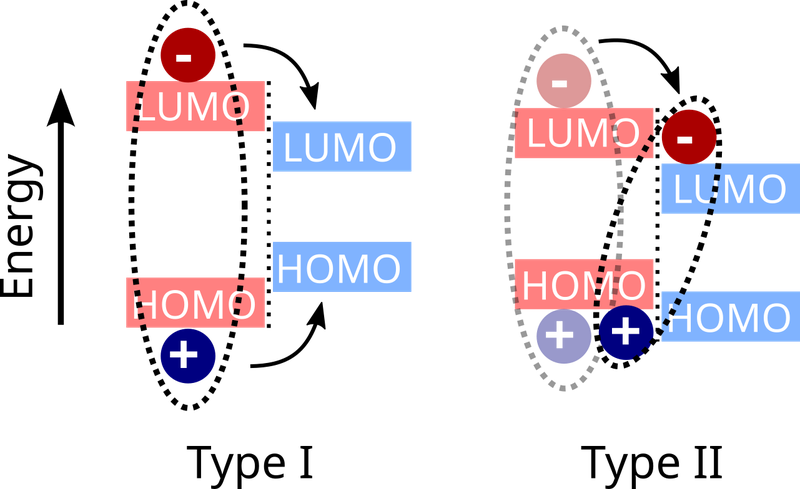
When two different semiconductor materials are brought together, many new questions arise with regard to the interface. Can excitations migrate from one material to the other? Are charges separated at the interface? Do we perhaps observe new signatures in optical spectra that can be assigned to the interface? And what do such signatures reveal about the nature of the interface? Addressing such questions is crucial for assessing the potential of new materials for semiconductor devices. Depending on the electronic structure at the interface, a distinction is made between type-I-heterojunctions, which enable a transfer of excitation energy from one material to another, and type-II-heterojunctions, where charges are separated from each other.
For further reading:
N. Hofeditz et al., ”Efficient Energy Transfer and Singlet Fission in Co-Deposited Thin Films of Pentacene and Anthradithiophene”, Adv. Mater. Interfaces 11, 2300922 (2024). DOI: 10.1002/admi.202300922
N. Hofeditz et al., “Photoexcitation Dynamics in Strongly Interacting Donor/Acceptor Blends Probed by Time-Resolved Photoluminescence Spectroscopy”, J. Phys. Chem. C 125, 17194 (2021). DOI: 10.1021/acs.jpcc.1c04183
M. Gerhard et al., “Field-induced exciton dissociation in PTB7-based organic solar cells”, Phys. Rev. B 95, 195301 (2017). DOI: 10.1103/PhysRevB.95.195301