Main Content
Hybrid materials
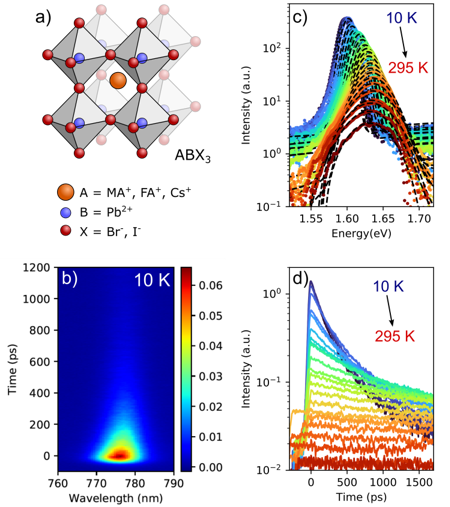
The combination of organic and inorganic materials, for example in the form of adamantane-like cluster compounds or hybrid perovskite semiconductors, makes it possible to adjust the optical properties over a wide range by selectively varying the organic and inorganic components. The strong electron-phonon coupling in these systems sometimes leads to a strong localization of optical excitations in the form of excimers or polarons, which significantly influence the resulting properties.
For further reading:
F. Schmitz et al., ”Tuning the Optical Properties of 2D Monolayer Silver-Bismuth Bromide Double Perovskite by Halide Substitution“, Nanotechnology 33, 215706 (2022). DOI: 10.1088/1361-6528/ac54df
E. Geringer et al., “Introducing Distinct Structural and Optical Properties into Organotin Sulfide Clusters by the Attachment of Perylenyl and Corannulenyl Groups”, Inorg. Chem. 60, 19381 (2021). DOI: 10.1021/acs.inorgchem.1c03206
E. Geringer et al., “Pyrene-Terminated Tin Sulfide Clusters: Optical Properties and Deposition on a Metal Surface”, Chem. Eur. J. 27, 2734 (2021). DOI: 10.1002/chem.202003889