Main Content
Fundamental processes in molecular semiconductors
Unlike inorganic semiconductors, organic semiconductors are not held together by electronic bonds, but rather by comparatively weak van-der-Waals interactions between the molecular building blocks. This has significant effects on the resulting band structure, optical properties and the transport of charge carriers or excitons. Two well-known phenomena are particularly noteworthy here, namely the spin-allowed splitting of a singlet exciton into two triplet excitons or the formation of so-called excimers through the structural relaxation of excited molecules. These processes can compete with each other and may be desirable or undesirable depending on the application. Fundamental investigations of the relationship between the packing motif, the optical properties and the dynamics of optical excitations are therefore crucial for the development of theoretical models with high predictive power.
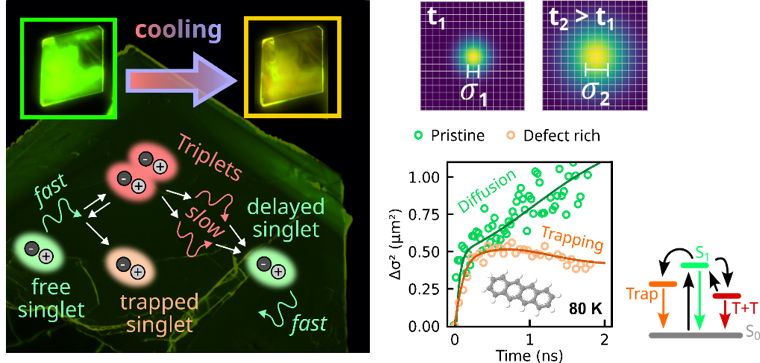
The illustration shows a model of exciton dynamics in tetracene single crystals: There is a dynamic equilibrium between singlet and triplet excitons, which has a significant influence on the diffusion of optical excitations. This can be investigated in greater detail by measuring the area of the luminescence profile as a function of time and at different temperatures, as shown on the right (see Muth et al.)
For further reading:
D. Muth et al., „Transport, trapping, triplet fusion: Thermally retarded exciton migration in tetracene single crystals”, Nanoscale 16, 13471 (2024). DOI: 10.1039/D4NR01086H
J. Thompson et al., “Singlet Exciton Optics and Dynamics in Oligoacene Semiconductor Crystals”, Nat. Sci. 3, e20220040 (2023). DOI: 10.1002/admi.202300922
D. Bischof et al., “Regioselective Fluorination of Acenes: Tailoring of Molecular Electronic Levels and Solid State Properties”, Chem. – A Eur. J. 28, e202103653 (2022). DOI: 10.1002/chem.202103653