20.05.2026 European Vaccines Hub for Pandemic Readiness Marks One Year of Progress
EVH Annual Consortium Meeting takes place in Marburg from 19 to 21 May 2026
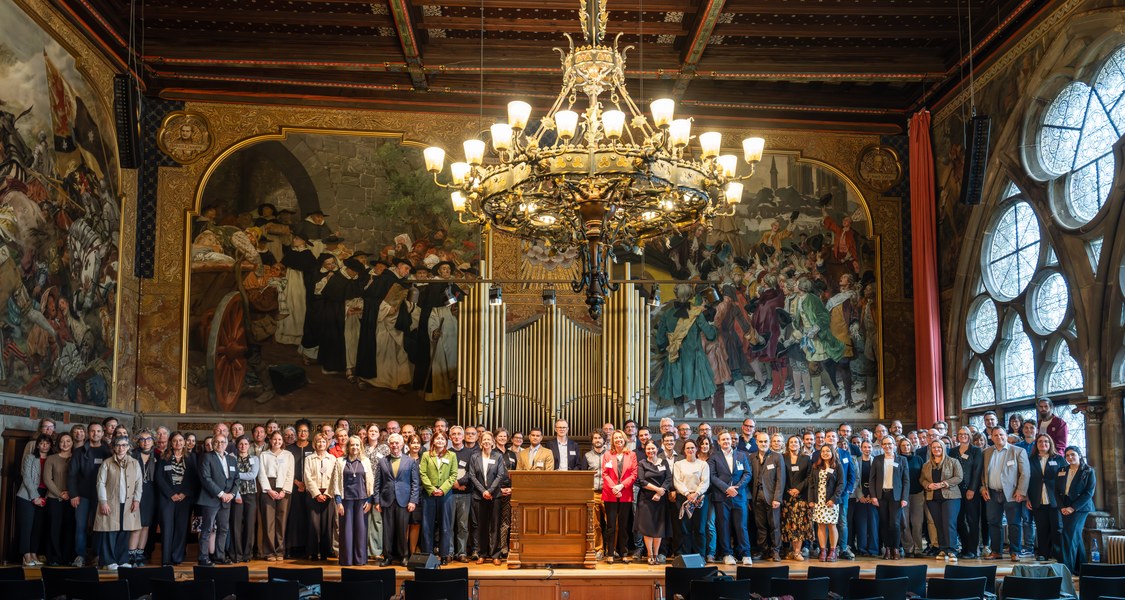
The European Vaccines Hub (EVH) for Pandemic Readiness, convenes its annual consortium meeting at the Old University of the Marburg University, in Marburg, Germany, from 19 to 21 May 2026. The EVH is a pan-European public‑private partnership co-funded under the EU4Health programme by the European Health and Digital Executive Agency (HaDEA) on behalf of the Health Emergency Preparedness and Response Authority (DG HERA) of the European Commission.
Launched in 2025, the EVH is a transformative initiative designed to strengthen Europe’s ability to anticipate and respond to future health emergencies through coordinated, public health–driven vaccine development. Just one year on, the EVH has already delivered tangible scientific, clinical, and strategic achievements through its four pillars (discovery, preclinical studies, clinical studies and regulatory and manufacturing), underscoring the value of a highly integrated European vaccine R&D ecosystem.
The meeting provides a wealth of exciting keynote talks and project discussions on partnerships and measures accelerating vaccine development in crisis. Key first-year milestones include major industrial partnerships with Sanofi to develop a mucosal vaccine against avian influenza H5N1, and advanced discussions with BioNTech to define areas of joint work to support clinical development of an mRNA-based mpox vaccine candidate. Through its discovery pillar, EVH has isolated neutralizing human monoclonal antibodies against mpox and leveraged artificial intelligence to identify novel vaccine antigens.
On the clinical side, EVH initiated trials in 2025 to investigate long-term, cross-reactive immune responses in individuals previously vaccinated against H5N1, launched a dialogue with Vaccines Europe on harmonized vaccine trial site criteria, and prepared multi‑center, multi‑country studies for pre‑pandemic H5N8 vaccines planned for 2026. EVH has also submitted its first pandemic preparedness plan, mapped European manufacturing capabilities for vaccines and monoclonals, established working groups on influenza and priority pathogens, launched a pilot expression‑of‑interest platform to widen collaboration across Europe, and strengthened its collaboration with DG HERA.
The EVH consortium meeting brings together more than 110 participants, including representatives from all EVH beneficiaries, affiliated and associated entities, as well as from the European Commission and key European and national authorities, including DG HERA. Building on the achievements since the project’s launch, the meeting focuses on progress across the four EVH pillars, cross‑pillar integration, and strategic alignment on prototype vaccines and enabling technologies for priority pathogens with pandemic potential.
The EVH consortium comprises 11 Beneficiaries and 13 Affiliated and Associated entities from 7 European countries, including leading organizations directly involved in vaccine development and responsible for pandemic preparedness at national level. The project is coordinated by the Sclavo Vaccines Association, a non‑profit organization based in Siena (Italy), committed to advancing vaccine research and development.
Structured around four complementary pillars spanning the entire vaccine development pipeline, EVH integrates institutions with long‑standing expertise and infrastructure:
- Pillar 1 – Discovery, led by Fondazione Biotecnopolo di Siena (Italy);
- Pillar 2 – Preclinical Studies, led by Institut Pasteur (France);
- Pillar 3 – Clinical Studies, led by Vaccinopolis, University of Antwerp (Belgium);
- Pillar 4 – Regulatory and Manufacturing, led by DZIF and ZEPAI (Germany).
Hosting the meeting in Marburg, a major European center for infectious‑disease research and vaccine manufacturing, highlights the strategic importance of manufacturing readiness and scale‑up within EVH’s mission to ensure rapid deployment of vaccines during future pandemics.
“The European Vaccines Hub is a very innovative project that leverages capabilities present in the Hub with the ability to integrate European partners with innovative projects, to build an end-to-end capacity to deliver vaccines and monoclonals against emerging infections. I am very proud of the achievements of the first year of operation, they confirm the innovative design is delivering.” said Prof. Rino Rappuoli, Scientific Director of Fondazione Biotecnopolo di Siena and Coordinator of the project.
“This meeting marks an important milestone in strengthening collaboration and integration across the four pillars of the European Vaccines Hub,” added Donata Medaglini Deputy Rector of the University of Siena and EVH Scientific Coordinator. “By connecting expertise, infrastructures, and coordinated activities across Europe, EVH is creating a collaborative framework capable of accelerating preparedness and enabling a faster and more effective response to emerging health threats.”
“The European Vaccines Hub is an innovative mechanism to create an R&D network securing both resilience and innovation in pandemic vaccine development. It is a pleasure to host the meeting here where an outbreak initiated Marburg virus research!” said Prof. Dr. Isabelle Bekeredjian-Ding, Chair of Medical Microbiology at Marburg University, Pillar 4 Lead and member of the German Center for Infection Research(DZIF).
“One year on, the European Vaccines Hub stands as a testament to what Europe can achieve when we unite expertise along the entire value chain of vaccine development, from discovery to regulatory and manufacturing under a shared mission: to turn preparedness into action. The EVH’s rapid progress, including advancing medical countermeasures R&D for avian influenza and mpox, demonstrates how DG HERA’s strategic investments are building the end to end resilience Europe needs to face future threats. Through the EVH, we are not only accelerating innovation but ensuring that vaccines reach citizens swiftly when the next crisis strikes.” said Florika Fink-Hooijer, Director-General of DG HERA.
“The Ebola virus outbreak in the Democratic Republic of the Congo, which the WHO has recently classified as a public health emergency of international concern, demonstrates how important it is to be prepared for epidemics and pandemics. To this end, the EVH is building a strong network of outstanding European experts who can respond quickly to emerging viruses and help people,” said Prof. Dr. Thomas Nauss, President of the University of Marburg. He highlighted the role of the Marburg Centre for Epidemic Preparedness (MCEP) in researching emerging infectious diseases within the framework of the EVH.
During the three‑day meeting, participants will review scientific and operational progress, refine shared procedures and standards, and discuss alignment with international pandemic‑preparedness strategies, including WHO‑endorsed pathogen prioritization for the European region. Particular attention will be given to digitalization, data integration, and coordination with manufacturers to accelerate vaccine availability in emergency situations.
The EVH project (GA number 101202831; https://ec.europa.eu/info/funding-tenders/opportunities/portal/screen/opportunities/projects-details/43332642/101202831) is co‑funded for four years by the European Union’s EU4Health Programme, with an EU contribution of EUR 101,995,339 and an estimated total project cost of EUR 169,992,333. Through long‑term collaboration and investment, EVH aims to deliver a sustainable, proactive vaccine‑development ecosystem that enhances Europe’s readiness for future pandemics. (EVH press release)
Facts about the EVH project
Title: European Vaccines Hub for Pandemic Readiness
Acronym: EVH
Duration and start date: 48 months from 1st March 2025
Coordinator: Sclavo Vaccines Association (Italy)
Estimated total project cost: 169 992 333,00 EUR, including 60% of EC-cofunding
Project co-funder: European Health and Digital Executive Agency (HaDEA)
Consortium Composition – 11 Beneficiaries and 13 Affiliated and Associated Entities from 7 European countries
Beneficiaries:
- Sclavo Vaccines Association ETS (Italy)
- Fondazione Biotecnopolo di Siena (Italy)
- Institut Pasteur (France)
- University of Antwerpen -Vaccinopolis (Belgium)
- Deutsches Zenturm fur Infektionsforschung - (Germany)
- The Center for Pandemic Vaccines and Therapeutics – ZEPAI (Germany)
- Leiden University Medical Center (The Netherland)
- Université Libre de Bruxelles (Belgium)
- Folkehelseinstituttet- Norwegian Institute of Public Health (Norway)
- University of Siena (Italy)
- Instituto de Biologia Experimental e Tecnologica (Portugal)
Affiliated entities:
- Istituto Zooprofilattico Sperimentale delle Venezie (Italy)
- Infectious Disease Models and Innovative Therapies – CEA (France)
- Institut national de la santé et de la recherche médicale (France)
- Philipps-Universität Marburg (Germany)
- Helmholtz Zentrum München Deutsches Forschungszentrum für Gesundheit und Umwelt (Germany)
- Helmholtz-Zentrum für Infektionsforschung (Germany)
- Klinikum der Ludwig-Maximilians-Universität München (Germany)
- Stiftung Tierärztliche Hochschule Hannover (Germany)
- Technische Universität München (Germany)
- Klinikum der Universität zu Köln (Germany)
- Universitatsklinikum Hamburg-Eppendorf (Germany)
- Eberhard Karls Universität Tübingen (Germany)
Associated entity:
- Pasteur Network (France)