05.05.2026 Leading Marburg Physician Joins Steering Committee on Post-Infectious Diseases
Prof. Dr. Bernhard Schieffer Helps Shape National Research Strategy
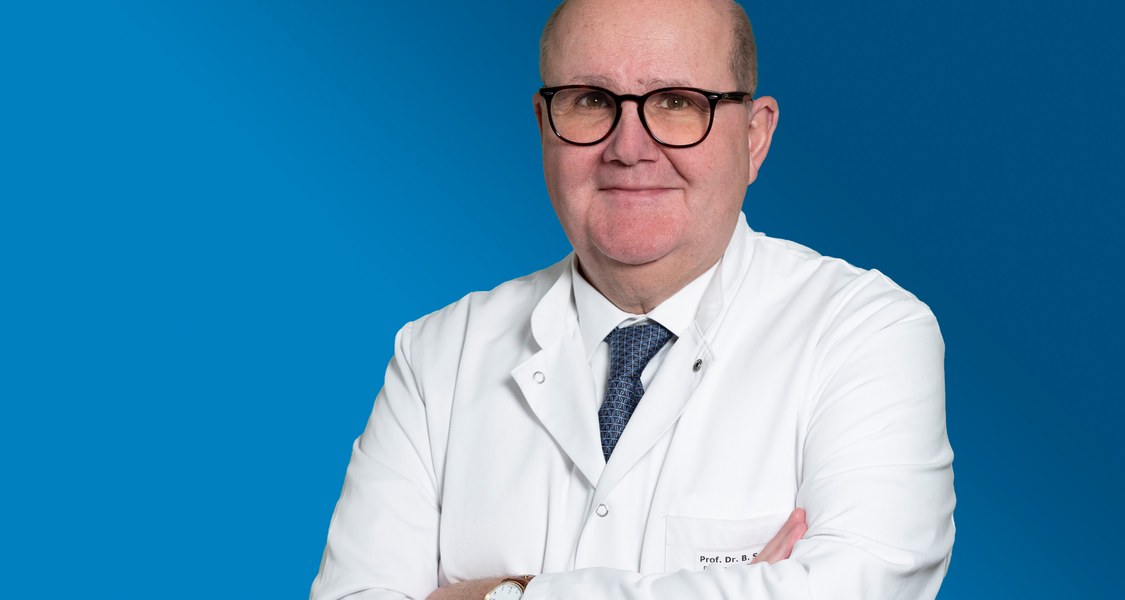
As part of the National Decade against Post-Infectious Diseases, initiated by the Federal Ministry of Research, Technology, and Space, Prof. Dr. Bernhard Schieffer was appointed to the national steering committee. Prof. Dr. Schieffer is the Director of Cardiolgy and Angiology at Philipps University Hospital (UKGM) Marburg. He brings his extensive scientific and clinical expertise to the Decade’s strategic development. His appointment highlights the excellence of clinical research in Marburg, which is highly recognized both nationally and internationally.
The steering committee shapes the long-term research strategy by defining key areas, initiating measures, and adapting the Decade’s focus to current scientific and health policy developments. At its first meeting on February 27, 2026, the committee established three working groups focused on translation, data and cohorts, and health services research.
The President of the University of Marburg, Prof. Dr. Thomas Nauss, congratulates Prof. Schieffer on his appointment: “I warmly congratulate my colleague Prof. Schieffer on his appointment to the steering committee of this significant national initiative. His outstanding expertise in research and clinical practice will make an important contribution to the successful implementation of the Decade and further strengthen Marburg’s profile.”
Prof. Dr. Schieffer’s appointment further ensures that expertise from advanced university research and clinical care is integrated into strategic national management. The goal is to efficiently translate research advances into new diagnostic and therapeutic approaches, improving care for patients with post-infectious diseases.
Background: National Decade Against Post-Infectious Diseases
Post-infectious diseases such as Long COVID and ME/CFS present significant challenges for modern medicine. Although recognized for decades, their chronic forms remain difficult to treat or cure. Case numbers have risen, especially following the COVID-19 pandemic, placing a heavy burden on patients and families. To improve patient outcomes, new approaches to diagnosis, treatment, and rehabilitation are warranted. Greater understanding of protective and preventive factors is also essential. In response, the Federal Ministry of Research, Technology, and Space (BMFTR) launched the “Decade Against Post-Infectious Diseases,” a ten-year initiative developed with health research partners. The initiative aims to uncover the causes and mechanisms of these diseases and gradually develop new therapies. Representatives from politics, research, healthcare, industry, and society are collaborating to combat post-infectious diseases effectively and thereby improve future pandemic resilience.
Contact
Prof. Dr. Bernhard Schieffer
Tel.: 06421 58-66462
Mail: sekretariat.kardiologie@uk-gm.de
Department of Medicine
Philipps University of Marburg