30.06.2026 New Early Career Postdoc Group at the Microcosm Earth Centre (MEC)
Dr. Liujuan Zheng and his team investigate how bacteria respond to stress

How do bacteria adjust their biochemistry to cope with stress? This question is at the heart of the Early Career Postdoc Group (ECPG) at the Microcosm Earth Centre (MEC). Led by Dr. Liujuan Zheng, it marks the beginning of a new funding format: an independent junior research group for promising scientists at the start of their careers – with dedicated resources and embedded in the excellent research network on the Lahnberge campus.
Liujuan Zheng's path took him across disciplinary boundaries early on. Trained as a pharmacist, he initially worked in Prof. Shu-Ming Li's lab at Philipps University Marburg on natural compounds produced by fungi. What fascinated him most were the molecular machines responsible for making these metabolic products: enzymes. "To produce just a single natural compound, organisms sometimes deploy dozens of different enzymes working together. I wanted to understand how that works at a molecular level," he recalls. In 2021, he joined the group of Prof. Dr. Gert Bange – Professor at Philipps University Marburg and Max Planck Fellow at the Max Planck Institute for Terrestrial Microbiology (MPI-TM) on the Marburg Lahnberge campus – as a postdoctoral researcher. There, his scientific focus would undergo a fundamental transformation.
From Metabolism to Stress Response
On the advice of his mentors Prof Gert Bange, Liujuan Zheng immersed himself in a question that reaches far beyond his original topic: how do cells regulate their response to stress? At the centre of this question is a key metabolic enzyme: acetyl-CoA synthetase. It converts acetic acid (acetate) into the cofactor acetyl-CoA, one of the most central molecules in living cells, required by nearly every metabolic pathway – from bacteria to humans. Understanding how such a pivotal enzyme is switched on and off is therefore of fundamental importance.
In the model organism Bacillus subtilis, Zheng studied a so-called operon – a cluster of genes that are read together and produce a set of related proteins. Specifically, the acuABC operon encodes three proteins: AcuA, AcuB, and AcuC. AcuA inactivates acetyl-CoA synthetase by attaching a chemical tag called an acetyl group; AcuC removes this modification and reactivates the enzyme. This reversible protein acetylation allows bacteria to flexibly adapt their enzymatic activity to different metabolic conditions. Liujuan Zheng and his colleagues were able to show that AcuA acts through a second, previously unknown mechanism as well: it forms a stable physical complex directly with acetyl-CoA synthetase – inhibiting it through direct protein-protein contact alone, without any chemical modification. "We have thus identified two mechanisms by which this central enzyme is regulated," Zheng summarises.
And the third protein, AcuB? It was discovered over thirty years ago – yet its biological function remained a mystery. In an international collaboration with Prof. Jade Wang in the United States, Liujuan Zheng and the research group of Gert Bange achieved a breakthrough: AcuB specifically binds a signalling molecule called diadenosine tetraphosphate – Ap4A for short. This is no ordinary metabolite. It accumulates in bacteria precisely when the cell is under stress – for instance during heat shock or oxidative stress caused by reactive oxygen species.
A Regulatory Mechanism with Far-Reaching Implications
Ap4A was long regarded as a biochemical curiosity. Today it is recognised as an important signalling molecule present across virtually all forms of life. When Ap4A binds to AcuB, it indirectly inhibits AcuC – the enzyme that normally reverses acetylation – meaning that in stress conditions, the acetylation of proteins persists for longer. The discovery that stress signals feed directly into the cell's acetylation machinery via Ap4A reveals that the metabolic state of the cell and its stress level act together to control protein acetylation. What began as a study of a single metabolic enzyme has led to the discovery of a complex regulatory mechanism.
This research has implications that extend well beyond basic microbiology. Acetyl-CoA synthetases and protein acetylation are found across nearly all forms of life – from bacteria and fungi to humans. Particularly noteworthy: tumour cells preferentially rely on acetate as a carbon source and therefore depend on active acetyl-CoA synthetases. Inhibiting these enzymes could selectively impair cancer cell growth, while normal body cells, which are less dependent on acetate as an energy source, would be less affected. The first compounds pursuing exactly this approach are already in preclinical studies.
Beyond oncology, the regulation of acetyl-CoA synthetases and protein acetylation plays an important role in other areas too – from human epigenetics to bacterial stress responses. A deeper understanding of these processes may prove valuable for the treatment of infectious diseases and for environmental microbiology, particularly for deciphering the role of microorganisms in the context of climate change, where they play a key role in taking up and converting acetate from the environment.
The New Funding Format: Early Career Postdoc Group
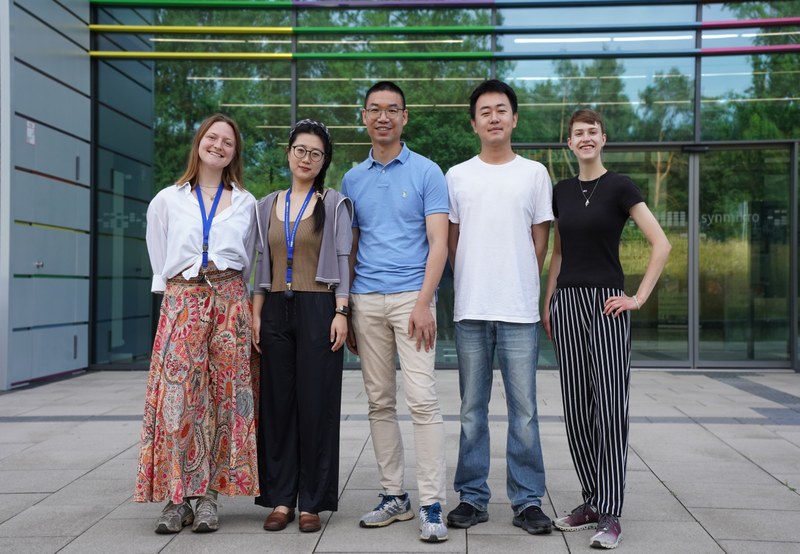
The Early Career Postdoc Group format at the Microcosm Earth Centre is aimed at young researchers shortly after completing their doctorate. It enables them to build an independent group and pursue their own research ideas earlier than was traditionally possible. "My work has expanded: alongside my own research, it now also involves mentoring and training the students in my team. And having a team of my own gives me the opportunity to try out so much more," says Zheng.
With his new group, a circle closes for Liujuan Zheng – one that connects the full arc of his scientific career. From asking how acetyl-CoA synthetases work, he now turns to the inverse question: how do metabolites in turn control this central enzyme? "During my PhD, I investigated what natural compounds could do for humans – for example as antibiotics. But bacteria and fungi don't produce these molecules for our benefit. They must serve a function within the cell itself. One such function is apparently cellular signalling," says Liujuan Zheng.
His group is affiliated with Philipps University Marburg (UMR) and benefits from the close partnership between the university and the Max Planck Institute that defines the MEC – and the wider Marburg research landscape. "I have now been doing research in Marburg for around ten years, without ever having to move to a big city. It is rare to be able to expand one's research focus with access to all the technologies one needs, while also collaborating with so many outstanding colleagues – that is truly exceptional," says Zheng.
Prof. Dr. Gert Bange, Vice President for Research at Philipps University Marburg, adds: "It has been a great pleasure to accompany Liujuan Zheng's development as a postdoctoral researcher in my group. Liujuan is a true scientific talent who is breaking new ground. These are exactly the kinds of researchers we need at the Marburg research campus. I am delighted about the launch of his Early Career Postdoc Group and wish him and his team every success.”
The Microcosm Earth Centre (MEC) is a joint initiative of the Max Planck Institute for Terrestrial Microbiology (MPI-TM) and Philipps University Marburg (UMR), dedicated to the urgent and wide-ranging field of environmental and climate microbiology – from molecular mechanisms to global biogeochemical cycles. The centre is funded by the State of Hesse and complements the existing SYNMIKRO research centre as a further hub of interdisciplinary microbiology in Marburg.
Source: Press-Release of the Max Planck Institute for Terrestrial Microbiology (MPI-TM)