26.01.2026 Single-molecule approaches to study protein machines involved in DNA metabolism
In our Speaker Series, Prof. Fernando Moreno-Herrero highlighted several of his ongoing projects.
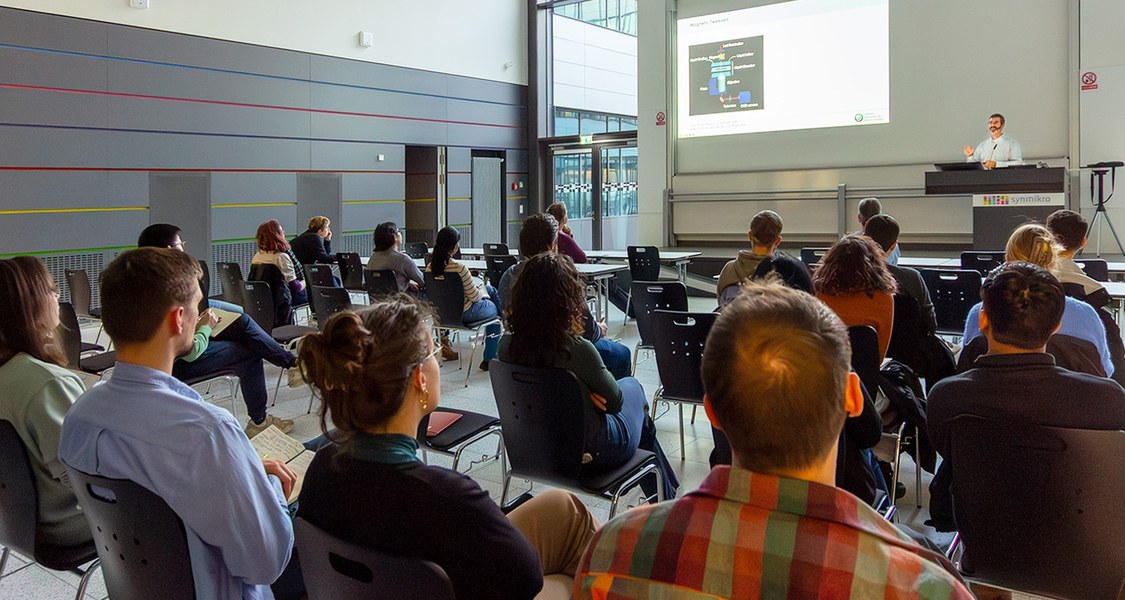
On 19 January, we welcomed our first speaker of the new year to RTG 2937: Fernando Moreno-Herrero is professor at the Universidad Autónoma de Madrid with a lab at the National Biotechnology Center in Madrid. Research in his Molecular Biophysics Lab focuses on studying double strand DNA break repair, Chromosome organisation and replication at the single molecule level using Atomic Force Microscopy, Magnetic and Optical Tweezers combined with Fluorescence, and standard biochemical techniques. Read more about the Moreno-Herrero Lab here.
The abstract of Fernando's talk at GRK 2937: DNA metabolism is essential for the proper functioning of the cell. It encompasses processes that preserve the stability, structure, and integrity of the genome, including DNA repair mechanisms and higher-order DNA organization. These tasks are performed by complex, specialized protein machineries composed of low-copy number components that operate in a coordinated and often sequential manner. Many of these processes are inherently mechanical, proceeding through a series of events that are exquisitely regulated by force. Traditional biochemical methods provide ensemble-averaged measurements, lack single-molecule resolution, and offer limited access to physical parameters such as force and directionality. As a result, they can obscure rare or atypical molecular behaviors that may be crucial for proper cellular function. In this talk, I will introduce two single-molecule techniques – Magnetic Tweezers and Optical Tweezers – that enable us to study protein machines involved in DNA processing one molecule at a time. Moreover, by combining these approaches with fluorescence microscopy, we can correlate the biological activity of molecular motors with their spatial localization along the DNA. I will highlight several ongoing projects, including investigations of helicases and molecular motors implicated in bacterial and eukaryotic double-strand break repair, as well as studies of ParB and ParB-like proteins involved in bacterial chromosome segregation and gene regulation of multi-drug resistance plasmids.
Thank you for the impulses you gave us, Fernando! We were thrilled to welcome you to Marburg.