15.07.2026 Publication alert - Insights into the development of cell-cell connections in human intestine
Insights into the development of cell-cell connections in human intestine
Only few months in and there are already the first publications by DEFINE cooperations getting published!
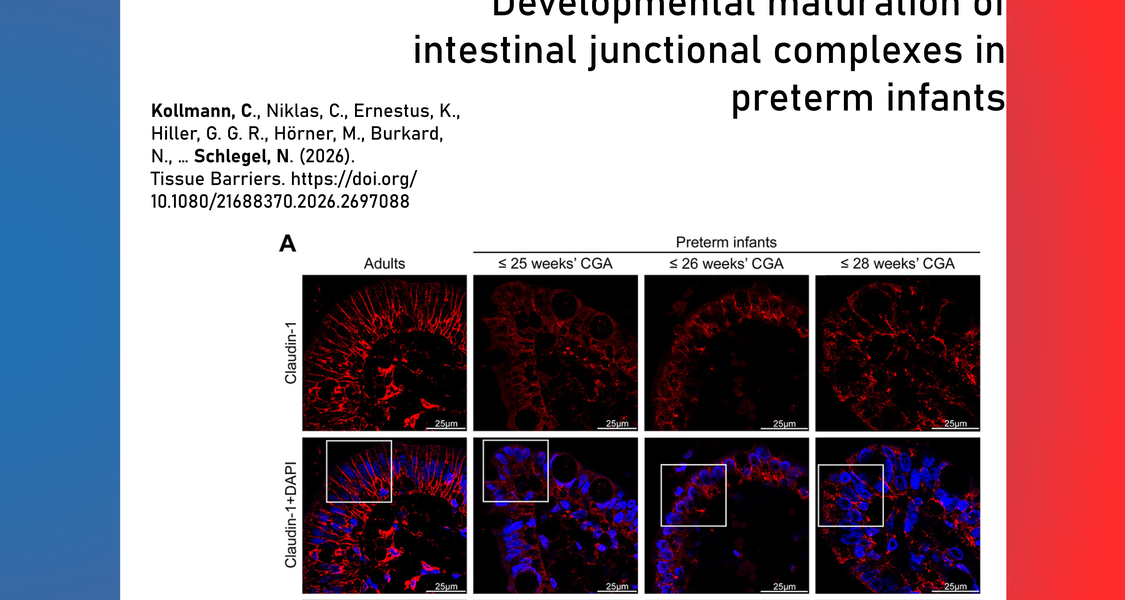
Catherine Kollmann (C05) and Nicolas Schlegel (C01) looked into the development of cell-cell connections in human intestine.
Very prematurely born children sometimes develop focal instestinal perforation, a single, isolated hole in their intestine, which can cause severe infection. One part of the treatment is to undergo surgery. Something that is scary for children and their parents, can still have a positive impact on science: due to this surgery, researchers can get healthy intestine tissue for investigation.
This tissue, especially the tight junctions, was compared to healthy tissue of adults to get a better understanding of developmental processes during pregnancy.
It was already known that the barrier function of the intestine is not fully developed in those infants and not properly working yet, but it was unclear which junction proteins develop at which time point.
The most important take away from this study?
Not all junction proteins mature at the same point. Each protein has its own dynamic:
- Some tight junction proteins show similar localization and expression as in adults – as early as in week 25! Other ones show strong development processes and are thought to have a reasonable maturation process during week 26-28 of pregnancy.
- Adherens junctions are fully mature in week 25, there are no differences to adult and mature junctions visible with immunostaining!
- Desmosomes show the most complex picture: some proteins (like Plakoglobin and Plakophilin-2) are fully mature, others like Desmoglein-2 and Desmoplakin are in week 28 less expressed than in adults – and most surprising: Desmocollin-2 was not reduced, but overexpressed in preterm infants!
This study shows that the maturation of the intestinal epithelial barrier is a dynamic and continous process. This selective maturation could increase the risk of intestine permeability and diseases like necrotic enterocolitis (NEC). The more knowledge on the processes during development, the higher the chances for prevention and treatment strategies!
Read the full paper here!