Main Content
Uncover the Role and Mechanisms of Desmosomes to regulate Homeostasis in the digestive Tract
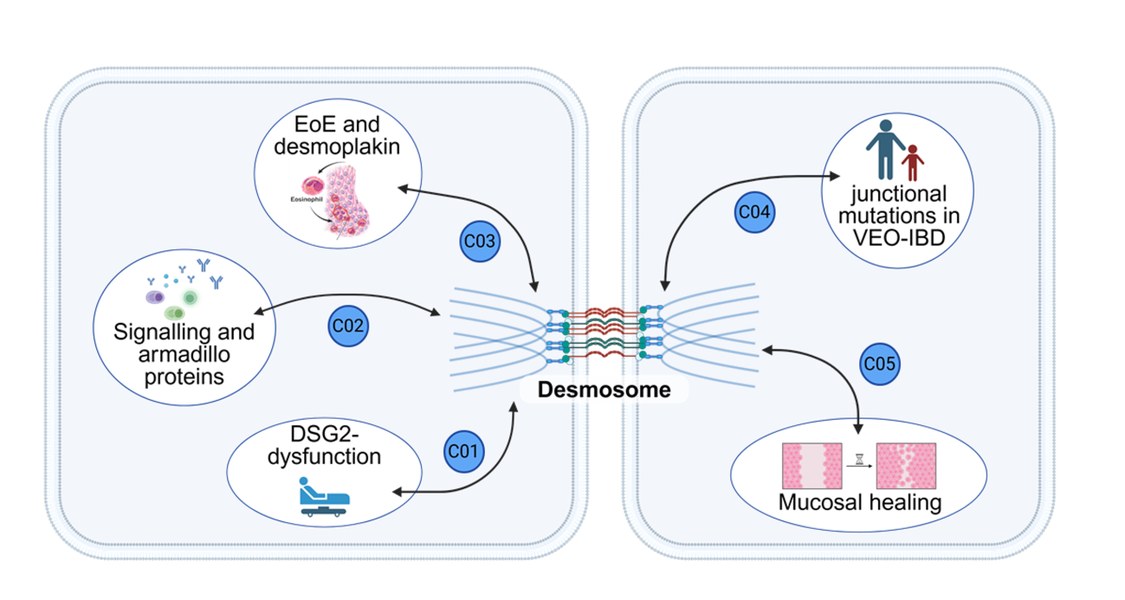
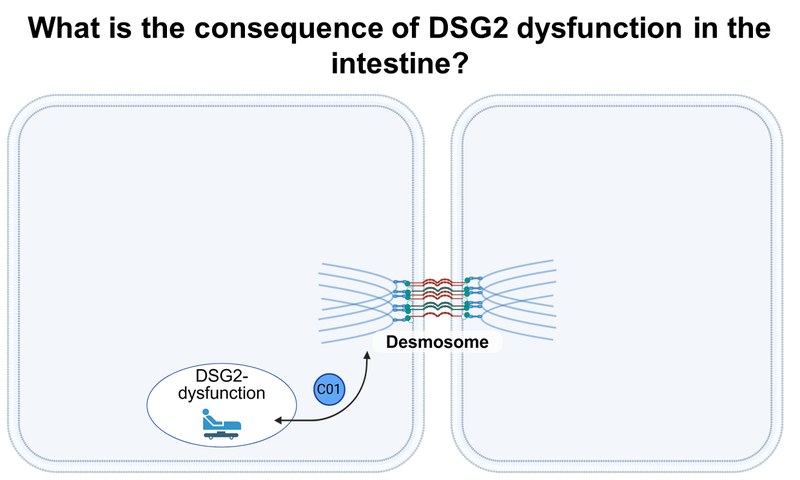
C01 - Role and mechanisms underlying desmoglein 2 (Dsg2) truncation and deficiency in the intestinal epithelium
Nicolas Schlegel, Department of General, Visceral, Transplant, Vascular and Pediatric Surgery, Universitätsklinikum Würzburg
Daniela Kugelmann, Department of Anatomy, LMU Munich
PhD students/PostDocs: Dr. Laura Cyran (Würzburg), Sameena Shaikh (Munich)
Project: The aim of C01 is to investigate the total loss of desmoglein (Dsg)2 in an inducible gut-specific mouse strain and to explore the consequences of Dsg2MUT as a patient-based model for assessing digestive tract inflammation in the context of primary desmosomal dysfunction in the intestinal epithelium.
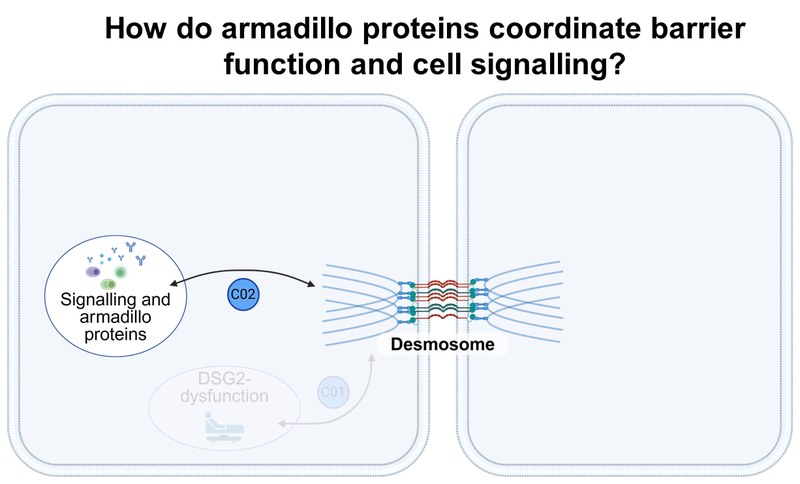
C02 - Regulation of barrier integrity by Armadillo proteins in digestive tract inflammation
Matthias Kelm, Department of General, Visceral, Transplant, Vascular and Pediatric Surgery, Universitätsklinikum Würzburg
Brenda Gerull, Comprehensive Heart Failure Centre, Department of Medicine I, Universitätsklinikum Würzburg
PhD students: Aarushi Mukherjee, Laura Kimmel
Project: C02 aims to elucidate the role of the epithelial plaque proteins JUP and PKP2 as critical regulators in the intestinal epithelium. To this end, mice with an inducible intestinal epithelial knockout of JUP (iVilCreERT2Jupfl/fl) and PKP2 (iVilCreERT2 Pkp2fl/fl) will be used, as well as derived organoids. In addition, a systematic analysis of the intestinal epithelium of patients with pathogenic genetic variants of desmosimal proteins will be conducted, including the generation of patient-derived organoids.
C03 - Barrier dysregulation and T cell immunity in digestive tract inflammation
Pavel Strnad, Department of Internal Medicine 3, RWTH Aachen University
Tobias Schwerd, Department of Paediatric Gastroenterology, Hepatology and Nutrition, LMU Munich
PhD students: Sandra Jordan (Aachen), Markus Käs (München)
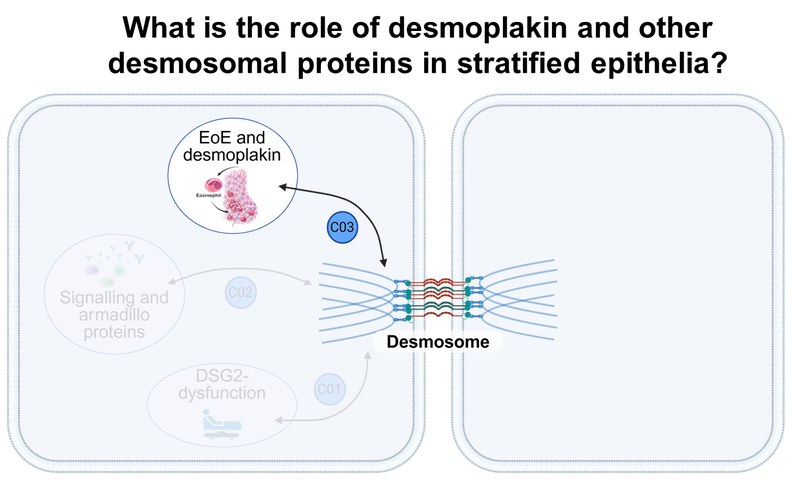
Project: C03 will investigate epithelial integrity and epithelial-immune cell-cell interactions in eosinophilic oesophagitis (EoE) using multiparametric immunofluorescence microscopy and spatial proteomics, as well as STED and electron microscopy. We will also conduct single-cell RNA and kinome analyses. Epithelioids and organoids will be used to investigate the functional consequences of desmosomal defects. We will then compare the molecular alterations in human samples and preclinical animal models.C04 - Exploration of genetic alterations affecting desmosomes and tight junctions in childhood inflammatory bowel disease
Daniel Kotlarz, KUBUS Research Center, LMU Munich
PostDoc: open
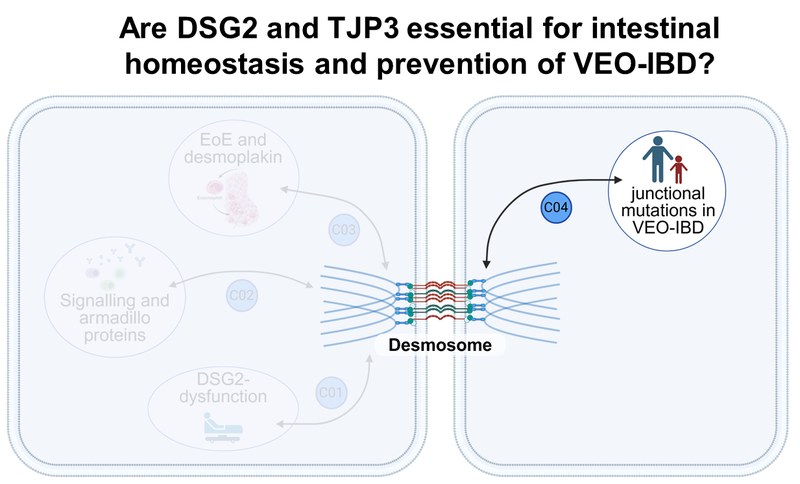
Project: Defective intestinal barrier functions, caused by alterations of tight junctions (TJs), adherens junctions (AJs), and desmosomes, play a crucial role in IBD pathogenesis. C04 aims to decipher the molecular phenotypes and mechanisms of DSG2 and TJP3 deficiencies in advanced disease models. Functional analyses include the assessment of intestinal epithelial cell polarization, desmosome/TJ structures, and barrier permeability in isolated intestinal segments.C05 - Role of desmosomal adhesion and tight junction formation for mucosal wound healing
Sven Flemming, Department of General, Visceral, Transplant, Vascular and Pediatric Surgery, Universitätsklinikum Würzburg
Catherine Kollmann, Department of General, Visceral, Transplant, Vascular and Pediatric Surgery, Universitätsklinikum Würzburg
PhD students: Jenith Budha, Lukas Stoy
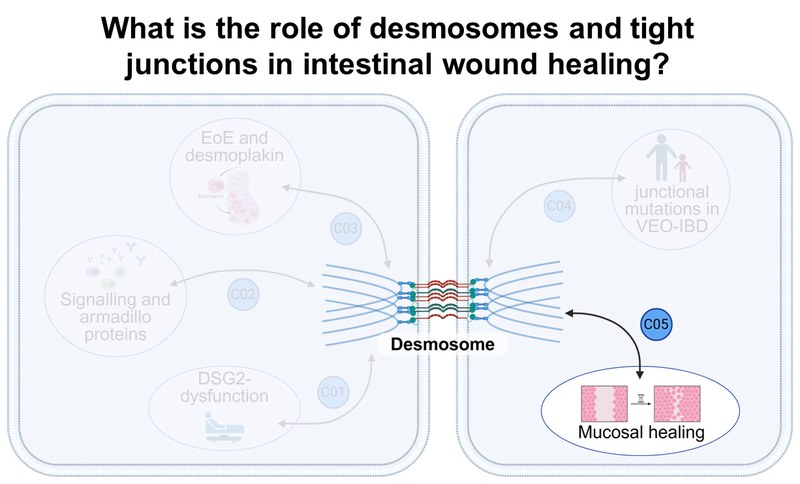
Project: C05 investigates the interactions and signaling pathways of desmosomal (DSM) and tight junction (TJ) proteins during intestinal wound healing. Sequential alterations of DSM and TJ are being investigated in various mouse models of wound healing. Furthermore, DSM proteins and the relevant signaling pathways are being modulated in murine intestinal organoids, and the effects on barrier repair and mucosal regeneration are being correlated with tissue samples and intestinal organoids from IBD patients.