21.07.2026 Publication alert - Erlotinib impairs epidermal tight junction and barrier integrity by inhibiting EGFR and Src and affects maturation of cell–cell junctions in human and mouse keratinocytes
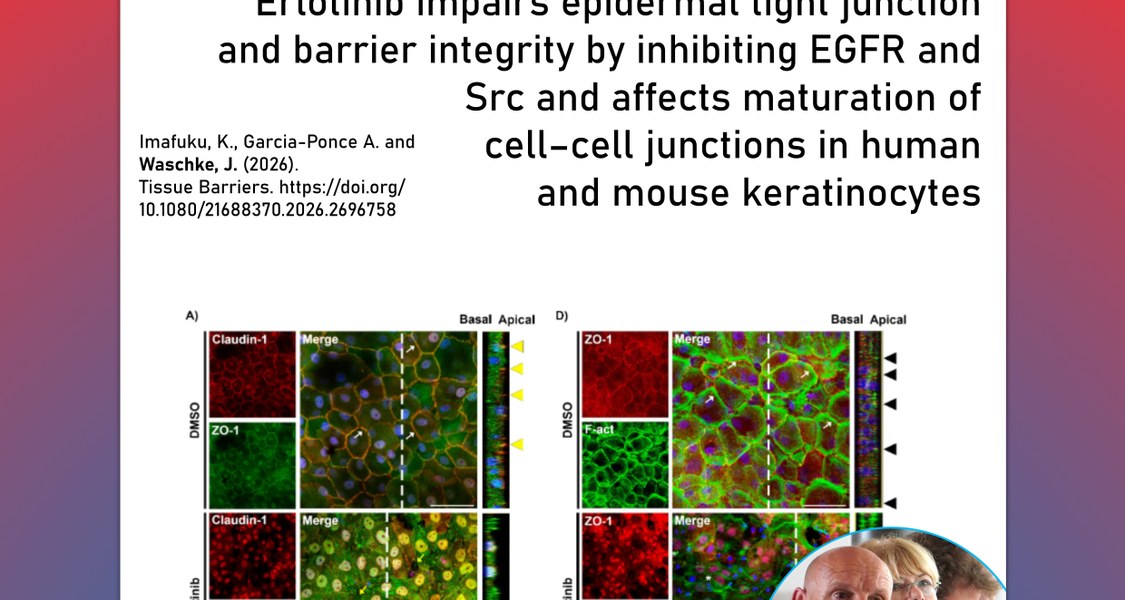
Erlotinib impairs epidermal tight junction and barrier integrity by inhibiting EGFR and Src and affects maturation of cell–cell junctions in human and mouse keratinocytes
Already another paper alert!
In this paper, the group of Jens Waschke (LMU Munich) took a closer look at the mechanism responsible for the skin damage caused by the cancer medication Erlotinib.
Skin damage is one of the most common side effects in EGFR therapies (like Erlotinib). Those EGFR therapies are targeting the Epidermal Growth Factor Receptors (EGFR) tyrosine kinases to slow down (cancer) cell growth. In healthy tissue, receptor tyrosine kinases are key regulators of cellular processes, but they can have a critical role in development and progression of various cancers.
To better understand the adverse effects in the skin by Erlotinib treatment, it was examined how Erlotinib affects barrier integrity (especially tight junctions) and the cytoskeleton.
Jens Waschke shows in this paper that Erlotinib does not primarily destroy desmosomes, but rather prevents the maturation of tight junctions. This is caused by the blockage of the EGFR/Src-signal cascade, which in turns changes the organization of the actin cytoskeleton, which leads to impairment of the mechanical tension inside the cell. Without this mechanical tension, tight junctions are not built properly – and the barrier function of the epidermis is decreased.
This study offers an explanation to the side effects shown in EGFR therapies and suggests options to protect skin barrier during treatment like local application of EGF to activate EGFR/Src pathways or stabilization of the actin cytoskeleton.
Even more relevant to us – all those findings could also be important in other diseases like Pemphigus!
Read the full study here!