04.08.2026 Bridging Science
African researcher Catherine Oluwakemi Esuola receives funding from the Max Planck Africa Mobility Grant to conduct research at the Max Planck Institute in Marburg, Germany
July 27, 2026
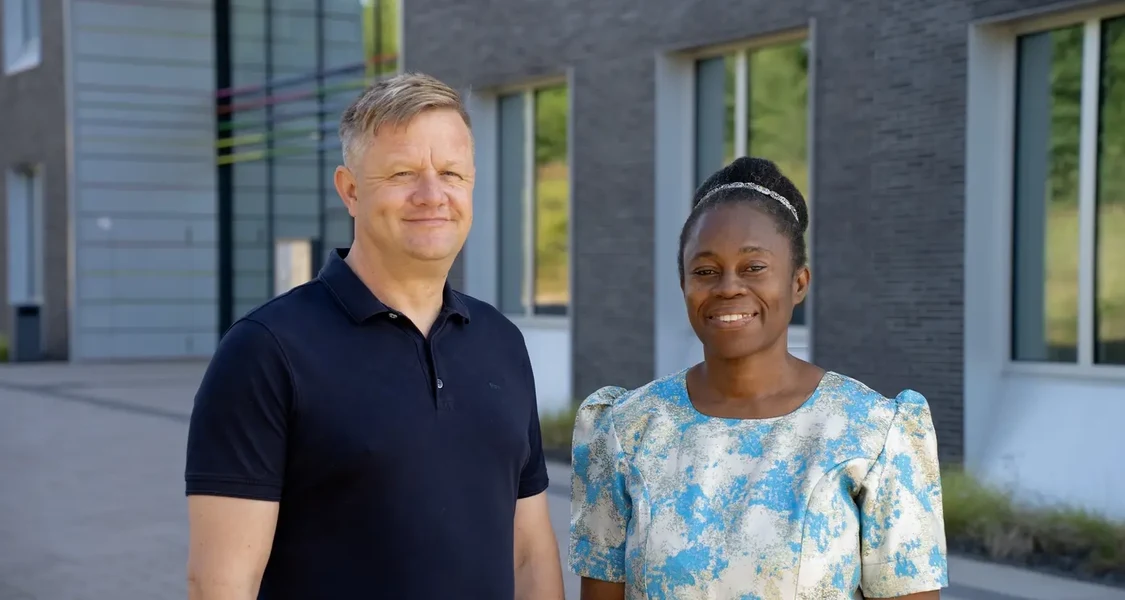
For scientist Catherine Oluwakemi Esuola, the path to the forefront of synthetic biology did not require permanent relocation but a strategic connection and a welcoming partnership with microbial research in Marburg. Through the Max Planck Africa Mobility Grant (MPAMG), Esuola is currently visiting as a guest researcher under the mentorship of Prof. Dr. Gert Bange, Max Planck Fellow at the Max Planck Institute for Terrestrial Microbiology and professor at the University Marburg.
Catherine Oluwakemi Esuola is among the early-career scientists benefiting from the Max Planck Society’s Africa Initiative. The Mobility Grant targets young African scientists in their final PhD year or who earned their doctorate within the past ten years. It covers all costs—from travel and health insurance to research consumables—enabling recipients to visit for a month to focus on scientific challenges. Unlike traditional fellowships that often require permanent relocation, the Mobility Grant is designed to counteract brain drain by allowing African researchers to access world-class infrastructure in Germany while remaining anchored at their home institutions in Africa.
"Truly sustainable international collaboration is not about recruiting talent away from where it originates, but about building partnerships."
Prof. Dr. Gert Bange
“Scientific excellence knows no geographical boundaries”, says her mentor, Max-Planck-Fellow Prof. Dr. Gert Bange. “Truly sustainable international collaboration is not about recruiting talent away from where it originates, but about building partnerships that enable world-class research while strengthening the scientific capacity of home institutions. The Max Planck Africa Mobility Grant embodies this vision by combining scientific excellence with long-term capacity building, demonstrating that the greatest advances in science are achieved when knowledge, trust, and responsibility grow together. In this way, it creates lasting networks that benefit not only individual researchers, but entire scientific communities.”
Catherine, today you are a lecturer at Ancho University in Lagos, Nigeria. You have already been to Marburg once, during your PhD research in Environmental Biology, now for the second time. When has your passion for biology started?
It really started in the backyard of my primary school. I was always drawn to plants. I was lucky to have siblings, especially my older sister who was also interested in science, so I grew up reading her textbooks. While I initially wanted to be a medical doctor, I had a teacher who recognized my aptitude for chemistry and encouraged me to pursue chemical biology. I eventually fell in love with basic science. I remember when I first started in biotechnology, molecular biology was still very new and working with DNA was difficult—practical applications were scarce. It wasn't until my Master’s studies that I was finally able to isolate and clone DNA for the first time.
You are now recipient of the Max-Planck Africa Mobility Grant. What is the specific scientific challenge you are tackling here, and why is it so critical for Nigeria?
In Nigeria, we have a very dense population and a critical need to ensure food security. However, we face severe nutrient deficiencies in the soil and frequent droughts. Microbes are the mediators between soil fertility and plant growth, and it is their enzymes that allow them to adapt to these extreme environments.
I have done fieldwork with traditional crops, like the African Yam Bean, which can act as a biological fertilizer through symbiosis with nitrogen-fixing bacteria. But to truly understand how these bacteria adapt and how we can strengthen their resilience, I need to answer basic biochemical questions. Unfortunately, I lack the facilities to do this at home. Here in Prof. Bange’s lab, I can isolate enzymes, characterize them, and look at their catalytic structural functions. My main goal now is to crystallize enzymes from Nigerian soils to understand their role in adaptation.
Beyond the technical equipment, what has been the most impactful part of your mentorship with Professor Gert Bange?
The experience has been amazing; I feel very well integrated. One of the most valuable things Prof. Bange has given me is a shift in perspective. He pointed me toward the most important question in research: defining why you want to do something. It’s not just about the "how," but about the purpose behind the work. I am actually continuing to teach my students online while I am here in Marburg. I want to pass on this experience to the next generation. Beyond the science, I want to teach them the approach Prof. Bange shared with me—encouraging them to ask themselves: "What exactly do I want to do? Where can this take me?" I want to align my students with this goal-oriented way of thinking.
When you return to Lagos, what are the practical "tools" or habits you plan to implement in your own laboratory?
Besides the scientific know-how, I am taking back the culture of organization. The lab here is highly organized—everything has its place, and there is a clear structure to the day, and a detailed lab folder. I want to bring that efficiency home. If we can organize our workflows better, we can be more productive in our research.
Looking at the broader perspective, how do you hope your work in Marburg will eventually benefit the society and the environment in Africa?
My ultimate goal is to find sustainable alternatives to chemical fertilizers. They are often toxic, and guidelines for their use are not always followed. By understanding how indigenous bacteria adapt, we could develop biofertilizers that are safe and sustainable. I am using model organisms here in Marburg to gain the expertise I need, which I will then apply to the organisms at home.
The Max Planck Africa Mobility Grant aims to foster a "circular flow of knowledge." How have you contributed to the lab in Marburg during your stay?
I bring my expertise in microbial ecology, particularly my experience studying indigenous soil microorganisms and plant–microbe interactions in Nigeria. I also bring strong teamwork skills, cultural diversity, and a positive attitude that helps create a collaborative research environment. I believe that scientific progress is strengthened by different perspectives, and my wish is that these connections between our institutions become even more permanent.
The Max Planck Africa Mobility Grant is part of a broader initiative by the Max Planck Society, which includes mentoring programs, virtual lecture series, and enhanced research cooperation. The goal is to strengthen African institutions and advance global science through genuine collaboration, ensuring African scientists have the resources to engage in the global discourse in life sciences.
Copyright to article and pictures: Dr. Virginia Geisel, MPI for terrestrial Microbiology, Marburg
Contact
Prof. Dr. Gert Bange
Phone: +49 6421 28-23361
Mail: gert.bange@synmikro.uni-marburg.de
Web: https://synmikro.com/bange/