09.09.2026 Cracking Open the Gatekeeper of the Cell
The Sec translocon is the essential molecular gateway for the transport and integration of nearly all membrane proteins – from bacteria to human cells. Because this channel is vital for cellular survival, direct study or manipulation in living organisms has long been impossible. Researchers at the Max Planck Institute for Terrestrial Microbiology led by Tobias Erb have now developed “Prosecco” – a cell-free platform that enables the direct assembly of the Sec translocon in synthetic membranes. With unprecedented speed and scalability, this breakthrough opens new frontiers in biotechnology and synthetic biology.
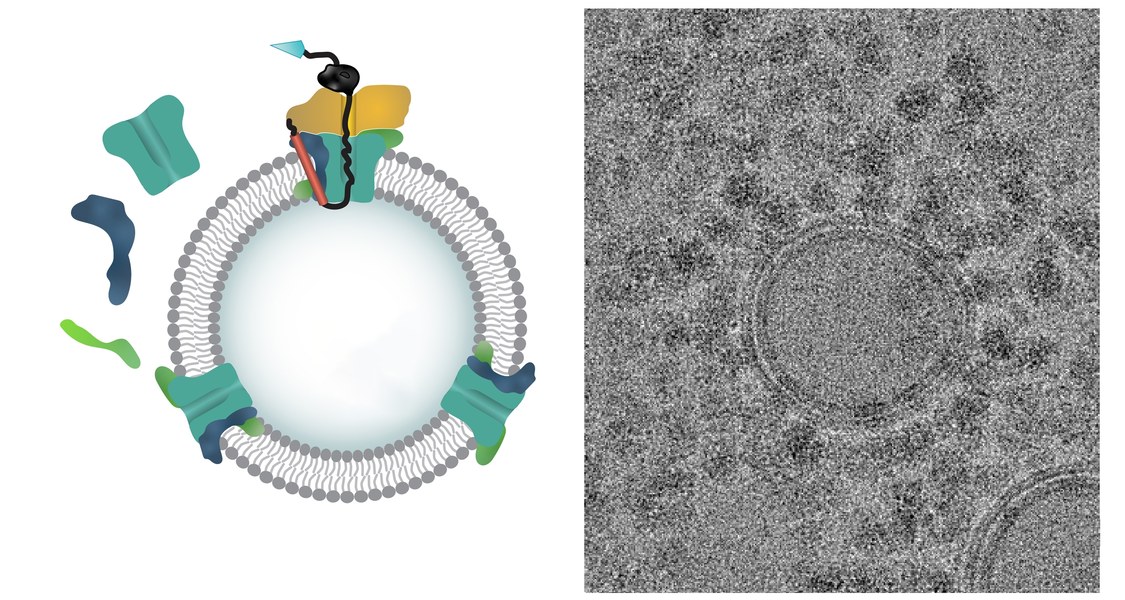
In a nutshell:
- Nearly every protein that sits in or crosses a cell membrane passes through the Sec translocon—a molecular gateway so fundamental to life that its core component can be traced back to the last common ancestor of all cells.
- Because Sec is essential for cell survival, many mutations are lethal, making it almost impossible to study or engineer the channel comprehensively in living cells.
- With Prosecco, Sec protein channels can be produced directly in synthetic membrane vesicles, allowing their activity to be measured in real time and entirely outside of living cells.
- In a single experiment, the team characterized far more Sec variants than had been studied in the previous three decades, identified channel variants with substantially increased activity, and used these findings to improve the export of a therapeutically relevant protein.
An essential gatekeeper
The Sec translocon is the gatekeeper of life. Nearly every protein destined for export from a cell or integration into a cell membrane must first pass through this molecular gateway. So fundamental is it to life that its core component, SecY, has remained essentially unchanged across hundreds of millions of years. Yet this indispensability poses a challenge for researchers: mutations typically cause cell death. Despite strong scientific interest in controlling protein transport across cell membranes, only a handful of Sec variants had been characterized in detail over the past 30 years.
Building a protein channel in synthetic cells
A team of synthetic biologists led by Dr Markus Meier, Dr Scott Scholz, and Prof Dr Tobias Erb at the Max Planck Institute for Terrestrial Microbiology used approaches from synthetic biology to circumvent this problem. Prosecco—short for “Protein Secretion in Cell-free via synthetic Operons”—is a cell-free system that produces the Sec channel entirely in a test tube, directly from its genetic blueprint, without involving a living cell. The channel proteins assemble themselves into synthetic membrane vesicles, and a built-in luminescent reporter reveals in real time whether the channel has been correctly incorporated into the membrane and how efficiently it transports proteins. “In living bacteria, many of the most interesting mutations simply cannot be studied," explains Markus Meier, first author of the study. "Building the channel in synthetic vesicles makes this possible. Here, we can examine hundreds of variants—including ones that would be lethal to a living cell—simultaneously."
Three decades of research condensed into one experiment
Using an automated, high-throughput workflow, the team tested around 300 SecY variants in parallel, including more than 200 that had never been characterized before. In a single experiment, they nearly quadrupled the total number of characterized Sec variants. Among these were dozens distributed across nearly 40 distinct sites of the channel, with up to eightfold increased transport activity. The researchers also identified, for the first time, a variant that modestly but measurably improves the channel's insertion activity into the membrane. Prosecco's results were consistent with the majority of earlier findings and also helped clarify several long-standing discrepancies between studies that had relied on inconsistent, largely qualitative methods.
Speeding up protein export
To demonstrate Prosecco's potential for practical applications, the researchers applied their findings to a concrete biotechnological challenge: the production of a therapeutically relevant nanobody. Nanobodies are small antibody fragments used in both research and medicine. By systematically testing different signal peptides—short sequences that direct proteins to the export machinery—and combining the most effective one with a newly identified high-activity SecY variant, the team achieved a marked improvement in nanobody export compared to the standard approach. This provides a direct demonstration that the insights gained with Prosecco can be translated into practical improvements for the production of valuable proteins.
"Proteins like the Sec translocon that sit at the heart of cellular function are of great relevance to us," says Tobias Erb, Director at the Max Planck Institute for Terrestrial Microbiology. "This is where synthetic biology, with its cell-free systems, can revolutionize research. By isolating this molecular machine from the cell and studying it under controlled conditions, we were able to address open questions from around 30 years of Sec research, and at the same time create a practical toolkit for engineering membrane proteins for applications in synthetic biology."
This is particularly relevant in the context of building synthetic cells—artificial cell systems assembled step by step from individual biological components. The platform will be explored further as part of the newly funded European Postdoctoral Network SynCell-nExUs which will launch in Fall 2026.
Copyright to article and pictures: Dr. Virginia Geisel, MPI for Terrestrial Microbiology, Marburg - Original Press Release