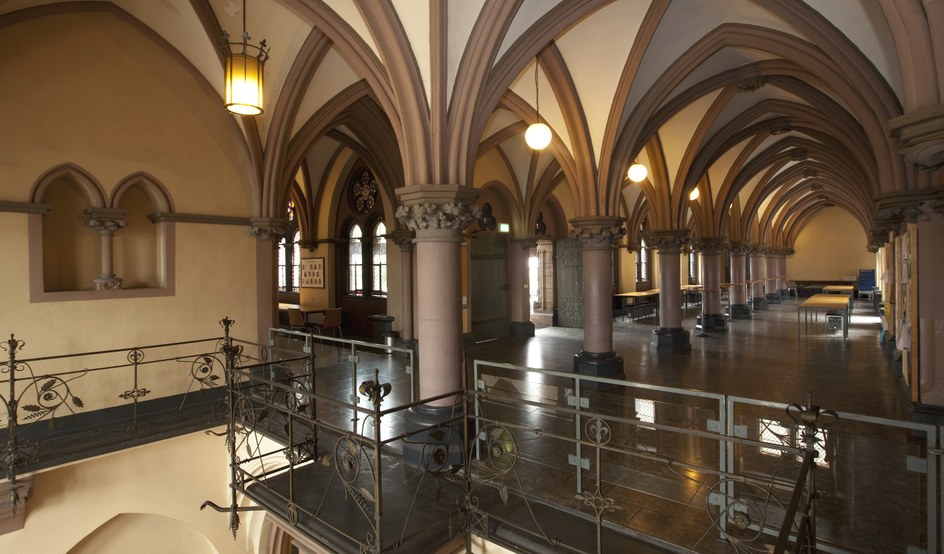
A joyous Welcome to Marburg! -
Information for foreign students at the Faculty of Protestant Theology
Students from abroad are always welcome!
This website will give you some first basic information about how to study at our faculty. For further questions and more detailed information, please contact Erasmus-Coordinator (erasmus05@uni-marburg.de).
More general information about studying at Marburg is available on the website of the Office for European Study Programmes:
http://www.uni-marburg.de/studium/res/index_html
contact:
Mr. Angel M. Rafael rafael@verwaltung.uni-marburg.de
Ms. Mariana Malková malkova@verwaltung.uni-marburg
Who is eligible for studying protestant theology at Marburg?
The professions aimed for by most of our students are either serving as a minister in one of Germany’s protestant churches or teaching protestant religion at a public school in Germany. However, our various study programmes (in particular those that lead to the degrees of Diplom and D.Theol.) are open to everybody belonging to a church that is a member of the ecumenical World Council of Churches.
What subject areas can be studied?
Our faculty offers a broad range of teaching in the five theological core disciplines of Old Testament, New Testament, church history, systematic theology and practical theology. Further subject areas in which our faculty is specialized are social ethics, history of religions and the history of the oriental churches. Language courses are offered in biblical Hebrew, classical Greek, Aramaic and Coptic. Furthermore, our faculty houses the Institut für Kirchenbau und kirchliche Kunst der Gegenwart (Institute of Modern Ecclesial Art and Architecture) of the Evangelische Kirche in Deutschland. – Classes in various areas of religious sciences can also be attended at the Faculty of Social Sciences and Philosophy (FB 03) and at the Centre of Near and Middle East Studies (CNMS).
A detailed lecture index for every semester is available online at:
https://qis.verwaltung.uni-marburg.de/qisserver/rds?state=wtree&search=1&menuid=lectureindex
How to organize your studies
All classes offered by our faculty (lectures, seminars, language courses etc.) are assigned to specific modules, which in accordance with their varying work loads are credited with 6, 8 or 10 ECTS credit points (for detailed information see the lecture index). However, for obtaining a Diplom (which roughly equals a Master of Theology), the current regulations do not require to attend any modules but only a certain number of lectures and seminars in our main subject areas in order to be admitted to the final examinations. For further details see our Diplomprüfungsordnung:
http://www.uni-marburg.de/fb05/studium/stupo/PO-05D-Evang-Theologie-28-4-2004_StAnz-32-2004.pdf
Foreign guest students who will obtain their degree from their home university abroad should contact our Erasmus coordinators in order to make up their individual lecture programme in accordance with the requirements of their home university.
Teaching language
As a rule, classes at our faculty are held in German. However, some disciplines (such as social ethics and biblical exegesis) offer graduate and postgraduate classes in English or in English and German.
The Philipps-Universität offers intensive language courses in German that are open to all its foreign students. For detailed information, see
http://www.uni-marburg.de/studium/raa/bwerberinternat/deutschk
http://www.uni-marburg.de/studium/raa/studinternational/deutschk
How to apply
There are basically two ways for foreign students to be admitted at our faculty.
One way is to apply for an Erasmus exchange at your home university. This holds in particular for students of the universities of Århus, Amsterdam, Bern, Debrecen, Groningen, Helsinki, Klaipeda, København, Leuven, Nottingham, Sibiu, Strasbourg and Uppsala, with which our faculty entertains particular exchange contracts.
The other way is to turn directly to the university’s Studierendensekretariat:
Biegenstraße 10
D-35032 Marburg, Germany
office hours 9–12 a.m.
phone: 0049-6421-2822222
fax: 0049-6421-2822020
Mail: studierendensekretariat@verwaltung.uni-marburg.de
Rooming in Marburg
If you participate in an Erasmus exchange, a room will be reserved for you in one of the university’s student dormitories. Otherwise you can request a dormitory room when applying at the Studierendensekretariat or just look for some private housing on your own initiative. Since rooming space at Marburg is rather limited, it is recommended to start your search at least a few weeks before the start of your first semester. Current housing offers can be found e.g. at
Living in a place alive with history
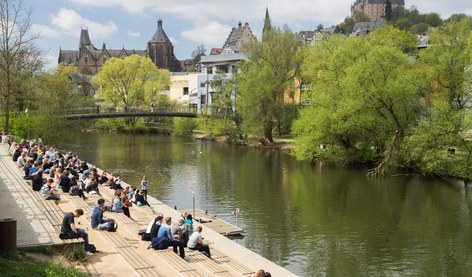
Marburg is a town of about 80.000 inhabitants, situated between steep hills on the river Lahn in the central region of the federal land of Hessen, at a distance of roughly 80 kilometres from Frankfurt in the south and Cassel in the north.
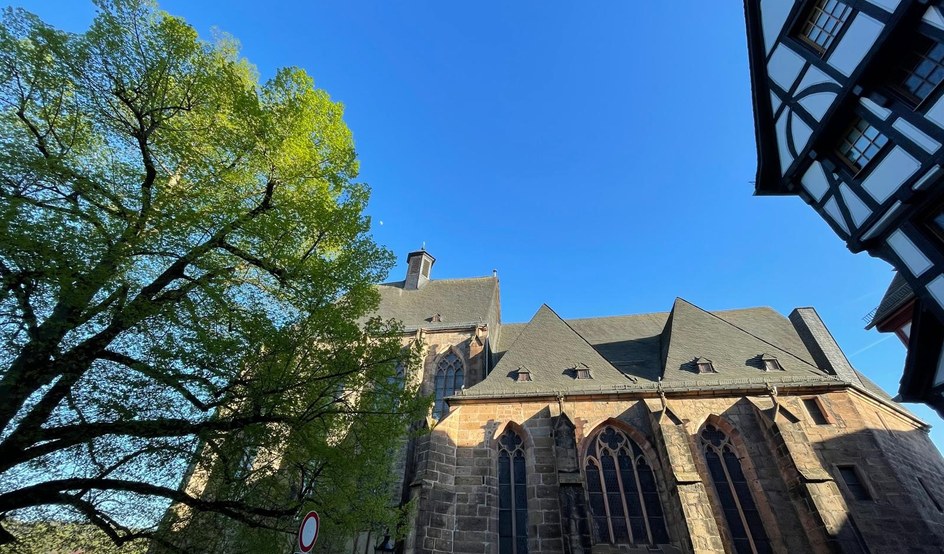
Marburg emerged as a town in the 12th century, and it gained its first fame in the years following 1228 when Elizabeth of Thuringia, the widow of the Thuringian landgrave Ludwig, chose it for a residence. Having devoted her life to the care of the sick and the poor, she died in 1231 at the age of 24 and was canonized only four years later. Soon afterwards, the Teutonic Order undertook at her burial site the erection of the Elisabethkirche, which is one of the first purely Gothic churches north of the Alps. From this time onwards, Marburg developed into one of the leading European centres of pilgrimage, which contributed a great deal to its economic flourishing.
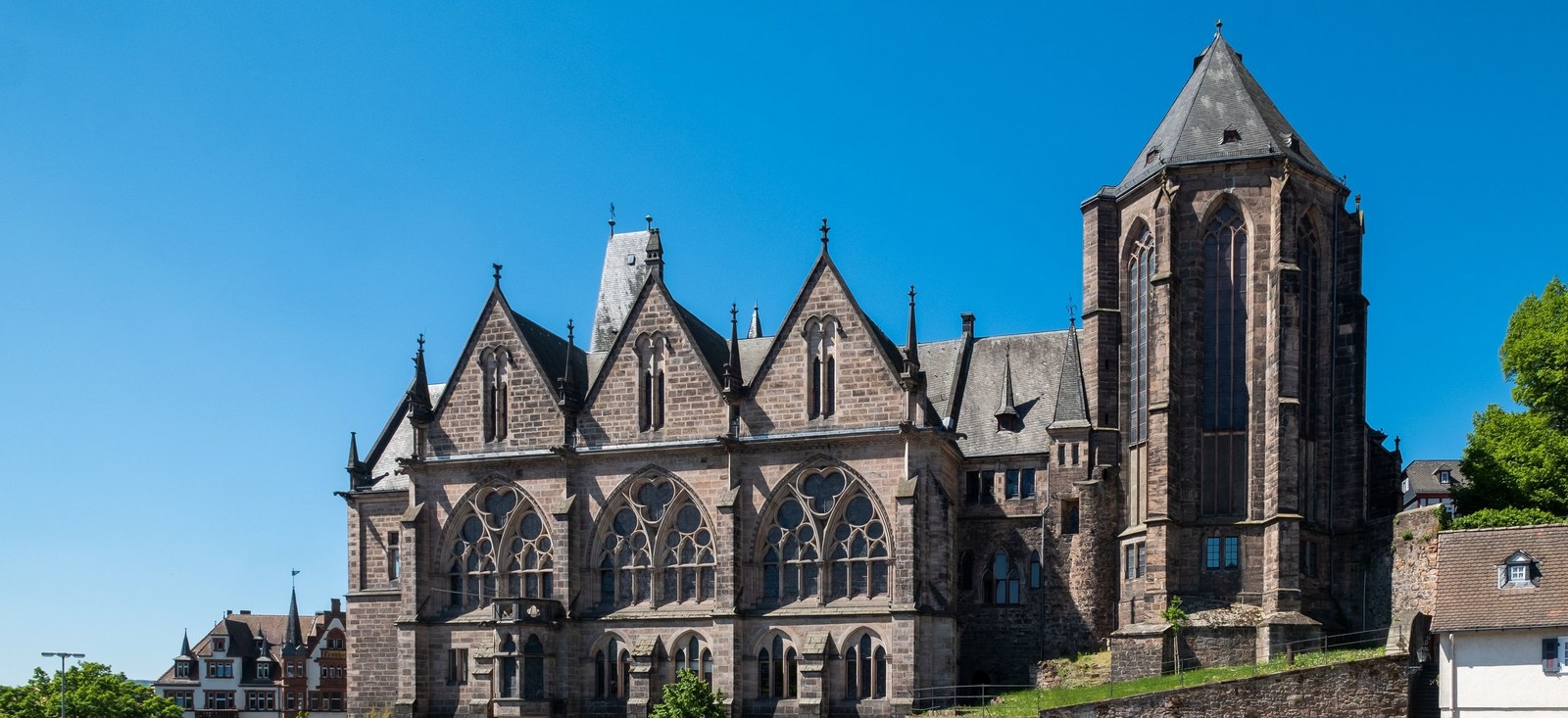
Under landgrave Philipp of Hesse, a descendant of St Elizabeth, Marburg became a stronghold of Protestantism. In 1527, Philipp founded Marburg’s university (which is therefore to this day the oldest extant university in the world which was founded as a protestant institution) and in 1529, the castle of Marburg was the arena of the so-called Marburger Religionsgespräch, a conference of leading reformers such as Luther, Zwingli and Bucer on questions concerning the Eucharist.
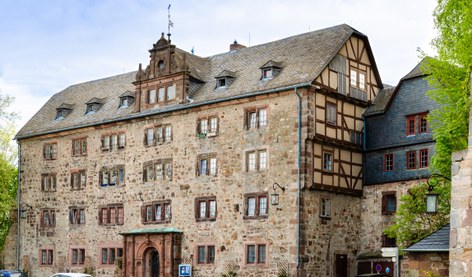
Today’s Marburg attracts its visitors not only by such eye-catching buildings as the Landgrafenschloss, the Elisabethkirche and the Alte Universität, but also by its old town centre (“Oberstadt”) situated at the foot of the castle with its many romantic half-timbered houses, outdoor cafés, restaurants, various gothic churches and the remains of the mediaeval synagogue.
More than a fourth of Marburg’s inhabitants are students, and roughly 12 percent of these 21.000 students are foreigners coming from about 120 nations. Due to the university and its great number of students, the town has a flair of intellectuality and internationality which also marks its cultural life. Apart from public lectures and other events organized by the university, Marburg prides itself on a large number of cinemas, a theatre, concerts, cabarets, pubs and a real night life.
For information about Marburg’s cultural life, see for example
www.wikipedia.org/wiki/Marburg
„Kulturladen KFZ“: www.kfz-marburg.de
Hessisches Landestheater: http://theater-marburg.com/tm/Index