Arrow-headed Script Project
Staff: Dr Dragomir Dimitrov
Project Director: Professor Michael Hahn
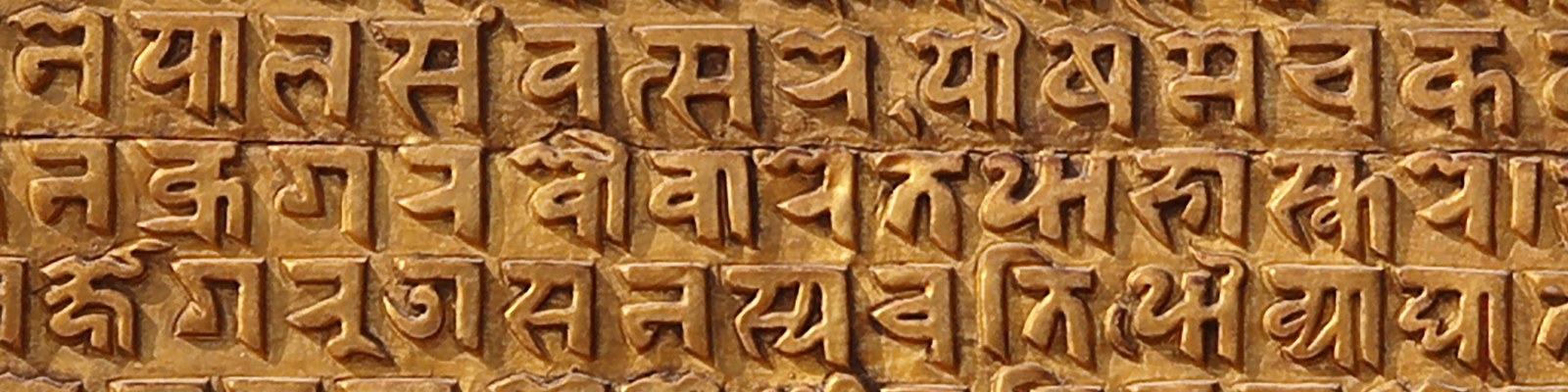
The Arrow-headed Script Project was launched in October 2004 with the
financial support of the German Research Foundation. Professor Michael
Hahn and Dr Albrecht Hanisch revived the interest in the little-known
Arrow-headed or Bhaikṣukī script and gave a fresh impetus to the study
of the few surviving documents written in this script. Only ten brief
inscriptions and three manuscripts, all of them to be assigned to a
date in the eleventh and the twelfth centuries, are known to have
withstood the ravages of time. The first part of the Project ended in
February 2007 with the successful completion of the work on the unique
manuscript of Sarvarakṣita’s Maṇicūḍajātaka, a poem written in a most
interesting mixture of Sanskrit and a special kind of Prakrit.
Since March 2007 Dr Dragomir Dimitrov has been in charge of the second
part of the Project which focuses on another remarkable manuscript
written in the Bhaikṣukī script, namely a fragmentary codex unicus of
the Candrālaṃkāra. The text preserved in this manuscript turned out to
be a hitherto unknown commentary on the Cāndravyākaraṇa, the seminal
Sanskrit grammar by the Buddhist scholar Candragomin (fifth century
AD). The Candrālaṃkāra was written probably in the first half of the
twelfth century by an anonymous Buddhist author.
Thirty-five leaves of the Candrālaṃkāra manuscript were found and
purchased by Cecil Bendall (1856–1906) when he made a trip to Nepal in
1884. In 1886 Bendall, who is considered to be the discoverer of the
Bhaikṣukī script, published his preliminary study of the script
together with a short description of the manuscript. In 1895 Bruno
Liebich, the renowned expert on the Cāndravyākaraṇa at that time,
analysed this codex and briefly described the text. After the
manuscript was eventually submitted to the Cambridge University Library
in 1934, however, it fell into complete oblivion. Thus, even when in
1971 another twenty-three folios of the same manuscript were
photographed unknowingly by the Institute for Advanced Studies of World
Religions (Stony Brook, USA) in Kathmandu and in 1983 two folios from
the same portion were microfilmed by the Nepal-German Manuscript
Preservation Project, no one was aware of the connection between the
two portions preserved in Cambridge and Kathmandu, and hardly anyone
was able to read the script, let alone establish the title and study
the text.
A
preliminary analysis of the Candrālaṃkāra manuscript shows that a
thorough examination of this codex is not only necessary but will also
be particularly fruitful in obtaining more information about Buddhist
studies in Sanskrit grammar. The aim in the final year of the Project
is to describe the palaeographical features of this Bhaikṣukī
manuscript and to compile a set of script tables containing as many
characters as possible. A comprehensive description of the Bhaikṣukī
script will provide the necessary basis for a detailed study of the
script and its development in historical perspective. This would also
facilitate work on other documents written in the Bhaikṣukī
script.
A
detailed description of the codex and a diplomatic transcript will be
prepared for use in preparing an editio princeps of the Candrālaṃkāra.
An attempt will be made to throw more light on the relationship between
this commentary and other grammatical treatises, its position in the
Cāndra school of grammar will be defined, and the identity of the
author of the Candrālaṃkāra will be investigated.
This
Project on the Candrālaṃkāra manuscript will provide, on the one hand,
a much better understanding of the poorly recorded Bhaikṣukī script as
used by Buddhist scholars in the twelfth century in Northern India,
mainly in today’s Bihar. Thus, a long-felt desideratum in the field of
Indian palaeography will eventually be fulfilled. On the other hand,
the field of Indian grammar will be enriched with the commentary on the
Cāndravyākaraṇa which until recently was believed to have been lost
irretrievably. This should provide a fresh impulse for more intensive
work on the Buddhist grammatical tradition in which many more texts
still remain unstudied.
Selected Literature:
BENDALL, Cecil
1886b “On a newly discovered form of Indian character”, in:
Verhandlungen des VII. Internationalen Orientalisten-Congresses
gehalten in Wien im Jahre 1886. Arische Section. Mit zehn Tafeln.
Vienna 1886. [Reprint: Nendeln/Lichtenstein 1968], pp. 111–125.
BÜHLER, Georg
1896 Indische Palaeographie von circa 350 A. Chr. –
circa 1300 P. Chr. (mit 9 Tafeln.). Von G. Bühler. Straßburg 1896.
(Grundriss der Indo-Arischen Philologie und Altertumskunde, I. Band,
11. Heft).
HAHN, Michael
2005 “Preliminary Remarks on Two Manuscripts Written
in the So-called “Arrow-headed” Script”, in: Buddhism and Jainism.
Essays in Honour of Dr. Hojun Nagasaki on His Seventieth Birthday.
Kyoto 2005, pp. 712–701, [119–130].
HANISCH, Albrecht
2006 “Progress in Deciphering the So-called
“Arrow-head” Script Allowing Access to Sarvarakṣita’s Maṇicūḍajātaka, a
Text of the Buddhist Sāṃmitīya School”, in: Journal of Buddhist
Studies, Vol. IV. Colombo 2006, pp. 109–161.
2007 “The Contents of the Extant Portions of the Candrālaṃkāra, an Unknown Commentary on the Cāndravyākaraṇa, as Preserved in a Manuscript Fragment Written in the “Arrow-head” Script”, in: Saṃbhāṣā, Nagoya Studies in Indian Culture and Buddhism. Volume 26. Nagoya 2007, pp. 127–161.
LIEBICH, Bruno
1895 Das Cāndra-Vyākaraṇa. Von Bruno Liebich.
[Göttingen] 1895. ([Sonderdruck a]us den Nachrichten der K.
Gesellschaft der Wissenschaften zu Göttingen. Philologisch-historische
Klasse. 1895. Heft 3).