Skip to content
 
 
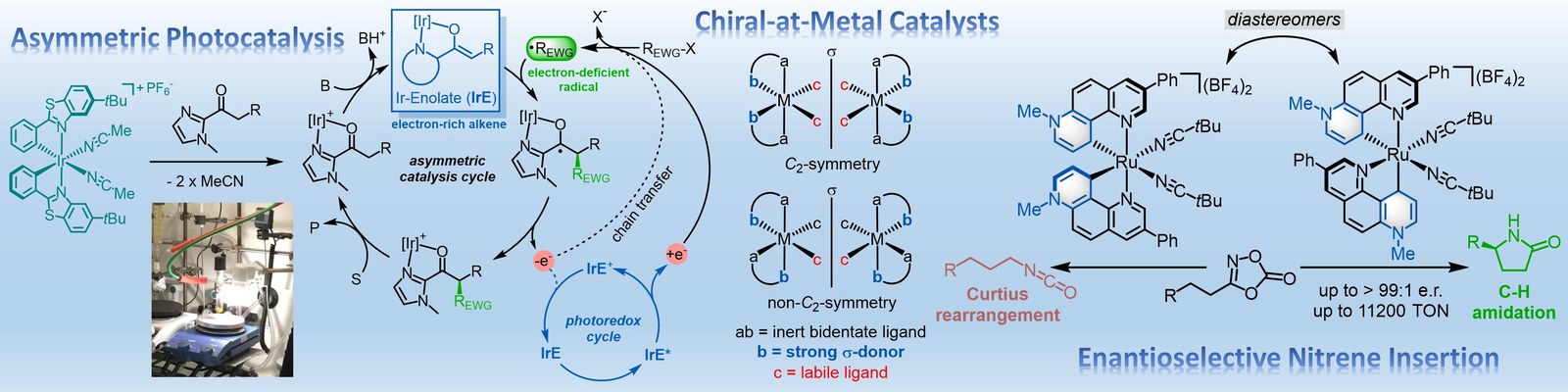
Bannergrafik (AG Meggers)
 
  Start  
 
You are here:» University » Chemie » AG Meggers

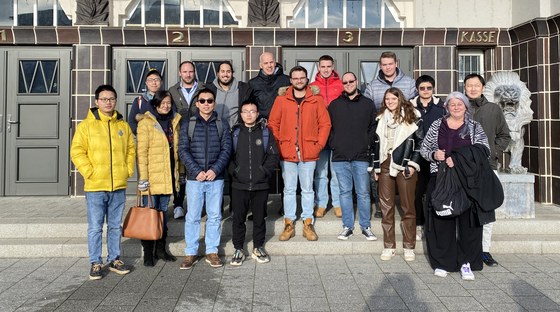
grouppicture
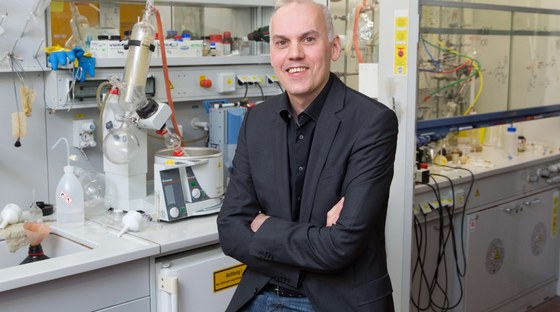
Welcome to the Meggers Laboratory!

CHEMICAL BIOLOGY AND MEDICINAL CHEMISTRY WITH ORGANOMETALLICS

Our research group is interested in the design and discovery of novel bioactive organometallic compounds and their application as tools in chemical biology and lead structures for the development of future medicines. Key focus of the Meggers lab is to exploit the unique structural opportunities provided by chemically inert metal complexes, in particular octahedral coordination geometries (up to 30 stereoisomers possible!), and apply them to difficult problems of biomolecular recognition. Along these lines, we reported over the last few years a series of inert organometallic compounds as highly potent and selective inhibitors for protein and lipid kinases, some of which also display promising anticancer activities.

A continued progress in this area of organometallic and inorganic medicinal chemistry also requires the development of strategies for the stereocontrolled synthesis of octahedral metal complexes. We therefore recently started a research program that aims in developing synthetic methods such as solid phase, combinatorial, diastereoselective, and asymmetric synthesis of complicated metal-containing compounds. 

See also: Link to Meggers-Gong laboratory at Xiamen University

HIGHLIGHTS 2012:
si2012

HIGHLIGHTS 2011:

jacs2011tocbmp

updatedhighlights2010HIGHLIGHTS 2010:

jacs2009toc
HIGHLIGHTS 2009:
2008_combined_cover
HIGHLIGHTS 2008:


More information on current areas of research:


I.) Metals as Building Blocks for the Design of Enzyme Inhibitors

Ruthenium complexes have been developed as protein and lipid kinase inhibitors. See the Figure below:a) Staurosporine as the lead structure for the design of metal complexes. b) Cocrystal structure of protein kinase PAK1 with the octahedral inhibitor lambda-FL172. Displayed are the most important H-bonding interactions and a surface view demonstrating the shape match between active site and coordination sphere. c) A selection of potent and selective ruthenium-based kinase inhibitors.

See also: Cocrystal structures with protein kinases.

kinase_inhibitors_overview

 For technology transfer of metal-containing kinase inhibitors, see following link. E-mail: meggers@transmit.de

II.)  New Synthetic Methodology for Metal-Containing Compounds: Asymmetric Coordination Chemistry

Most of our metal-containing enzyme inhibitors are chiral and, as expected, typically only one enantiomer has the desired properties, whereas the optical antipode often displays undesired different target selectivities. We recently developed a number of bidentate ligands that serve as chiral auxiliaries and in one case even as a catalyst for controlling the metal-centered configuration in octahedral ruthenium complexes.

Key references:

  • L. Gong, S. P. Mulcahy, K. Harms, E. Meggers, J. Am. Chem. Soc. 2009, 131, 9602-9603. Link to article.
  • L. Gong, Z. Lin, K. Harms, E. Meggers, Angew. Chem. Int. Ed. 2010, 49, 7955-7957. Link to article.
  • L. Gong, S. P. Mulcahy, D. Devarajan, K. Harms, G. Frenking, E. Meggers, Inorg. Chem. 2010, 49, 7692-7699. Link to article.
  • E. Meggers, Chem. Eur. J. 2010, 16, 752-758 (minireview). Link to article.
accfiguresmall


III.) Organometallic Catalysis in Living Cells

The exceptional ability of organometallic compounds to catalyze a wide variety chemical transformations has not yet been sufficiently exploited for chemical biology, but could yield bioactive molecules with novel properties. For example, such catalysts could eventually be used to amplify signals by turning over a substrate multiple times, catalytically label or deactivate target biomolecules, or release prodrugs, and all this in a cellular environment. However, designing catalysts which work under physiological conditions is a significant challenge due to the combined presence of air, water, and a plethora of cellular components such as millimolar concentrations of thiols that are prone to poison organometallic catalysts, especially under protic and aerobic conditions. With respect to this new aspect of bioorganometallic chemistry, we recently demonstrated a ruthenium-catalyzed release of amines from their allylcarbamates that tolerates the combination of water, air, and thiols, and we demonstrated the utility of this cleavage reaction in living mammalian cells: Streu and Meggers, Angew. Chem. Int. Ed. 2006, 45, 5645-5648.

carbamate cleavage.jpg

IV.) Previous Research in the Area of Nucleic Acid Chemistry
  • METAL-MEDIATED BASE PAIRING: In 2000, Meggers, Romesberg, and Schultz demonstrated for the first time that interbase metal coordination can replace the hydrogen bonding schemes found in the natural base Watson-Crick base pairs by reporting an artificial copper(II)-mediated base pair between pyridine and pyridine-2,6-dicarboxylate nucleotides. Metal-mediated base pairing (metallo-base pairing) will find potential applications in nucleic-acid-derived nanoelectronics or molecular motors and for the design of metal ion sensors and switches. See: E. Meggers, P. L. Holland, W. B. Tolman, F. E. Romesberg, P. G. Schultz, J. Am. Chem. Soc. 2000, 122, 10714-10715. For the first crystal structure of metal-mediated base pairs in a DNA duplex, see: S. Atwell, E. Meggers, G. Spraggon, P. G. Schultz, J. Am. Chem. Soc. 2001, 123, 12364-12367.
  • LONG-RANGE HOLE TRANSPORT IN DNA BY G-HOPPING: During the late 1990s we developed a technique that enabled us to generate single guanine radical cations site-selectively in double stranded DNA and to monitor the charge transport in different oligonucleotide systems. From our investigations we concluded that the overall transport of positive charge in a DNA duplex is a multistep hopping process between G bases where the individual steps contribute to the overall rate. The distance dependence is therefore no longer described by a single beta-value of the superexchange mechanism. This G-hopping mechanism can explain the transport of positive charge in DNA over long distances. See: E. Meggers, M. E. Michel-Beyerle, B. Giese; J. Am. Chem. Soc. 1998, 120, 12950-12955.

GNA_MBP_image

Biomimetic Nucleic Acid Chemistry: Glycol Nucleic Acids and Metallo-Base Pairing


Meggers Laboratory
Fachbereich Chemie, Philipps-Universität Marburg, Hans-Meerwein Strasse, D-35032 Marburg
Phone: ++49 6421 282 1534 Fax.: ++49 6421 282 2189 meggers@chemie.uni-marburg.de

Last modified: 16.05.2012 · meggers


Fb. 15 - Chemie

Meggers Laboratory, Hans-Meerwein-Straße, D-35032 Marburg
Tel. 06421/28-21534, Fax 06421/28-22189, eMail: meggers@chemie.uni-marburg.de

URL dieser Seite: http://www.uni-marburg.de/fb15/ag-meggers

Legal