Welcome to the Meggers Laboratory!
CHEMICAL BIOLOGY AND MEDICINAL CHEMISTRY WITH ORGANOMETALLICS
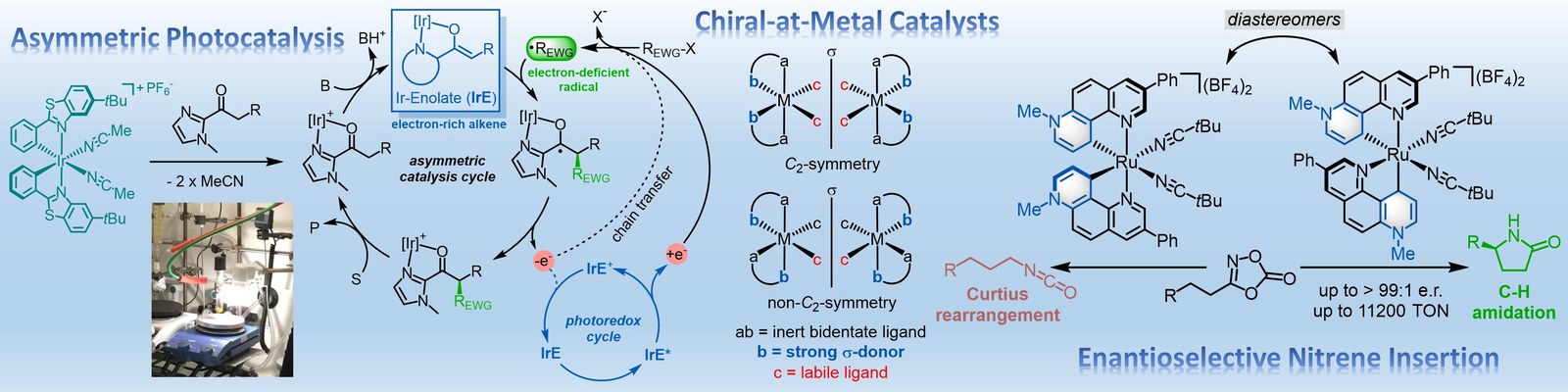
Our research group is focusing on the design and discovery of novel bioactive organometallic compounds and their application as tools in chemical biology and lead structures for the development of future medicines. Key aspect is to exploit the unique structural opportunities provided by chemically inert metal complexes, in particular octahedral coordination geometries, and apply them to unsolved problems of biomolecular recognition. Along these lines, we reported over the last few years a series of inert organometallic compounds as highly potent and selective inhibitors for protein and lipid kinases, some of which also display promising anticancer activities.
We have currently openings for diploma and master students:
Several projects in two main areas of research are available:
- Medicinal chemistry and chemical biology with organometallic compounds: a) Design, synthesis, and evaluation of protein kinase inhibitors and inhibitors for other targets. b) Development of organometallic enzyme inhibitors with functions in addition to molecular recognition, such as photo- and redox-activity.
- Stereoselective synthesis of octahedral organometallic compounds:
The enormous opportunities of octahedral metal complexes to serve as
functional scaffolds are offset by the difficulties to control the
relative stereochemistry. Projects are available to develop chiral
auxiliaries to control relative and absolute stereochemistry in
octahedral metal complexes.
HIGHLIGHTS 2010:
-
Atomic resolution structure of a GNA duplex containing solely Watson–Crick hydrogen bonded base pairs solved in collaboration with Prof. Dr. L.-O. Essen: Helical twist due to alternating syn & anti conformations of the vicinal CO bonds: Chem. Commun. 2010, DOI: 10.1039/B916851F.
- Minireview: Chiral auxiliaries as emerging tools for the asymmetric
synthesis of octahedral metal complexes: Chem. Eur. J.
2010, ASAP.
HIGHLIGHTS 2009:
-
Asymmetric coordination chemistry! First example of asymmetric synthesis of enantiopure ruthenium complex with the help of a chiral auxiliary: J. Am. Chem. Soc. 2009, 131, 9602-9603.
- Kinase selectivity through size and rigidity: Bulky octahedral
ruthenium complex as selective PAK1 inhibitor: J.
Am. Chem. Soc. 2008, 130, 15764.
- Close to a world record? Ultra-high affinity organometallic
inhibitor for protein kinase GSK-3: ChemBioChem 2008, 9, 2933.
- Finally solved: Structure of a duplex of the simplified nucleic acid GNA: J. Am. Chem. Soc. 2008, 130, 8158.
- Solid phase synthesis of ruthenium complexes: Cover art for the issue 12 of Inorganic Chemistry.
- Replacing the metal has virtually no effect on the biological properties of an organometallic scaffold! Chem. Eur. J. 2008, 14, 4816.
- Discovery of an organometallic lead structure which is selective
for lipid over protein kinases: ACS Chem. Biol. 2008, 3,
305.
More information on current areas of research:
Inert Organometallics as Enzyme
Inhibitors
Ruthenium complexes have been developed as protein and lipid
kinase inhibitors. See the Figure below:a) Staurosporine as the lead
structure for the design of metal complexes. b) Cocrystal structure of
protein kinase PAK1 with the octahedral inhibitor
lambda-FL172. Displayed are the
most important H-bonding interactions and a surface view demonstrating
the shape match between active site and coordination sphere. c) A
selection of potent and selective ruthenium-based kinase
inhibitors.
See also: Cocrystal structures with protein kinases.
Organometallic Catalysis in Biological
Environment
Previous research in the area of nucleic acid chemistry:
- THE MINIMAL NUCLEIC ACID GNA: We recently discovered a minimal nucleic acid backbone (GNA, glycol nucleic acid). Due to its unique combination of high duplex stability, base pairing fidelity, and easy synthetic access of its nucleotides, GNA comprises a promising scaffold for future nucleic-acid-based nanotechnology. Furthermore, GNA is structurally the most simplified solution for a phosphodiester-containing nucleic acid backbone and thus constitutes a candidate for initial genetic molecules of life. See: L. Zhang, A. Peritz, E. Meggers, J. Am. Chem. Soc. 2005, 127, 4174-4175. For the crystal structure of a GNA duplex, see: M. K. Schlegel, L.-O. Essen, E. Meggers, J. Am. Chem. Soc. 2008, 130, 8158-8159.
- METAL-MEDIATED BASE PAIRING: In 2000, Meggers, Romesberg, and Schultz demonstrated for the first time that interbase metal coordination can replace the hydrogen bonding schemes found in the natural base Watson-Crick base pairs by reporting an artificial copper(II)-mediated base pair between pyridine and pyridine-2,6-dicarboxylate nucleotides. Metal-mediated base pairing (metallo-base pairing) will find potential applications in nucleic-acid-derived nanoelectronics or molecular motors and for the design of metal ion sensors and switches. See: E. Meggers, P. L. Holland, W. B. Tolman, F. E. Romesberg, P. G. Schultz, J. Am. Chem. Soc. 2000, 122, 10714-10715. For the first crystal structure of metal-mediated base pairs in a DNA duplex, see: S. Atwell, E. Meggers, G. Spraggon, P. G. Schultz, J. Am. Chem. Soc. 2001, 123, 12364-12367.
-
LONG-RANGE HOLE TRANSPORT IN DNA BY G-HOPPING: During the late 1990s we developed a technique that enabled us to generate single guanine radical cations site-selectively in double stranded DNA and to monitor the charge transport in different oligonucleotide systems. From our investigations we concluded that the overall transport of positive charge in a DNA duplex is a multistep hopping process between G bases where the individual steps contribute to the overall rate. The distance dependence is therefore no longer described by a single beta-value of the superexchange mechanism. This G-hopping mechanism can explain the transport of positive charge in DNA over long distances. See: E. Meggers, M. E. Michel-Beyerle, B. Giese; J. Am. Chem. Soc. 1998, 120, 12950-12955.
Biomimetic Nucleic Acid Chemistry: Glycol Nucleic Acids and Metallo-Base Pairing
Meggers Laboratory
Fachbereich Chemie, Philipps-Universität Marburg, Hans-Meerwein
Strasse, D-35032 Marburg
Phone: ++49 6421 282 1534 Fax.: ++49 6421 282 2189 meggers@chemie.uni-marburg.de