15.07.2026 From thiocarbonyl dihalides to their carbocation derivatives
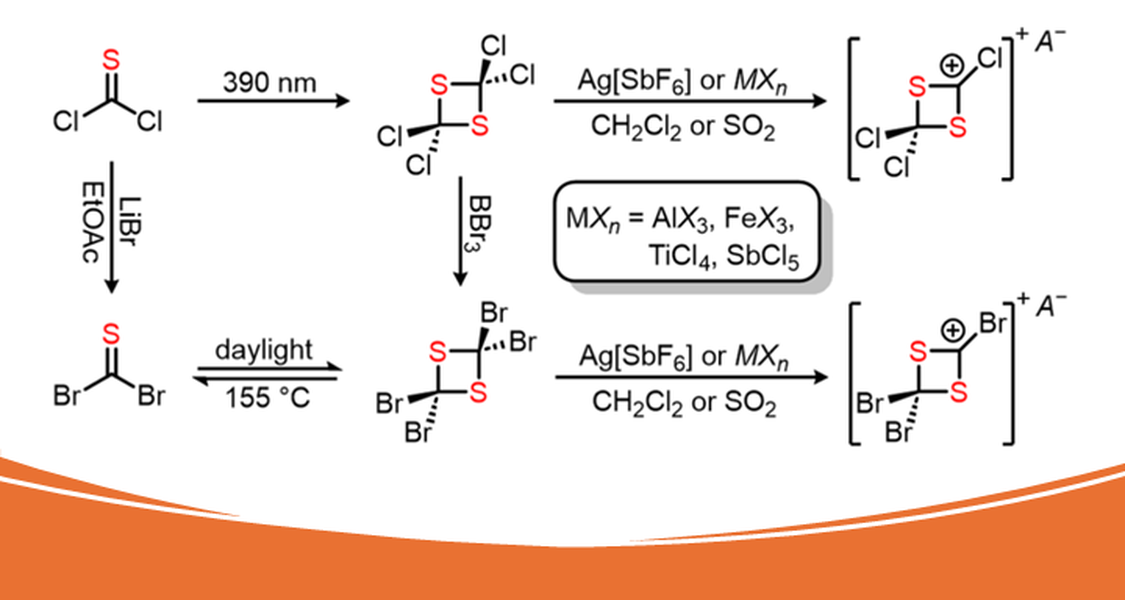
Unlike its lighter congener phosgene, the sulfur analogues CSCl2 and CSBr2 readily undergo [2+2] cyclodimerization to yield their.....dimers. This was in fact the trick to get to the pure carbonyl dibromide. The thiophosgene dimer (top middle) can undergo halide exchange to the bromide dimer (bottom middle). From there we can use heat to induce [2+2] cycloreversion to get to the unstable and hard to handle thiobromophosgene (CSBr2).
Back to the dimers: Halide abstraction from C2S2X4 (X = Cl, Br) using Lewis acids leads to series of glovebox-stable carbocations [C2S2X3]+. The charge is delocalised over four atoms (2 x S, 1 x X, and 1 x C) and the products are remarkeably stable. It doesn't seem to matter what Lewis acid is used; even weak ones such as FeCl3 work.
Stay tuned for more thiocarbonyl chemistry coming soon!