30.10.2026 Herzliche Einladung zum Workshop "Transatlantic Approaches to Environmental Racism: A Lens Through Ecologies, Materialities and Relations" am 6. und 7. November
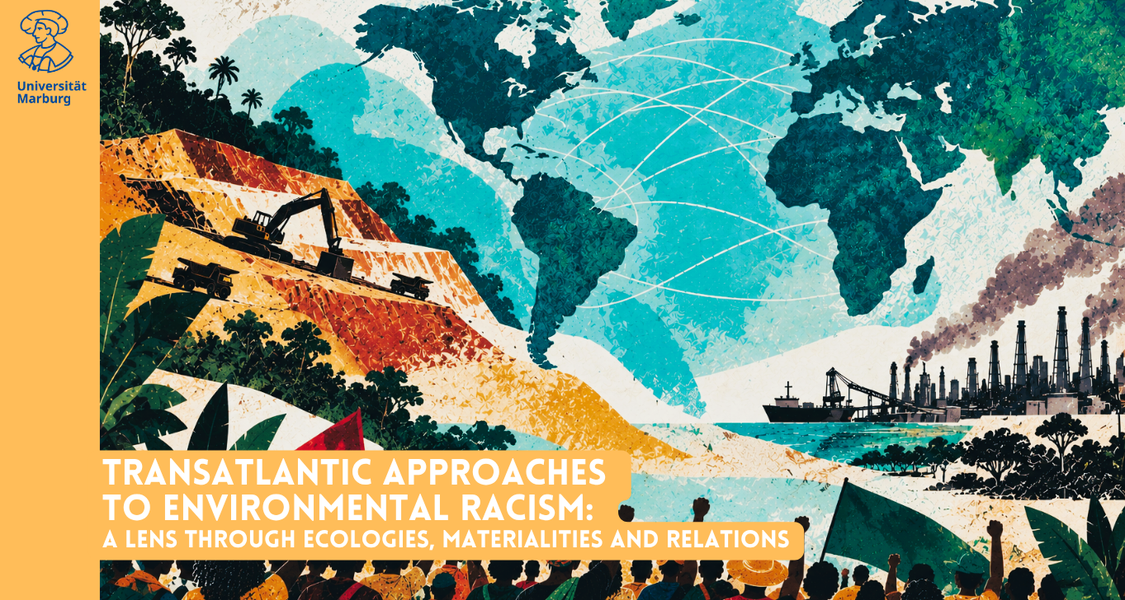
Transatlantic Approaches to Environmental Racism: A Lens Through Ecologies, Materialities and Relations
Workshop organized by the GASCA (DGSKA) regional groups Afro-America and African diaspora, Mesoamerica and South America
6-7 November 2026, Institute of Social Anthropology and Religious Studies, University of Marburg, Deutschausstrasse 3, Room 00/1020
Across the globe, Black, Indigenous, and other racialized communities are disproportionately affected by environmental degradation and climate change. Since the 1980s, social movements and critical scholarship have addressed such racial dimensions of environmental injustices through the concept of environmental racism. Originally coined in the United States to expose the intersections of race, class, and gender in contexts of environmental pollution (Bullard 1990), the concept has since influenced a wide range of socio-ecological analyses worldwide.
In Latin America and the Caribbean, for instance, environmental racism has sparked deeper conversations about the environmental hardships experienced by racialized populations, especially in situations involving climate change, systematic land dispossession, extractive industries, infrastructure mega-projects, and waste management/dumping (e.g., Berman-Arévalo & Ojeda 2020; Carruthers 2008; Moreno Parra 2019; Quiroga Manrique et al. 2025; Rodríguez Mir & Martínez Gandolfi 2023).
This workshop examines racialized environmental inequalities within the longue durée of transatlantic relations, which emerged through the conquest and colonization of the Americas and were consolidated through plantation economies and the transatlantic slave trade (e.g., Kummels et al. 2014; Rodney 2018; Zeuske 2022). This historical formation of the transatlantic network was crucial to the development of the modern/colonial world system, which is characterized by racial classification and an extractive economy (e.g., Ferdinand 2022; Gilmore 2019; Quijano 2024).
Against this backdrop, the workshop approaches the transatlantic as a field of ongoing ecological, material, and relational entanglements. By bringing together various perspectives, the workshop aims to deepen understandings of, and broaden perspectives on, environmental racism in Latin America, the Caribbean, and beyond. The full conference programme is available here.
To attend the workshop please mail to >transatlantic-conference-2026@uni-marburg.de<
Kontakt
Daniela Triml-Chifflard, Eriko Yamasaki
transatlantic-conference-2026@uni-marburg.de