02.02.2026 Computing natural magnitudes in the photometric systems of astronomical plates using Gaia DR3 spectral energy distributions
Neue Publikation erschienen in "Astronomy & Astrophysics"
Context. Accurate photometric calibration of astronomical photographic plates remains a fundamental challenge in astronomy, especially when bridging historical photographic data with modern observations due to the mismatch of spectral sensitivities of photographic plates and pass bands of modern calibration catalogs.
Aims. We intend to derive consistent natural magnitudes for celestial sources within the intrinsic photometric systems of astronomical photographic plates by using Gaia Data Release 3 (DR3) blue-photometer (BP) and red-photometer (RP) low-resolution spectral data and to show its superiority over former methods.
Methods. We compiled spectral characteristic data for emulsions and filters applied in photometric observations using glass plates. The collected color sensitivities, modified by atmospheric reddening depending on the air mass, were then used to compute accurate natural magnitudes and fluxes of objects in the photographic plates through synthetic photometry, utilizing a catalog of Gaia spectral energy distributions (SEDs) over the 330 nm ≤ λ ≤ 1050 nm range (XP spectra). This process uses GaiaXPy, a Python library designed to handle Gaia DR3 spectral data. These natural magnitudes are then compared with results from the color-term method used to compile the data in existing photoplate archives.
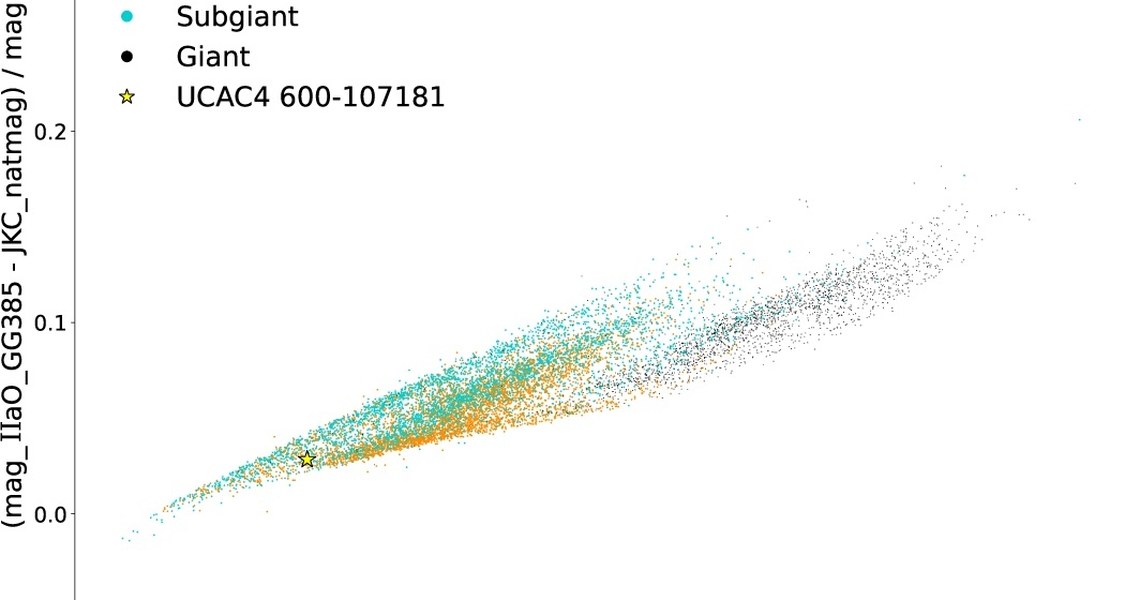
Results. Comparing the synthetic magnitudes with those existing in the Archives of Photographic PLates for Astronomical USE (APPLAUSE), we were able to reveal systematic errors of the existing data in the range of ±0.3 mag and higher. In addition, the presented method allows for an accommodation of stars with similar color index but of different luminosity classes as well as an effective correction of atmospheric reddening at higher air masses (approximately 0.2 mag).
Maryam Raouph, Andreas Schrimpf
Computing Natural Magnitudes in the Photometric Systems of Astronomical Plates using Gaia DR3 SEDs
Astronomy & Astrophysics, 707, A7 (2026)
DOI: 10.1051/0004-6361/202557161
Kontakt
Maryam Raouph
Mail: maryam.raouph@physik.uni-marburg.de
Arbeitsgruppe Astronomiegeschichte und Beobachtende Astronomie
Fachbereich Physik der Philipps-Universität Marburg
Renthof 7
35032 Marburg