Main Content
Research Topics
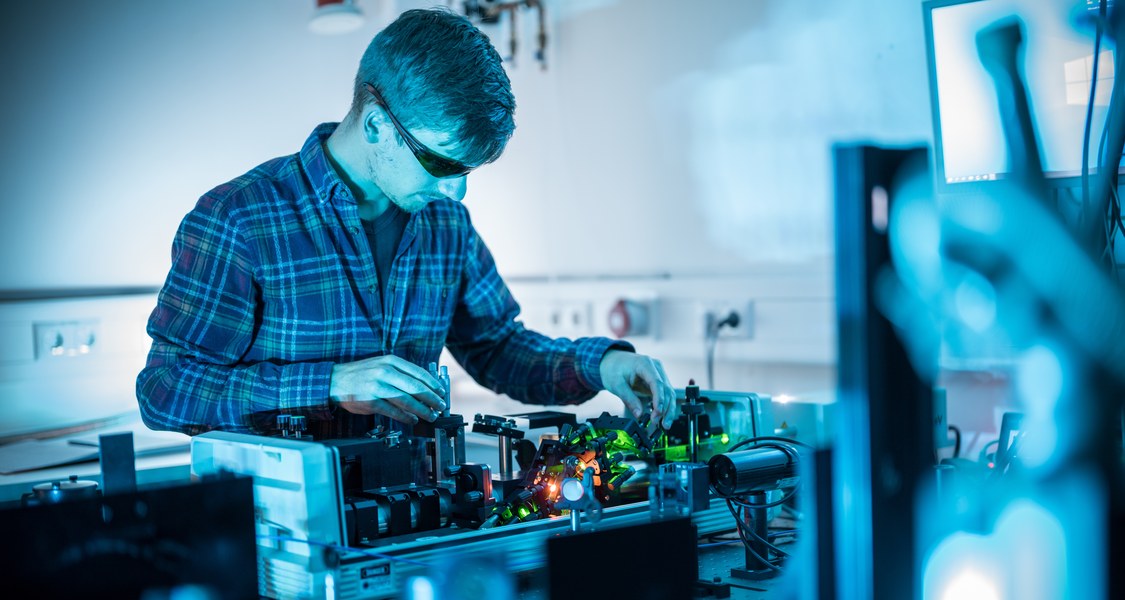
What actually makes a good solar cell? Or a bad one? How does sunlight turn into charge carriers and how do charge carriers become usable electricity? The processes that are crucial for answering such questions take place on very short time scales, often shorter than a nanosecond. To get to the bottom of things, we work with femtosecond laser pulses to optically excite semiconductor materials and we study the luminescence emitted during the transition back to the ground state. The time decay of the luminescence signal tells us a lot - for example, about the transport of charge carriers or bound electron-hole pairs, so-called excitons, about the properties of internal interfaces, or about the presence of defect states. Overall, our intention is to better understand how the micro- and nanostructure or the nature of interfaces affect the optical properties of organic and organic/inorganic semiconductor devices. We are particularly interested in these systems:
-
- Molecular single crystals and thin films
- Hybrid organic/inorganic materials
- Organic/organic and organic/inorganic heterostructures
Our research activities focus on:
- Fundamental processes in molecular semiconductors
- Hybrid materials
- Excitation dynamics in semiconductor heterostructures
- Defects and disorder