Main Content
Preprints
239. D. Erkensten, K. Sadecka, M.-C. Heißenbüttel, T. Deilmann, E. Malic „Impact of exciton-phonon and exciton-magnon interaction on transport in anisotropic 2D magnetic semiconductors”, arXiv: 2609.21746
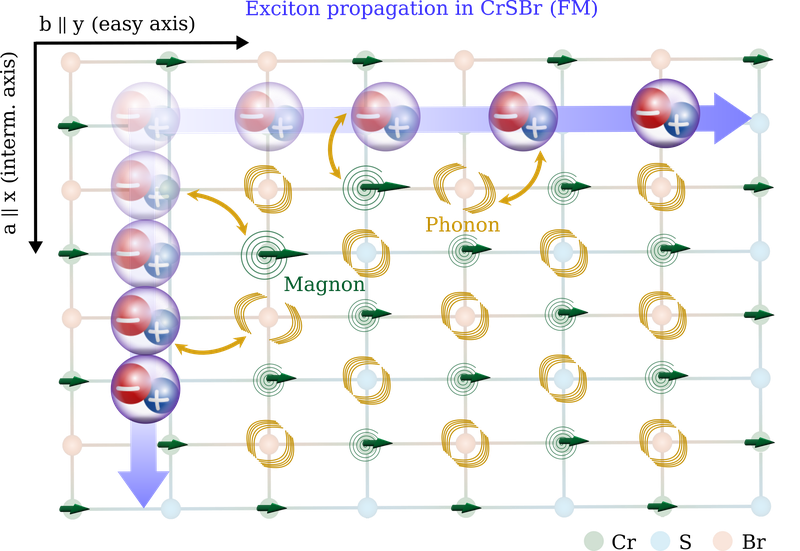
Two-dimensional magnetic semiconductors provide a unique platform for exploring the interplay between charge, lattice, spin, and light. The strong Coulomb interaction combined with long-range magnetic order enables efficient coupling between excitons and both lattice vibrations and spin excitations, thereby strongly influencing exciton dynamics and transport in these materials. Here, we develop a microscopic many-body theory of exciton--phonon and exciton--magnon interactions in mono- and bilayer CrSBr. We demonstrate that the quasi-one-dimensional character of excitons in CrSBr gives rise to strongly anisotropic exciton--phonon and exciton--magnon scattering, resulting in direction-dependent diffusion coefficients. Furthermore, we identify a distinct temperature dependence originating from one-phonon and two-magnon scattering processes, providing characteristic signatures of the underlying microscopic interactions. Our work establishes a microscopic framework for understanding exciton transport in magnetic van der Waals semiconductors and provides guidance for future optical spectroscopy and exciton transport experiments.
arXiv: 2609.21746238. M. Struve, H. Pashaei Adl, J. M. Fitzgerald, O. Janikowska, M. Śmiertka, A. Surrente, S. Stephan, C. Lienau, F. Eilenberger, Z. Sofer, W. Paritmongkol, W. A. Tisdale, P. Plochocka, E. Malic, C. Schneider, M. Esmann, "Coherent interaction of WS2 and quasi-2D perovskite excitons over micrometer distances via a cavity field", arXiv: 2609.03765
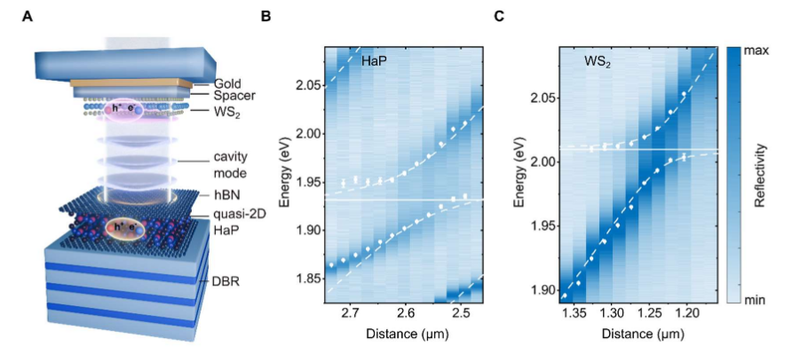
The coherent coupling of cavity-confined photons and excitonic matter resonances leads to the formation of cavity polaritons, hybrid light-matter quasi-particles. If multiple exciton resonances couple to the same photonic mode, the resulting polariton constitutes a coherent interaction between matter resonances that can be spatially separated without any direct electronic coupling. In this work, we demonstrate the formation of such a coherent coupling at room temperature using an open optical cavity containing two distinct van der Waals materials - monolayer WS2 and layered quasi-2D halide perovskites (HaPs) - separated by 1.5μm. The system forms three polariton branches, with the middle branch possessing nearly equal fractions of both excitons and the photonic mode. White-light reflectivity and luminescence measurements are in good agreement with simulations using a coupled harmonic oscillator and a microscopic Wannier-Hopfield framework. Our results lay the foundation to combine highly complementary degrees of freedom in 2D materials in an in-situ tunable fashion to enable new polaritonic functionalities.
arXiv: 2609.03765237. E. P. Kraus, J. M. Fitzgerald, C. Maciel-Escudero, E. Malic, „Perfect Absorption in the Strong Coupling Regime via Degenerate Critical Coupling”, arXiv: 2606.26708
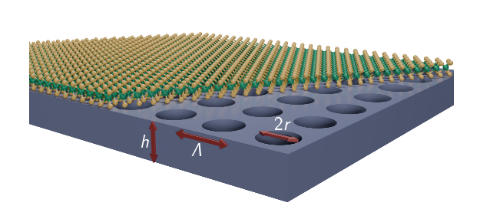
Perfect absorption (PA) represents a fundamental limit of light-matter interaction and a means to maximize nanoscale energy conversion. While PA is now a well-established phenomenon, both the theoretical feasibility and a practical mechanism for achieving it under single-beam excitation within the strong coupling regime is unknown. Through rigorous solution of Maxwells equations for a compact photonic crystal (PhC) architecture incorporating a two-dimensional semiconductor, we present a general method based on degenerate critical coupling for single-port PA of exciton-polaritons. At the crossing of two polariton branches, we achieve near-unity absorption exceeding 99.8 \% in a structure thinner than 100nm. This effect is robust under realistic Gaussian beam excitation and can be realized across different temperatures and excitonic materials by tailoring the PhC geometry. Our results establish a strategy for enabling efficient light-matter coupling, with direct implications for the development of metal-free, ultra-compact polaritonic logic devices, sensors, and energy-harvesting platforms.
arXiv: 2606.26708236. S. Saris, R. Rosati, V. Bruevich, T. J. Sheehan, M. Roman, V. Podzorov, E. Malic, W. A. Tisdale, “Nonequilibrium transport in epitaxial CsPbBr3 single crystals”, arXiv: 2606.02460 (2026)
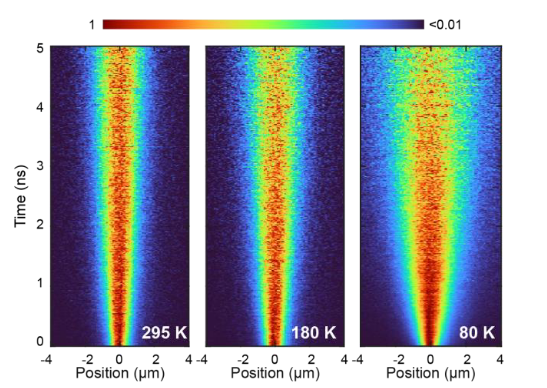
Transport of optically excited carriers in semiconductors is typically described within a quasi-equilibrium picture, where energy is carried by a single thermalized quasiparticle population characterized by well-defined transport coefficients. Here, we demonstrate that in epitaxial CsPbBr3 perovskite single crystals, this picture holds near room temperature - but breaks down dramatically at low temperature. Using transient microscopy, we show that optically measured carrier mobilities match device-scale Hall-effect and field-effect transistor measurements across a broad temperature range, resolving reported discrepancies and validating the equilibrium framework in the free-carrier regime. Below ~60 K, however, when excitonic effects become significant, equilibrium models begin to fail. We observe two coupled populations: a transient (<100 ps) hot-exciton gas with a diffusivity ~25-30 cm<sup>2</sup>/s - greatly exceeding the diffusivity expected for thermalized excitons - and a quasi-localized state that is fed by the cooling of the hot-exciton gas. These results reveal that in CsPbBr3, transport and thermalization are not separable processes: carriers move while still redistributing among internal degrees of freedom, breaking the timescale separation that underpins equilibrium transport theory in conventional semiconductors. By resolving transport at the population level, we can directly access the competing kinetics of exciton formation, interconversion, and cooling, offering a new space for controlling energy flow in perovskite materials and their photonic applications.
arXiv: 2606.02460235. J. Gradl, N. Hofmann, L. Weigl, S. Forti, N. Mishra, C. Coletti, R. Perea-Causin, E. Malic, I. Gierz, “Influence of sulphur vacancies on ultrafast charge separation in WS2-graphene heterostructures”, arXiv: 2603.16247 (2026)
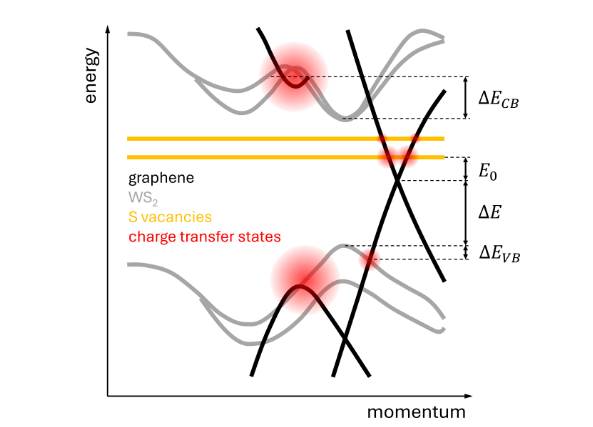
Understanding how defects influence charge separation in WS2 -graphene heterostructures is crucial for future applications in light harvesting and detection. Previous studies have reported widely varying lifetimes for the charge-separated state, all supposedly linked to electron trapping at sulphur vacancies. The exact impact of these defects, however, has remained unclear. Here, we deliberately introduce sulphur vacancies by annealing the heterostructures at high temperatures in ultrahigh vacuum. Angle-resolved photoemission spectroscopy (ARPES) reveals that these vacancies modify both the band alignment and doping level of the heterostructure. Time-resolved ARPES (trARPES) further shows that increasing the sulphur vacancy concentration prolongs the lifetime of electrons in the WS2 conduction band but shortens the lifetime of the charge-separated state. Guided by model calculations, we attribute this behaviour to shifts in the energy alignment between sulphur vacancy states and graphene's Dirac point, combined with a reduced excitonic absorption. The model also yields a transfer time for electrons tunneling from sulphur vacancies into graphene's Dirac cone of 4ps, consistent with our trARPES measurements. Our study clarifies the role of sulphur vacancies in WS2-graphene heterostructures, further improving our microscopic understanding of charge dynamics for future optoelectronic applications.
arXiv: 2603.16247