21.07.2026 Paper: Pressure-Dependent Electronic and Ionic Tortuosities During Fabrication of Composite Cathodes for All-Solid-State Batteries: Influence of Active Material Particle Morphology, Volume Fraction, and Coating
Vanessa Miß1, Greta Müller1, Sophie Schäfer1, Evelyn Versok1, Stefan Seus1, Valeriu Mereacre2, Joachim R. Binder2, Bernhard Roling1
1Department of Chemistry and Marburg Center for Quantum Materials and Sustainable Technologies (mar.quest), University of Marburg, 35032 Marburg, Germany
2Karlsruhe Institute of Technology (KIT), Institute for Applied Materials (IAM-ESS), 76344 Eggenstein-Leopoldshafen, Karlsruhe, Germany
Abstract
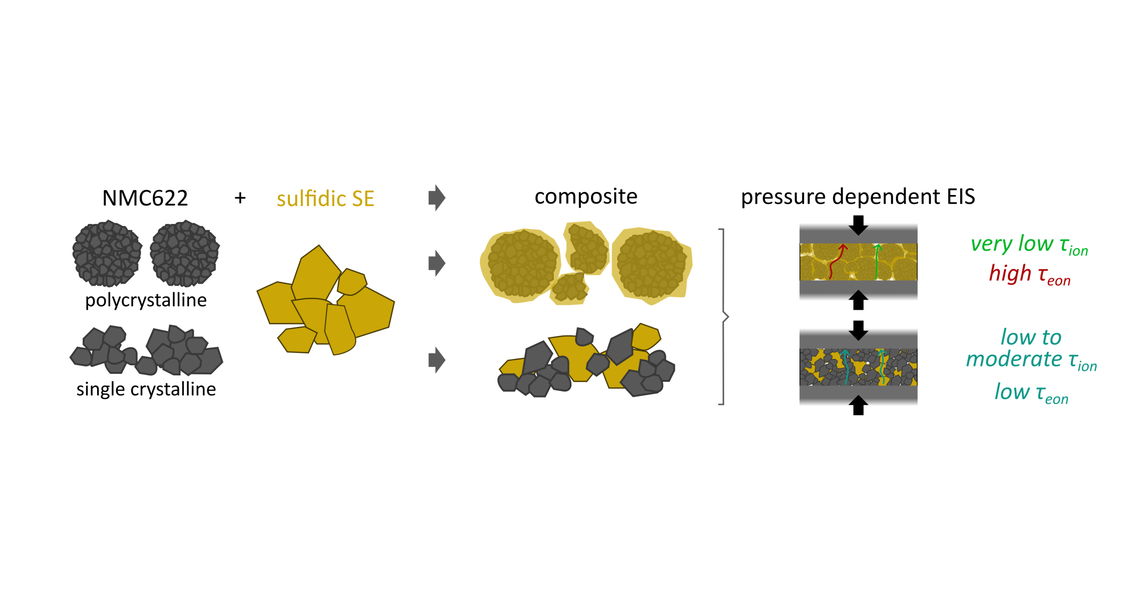
The cathode of bulk-type all-solid-state batteries (ASSBs) is a composite consisting of cathode active material (CAM) particles and solid electrolyte (SE) particles. Since ASSBs are usually fabricated and cycled under pressure, it is important to achieve a better understanding of the influence of pressure on the electronic and ionic transport in CAM/SE composites. However, experimental values for pressure-dependent electronic and ionic conductivities of CAM/SE composites are scarce. Therefore, we have carried out pressure-dependent impedance spectroscopic measurements during compaction of composite powders under an increasing fabrication pressure up to 663 MPa. The composites contained four different types of LiNi0.6Mn0.2Co0.2O2 (NMC622) cathode active material particles: (i) single-crystalline and uncoated, (ii) single-crystalline and coated with LiNbO3, (iii) polycrystalline and uncoated, and (iv) polycrystalline and coated with LiNbO3. In addition, the volume fractions of CAM particles and SE particles were varied. The physical meaning of the resistances extracted from the impedance spectra were analyzed, and electronic and ionic tortuosities were calculated. A strong influence of the CAM particle morphology and coating on the microstructure of the composites was observed. Based on the results, the interrelation between composite microstructure and tortuosities is discussed.
Read the full paper in ChemElectroChem 13 (2026), e70274 by Chemistry Europe.