Main Content
Interfacial Dynamics
How do molecules bind, organize, and move at interfaces?
Interfaces change molecular concentrations, orientations, and mobility. We investigate how these changes influence adsorption, chemical behavior, and exchange between phases.
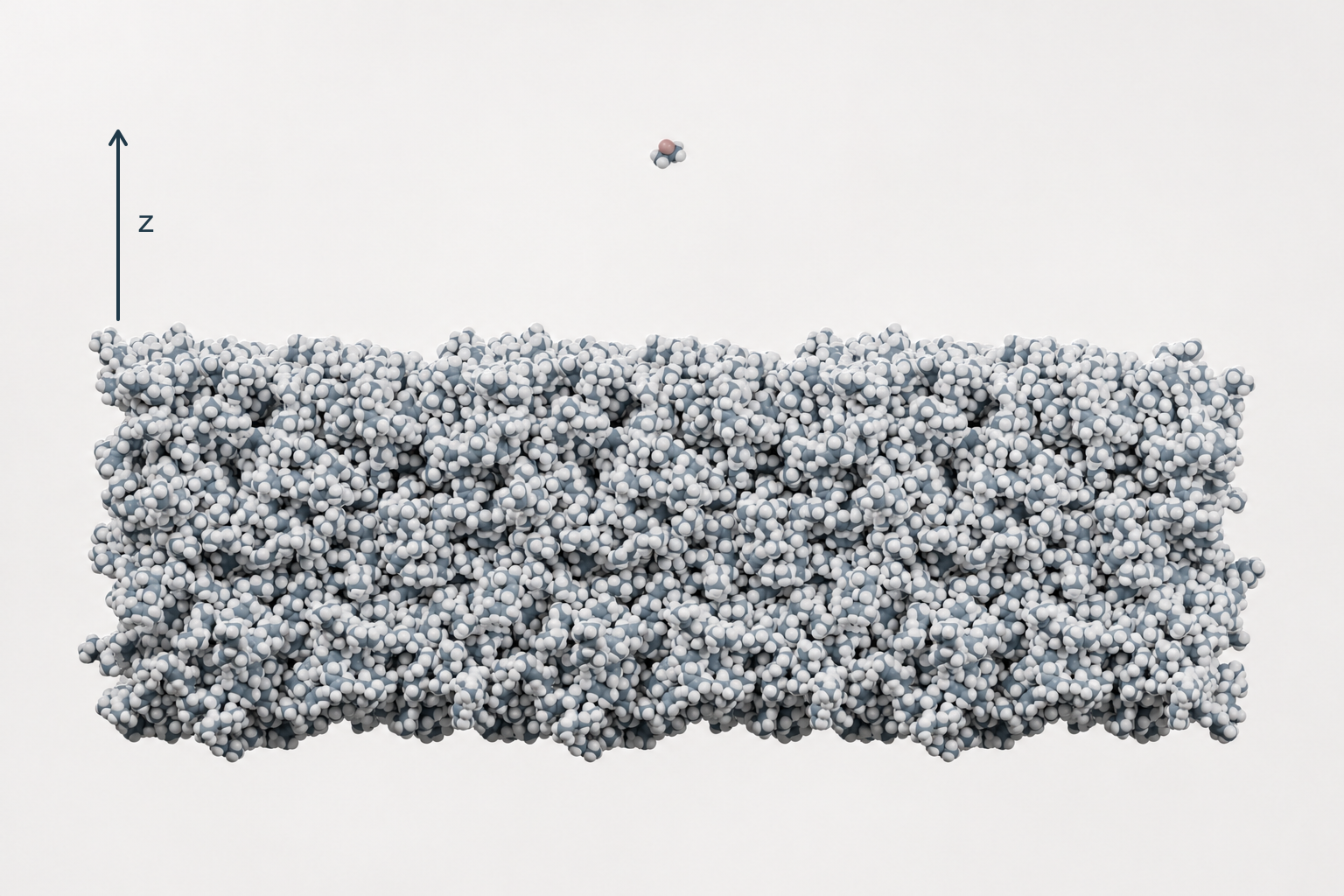
New rendering of simulations discussed in von Domaros and Tobias (2025).
Skin Oils and Indoor Chemistry
Skin oils react with ozone and influence indoor air composition. We study the organization of squalene and the interactions of its oxidation products with surfaces. Molecular simulations connect adsorption, partitioning, and residence times with larger-scale models of chemical fate and exposure.
Molecular Binding at Reactive Surfaces
We investigate biological cofactors at metal–water interfaces. Simulations characterize their binding, orientation, and mobility, complementing experiments on surface-mediated reactions. The central question is how molecular structure and dynamics influence interfacial behavior.
Selected Reading
- Molecular Dynamics Simulations of the Interactions of Organic Compounds at Indoor Relevant Surfaces — von Domaros and Tobias, Annu. Rev. Phys. Chem. (2025).
- Molecular Orientation at the Squalene/Air Interface from Sum Frequency Generation Spectroscopy and Atomistic Modeling — von Domaros et al., J. Phys. Chem. B (2021).