Main Content
Membrane Permeation
What determines how molecules cross a membrane?
We investigate how membrane composition, molecular packing, and dynamics control the passage of water and organic compounds. Our central systems are the skin lipid barrier and model phospholipid membranes.
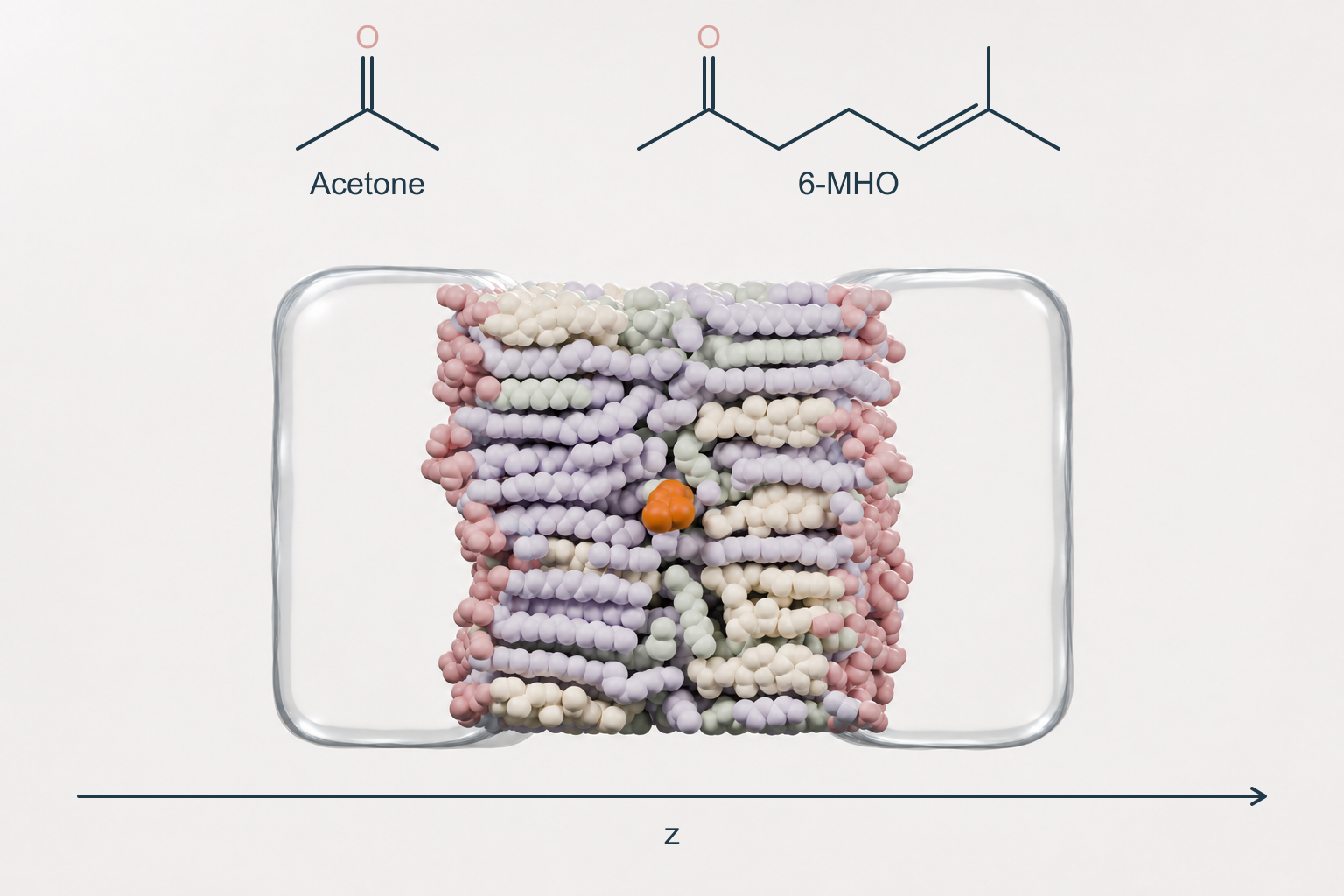
New rendering of simulations reported in Thomas et al. (2025).
The Skin Lipid Barrier
A mixture of ceramides, cholesterol, and fatty acids helps the outermost skin layer prevent water loss and limit chemical uptake. We simulate water and skin-oil oxidation products to understand where they accumulate, which barriers they encounter, and how readily they permeate. The resulting transport parameters inform models of dermal exposure and indoor chemistry.
A Moving Molecular Environment
Permeants form transient interactions and move through a membrane that continually fluctuates. Comparing fluid phospholipid membranes with skin lipids helps us determine how these rearrangements influence motion and when simplified diffusion models provide reliable permeability predictions.
Selected Reading
- Insights into Dermal Permeation of Skin Oil Oxidation Products from Enhanced Sampling Molecular Dynamics Simulation — Thomas et al., J. Phys. Chem. B (2025).
- Modeling Diffusion and Permeation Across the Stratum Corneum Lipid Barrier — Thomas et al., ACS ES&T Air (2026).