Main Content
Transport Modeling
How can we predict molecular transport reliably?
We develop methods that connect molecular trajectories with free energies, local mobilities, and transport predictions. The challenge is to identify a description that captures the relevant molecular processes at the right length and time scales.
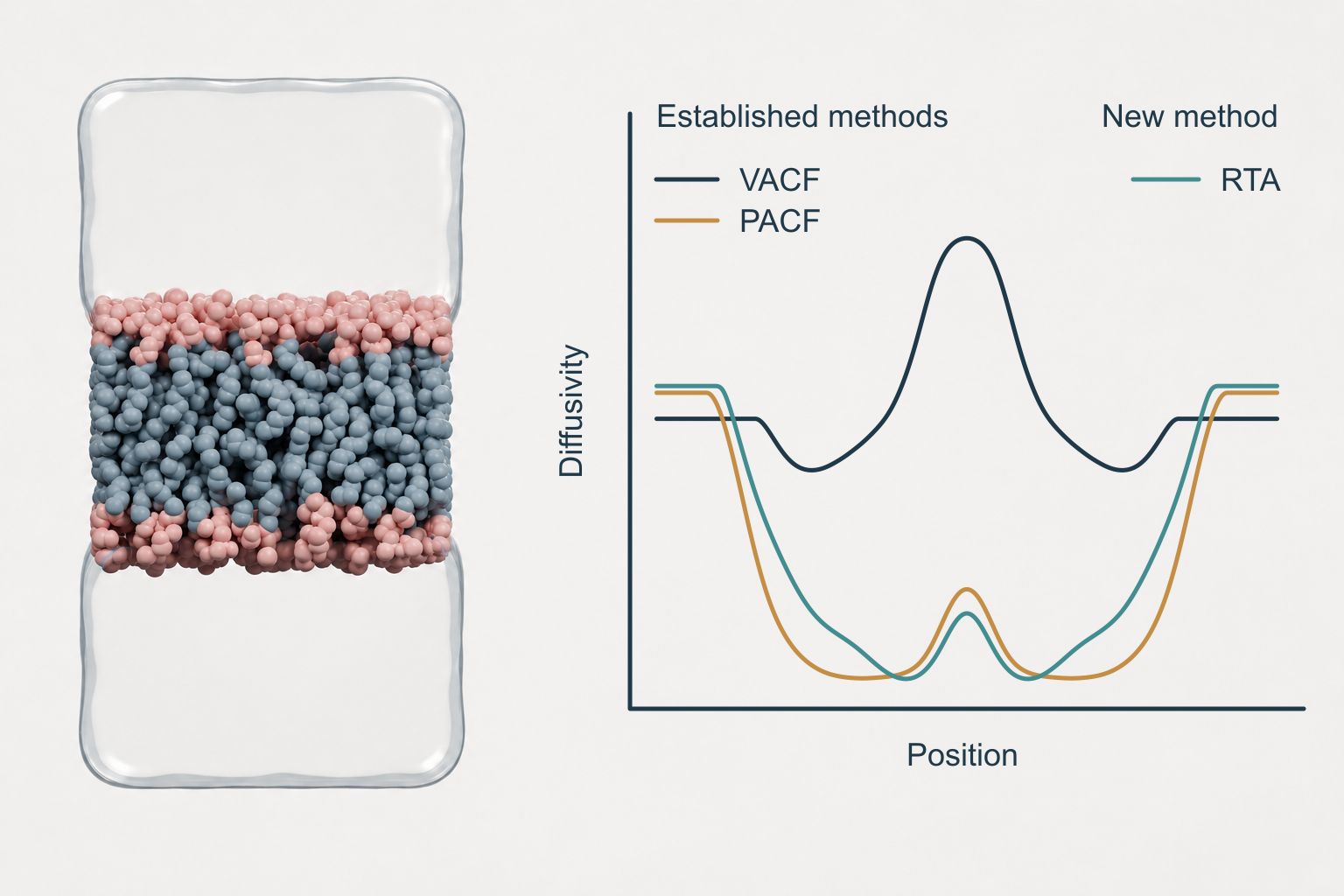
Based on Thomas et al. (2026), CC BY 4.0. Newly rendered and redrawn.
From Residence Times to Local Diffusion
Our residence-time approach (RTA) estimates diffusivity from the time a molecule takes to leave a small spatial interval in a biased simulation. We investigate how to choose the interval width, quantify uncertainty, and obtain reliable transport parameters.
Testing the Model
We compare model predictions with independent, unbiased simulations. These tests reveal when a local diffusion description works and when slow environmental rearrangements or directional motion require a richer model.
Our open-source library PDDA provides the analysis tools and worked examples.
Selected Reading
- A Residence-Time Approach for Determining Position-Dependent Diffusivities from Biased Molecular Simulations — Thomas et al., J. Chem. Theory Comput. (2026).
- Choosing Spatial Resolution in the Residence-Time Approach to Local Diffusivity — von Domaros et al., arXiv:2610.29703 (2026) [preprint].