Main Content
Political Will Formation
Political Education, Youth and Adult Education, Trade Union and Civic Education, Empowerment
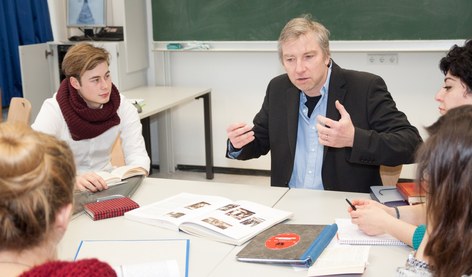
Shaping the will, education for the will. “Political parties and trade unions participate in shaping political will (…)”, as defined by the Basic Law. But this also means that political will can, may, should, and must be shaped in other places. Political education is not a matter of indulgence, but a constitutional mandate: that is why money flows into it and jobs are created here. How does information become knowledge, how does knowledge become opinion in the public sphere, how can the exchange of arguments and opinions lead to a common or even confrontational formation of will? Graduates from the political sciences, as professionals in theory-based discursive truth-finding, are always at the forefront of these jobs. They are accompanied by people from the historical sciences (“contemporary history”) as well as from specific areas of law (“human rights,” “international law,” “constitutional law”). Political scientists with sound historical knowledge and additional knowledge from the aforementioned areas of law therefore have expanded opportunities. Nevertheless, education itself is and remains the domain of the educational sciences. Methodology and didactics are also essential in political education. This knowledge can be borrowed from pedagogy, learned through practice (group work, presentations, defending a master’s thesis or doctorate), or expanded through specific continuing education and training (“train the trainer,” “moderating,” etc.).
Possible Tasks
-You develop educational concepts tailored to specific topics and target groups and conduct seminars, workshops, training courses, readings, lectures, information events, etc. In doing so, you use a variety of materials and different (digital and analog) learning and teaching methods.
-You conduct courses, seminars, and individual events on topics such as current political issues, political and social conflicts (anti-Semitism, racism, sexism, (economic) injustice, climate change, etc.), as well as reconciliation and conflict resolution/transformation. You broker knowledge and skills that enable people to reflect on their individual situations, make their own decisions, and influence societal processes in a constructive manner (political education).
-As a self-employed or freelance professional, you offer your educational repertoire to relevant actors in the public sphere (political parties, trade unions, foundations, think tanks) and educational institutions. You build networks with other educational providers within your subject area and with the organizations that request your services.Industries and Occupations
-Cities, municipalities, counties
-Political parties, trade unions/associations, think tanks, federal and state centers for political education
-Memorials, foundations, museums, and archives
-Educational centers, volunteer service providers
-Institutes offering Internet-based distance learning (e-learning)
-Conference centersJob Boards and Professional Associations
-WiLa-Arbeitsmarkt
-Deutscher Bildungsserver
-Arbeitskreis deutscher Bildungsstätten e.V.
-Stellenmarkt Bundesverband Deutscher Stiftungen
-Deutsches Institut für Erwachsenenbildung Leibniz-Institut für Lebenslanges Lernen e.V.
-Deutsches Institut für Erwachsenenbildung
-Stellenbörse der Bundesvereinigung Kulturelle Kinder- und Jugendbildung (BKJ) e.V.
-Institut für Internationale Zusammenarbeit des Deutschen Volkshochschulverbandes (dvv international)
-Arbeitsgemeinschaft Natur- und Umweltbildung Bundesverband e.V. (ANU)
-Bundesverband Deutscher Stiftungen
-Bundeszentrale für politische Bildung und Landeszentralen für politische Bildung