20.07.2026 Report - Canada Day 2026 - Resilient Communities
Renowned Canadian Poet, Novelist, and Visual Artist Shani Mootoo Speaks at High-Quality Canada Day 2026 Conference (July 3, 2026)
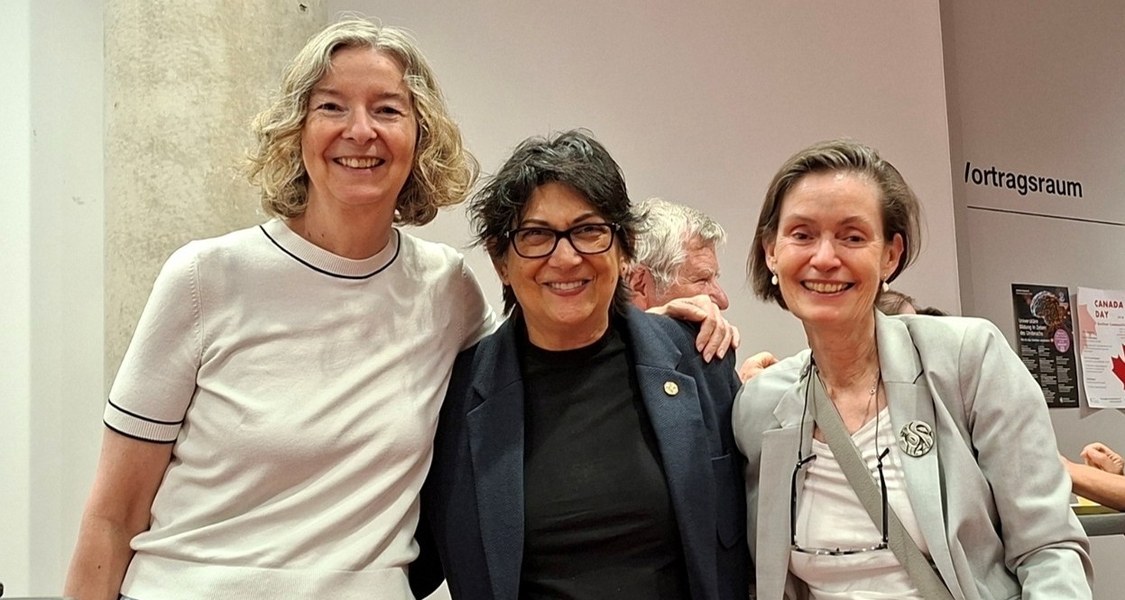
Amid shifting global dynamics, Canadian Prime Minister Mark Carney declares that “nostalgia is not a strategy” because “the old order is not coming back.” Canada, as he suggests, as one of the middle powers, must build[ ] what we claim to believe in.” As Prof. Dr. Carmen Birkle, current Executive Director of the Marburg Center for Canadian Studies, points out, these statements ask Canadians as well as many other nations “to resist and build resilient communities” to confront U.S. neo-imperial and authoritarian maneuvers both within Canada and across national borders. Prof. Dr. Nicole Waller’s (Potsdam) term “generative refusal” seems to capture the two-foldness in refusal to be, or become part of, settler colonial logics, while it, at the same time, generates a new understanding through dialog and conversation between Black and Indigenous Canadians. While this concept emerged in the context of Black and Indigenous studies, in its underlying structure it can also be applied to the creation of resilient communities communicating across gender, ethnic, and national borders. Waller complements this concept with Indigenous author Jeanne Simpson’s “blockades” as anti-colonial world-builders and, therefore, defines generative refusal as a “network of life-generating blockades.” Prof. Dr. Karina Vernon (Scarborough, Canada) picks up some of Waller’s cues, extends them to a “multi-species world, “including human and non-human actors, and takes her listeners to nineteenth-century prairie life and a focus on the Black cowboy figure, who has largely remained invisible in public perception. She adds questions of visibility and the need for the recognition, understanding, relevance, and analysis of popular culture because Black cowboys did not only build resilient communities on their cattle-herding trails following the bison from Texas to Canada, but they also sang Cowboy songs as a means of survival. These songs (collected by John A. Lomax in the early twentieth century) are important archives of knowledge about how those cowboys “told” their own stories in music. From Vernon’s talk, storytelling and voice emerge as significant pillars in resilient world-building and prove to be cornerstones of argumentation in the following presentations.
Dr. Matthias Dickert (Marburg Center for Canadian Studies) focuses on Muslim Canadians, who, as a large ethnic and religious group in Canada, are highly visible and have made storytelling a way to reach out across inner- and inter-religious borders. On the one hand, they claim to be proud of being Canadians; on the other hand, they, too, work with blockades as anti-colonial world-builders. This focus on community, collaboration, and regeneration is visible as well in Inuit poet Norma Dunning’s poetry, which Prof. Dr. Brigitte Glaser (Göttingen) discusses as one of resistance and refusal to be put into stereotypical boxes and as one of orientation toward the past but eventually also toward the future. Communication across ethnic and gender borders is an even stronger element in Indigenous Yvonne Johnson and Mennonite writer Rudy Wiebe’s collaboration in the writing of Johnson’s life story full of violence, abuse, and silencing. Johnson, as a convicted perpetrator, contacts Wiebe and asks him to collaborate in the composition of her own autobiography, which ultimately becomes Stolen Life. This result of collaboration, negotiations, compromises, and debates about whose voice is heard and in which way is what Dr. Anca-Raluca Radu (Göttingen) calls “survivance,” a term taken from Indigenous writer Gerald Vizenor. Once more generative refusal and the overcoming of blockades could be traced in this collaborative creation of a resilient community of Indigenous women, whom Johnson gives a voice while, at the same time, using autobiographical confession as a form of healing. Drag reality TV as popular culture is the focus of Marie Zarda’s (Philipps-Universität) presentation. The drag community, as she argues, offers a sense of belonging and safety in numbers, but also reveals the ambiguity in striving for visibility, which can be dangerous. Here, too, resilience is the result of collaboration, mutual respect, and the creation of an archive of knowledge. Shani Mootoo (Ontario, Canada) concludes the day with a beautifully written creative piece on “Our Planet, a Model of Resilience,” in which she refers back to Vernon’s idea of human-non-human relationships, presents bleak visions of wildlife species’ extinction, and suggests to read the changes of the earth as a memoir of resilience, which humans still need to learn to read. The planet’s storytelling is similar to humans’ need to tell stories about destruction, extinction, and war as a communal act of resistance and resilience. Mootoo points to communal actions in her final reference to the popular song “Rise Up” (1983) by the Canadian band Parachute Club, a song inspired by West Coast First Nations People and Caribbean music, which has become an anthem of freedom and equality. Mootoo ends on a tiny little bit of hope for resilient communities to make a difference in world survival.
Prof. Dr. Carmen Birkle