Hauptinhalt
Canada Day 2026 - Resilient Communities
In recent years, resilience has become a buzzword in Western societies because of the increasing rise of governments inspired by authoritarian power structures and inclined to claiming the protection of its citizens against threats that either do not exist or have been invented as coming from opponents’ perspectives. Moreover, those regimes work with people’s fears, rewrite history, and redefine language to suit their needs. The resulting political atmosphere is often full of xenophobia, racism, and anti-elitist sentiments that polarize groups against each other. The “us vs. them” narrative is a frequent factor in such a regime’s search for scapegoats. Looking at the current situation in North America, we notice the rise of authoritarianism, on the one hand, and the need for resistance and community-building, on the other hand. While the United States and Canada have turned from partners to opponents and Canada has to withstand U.S.-American aggression on a national basis, resilient communities have always also developed intra-nationally. In Canada, Québec demonstrates this as well as, for example, minority cultures such as African Canadians, First Nations People, Muslim Canadians, and queer communities.
The contributions to this Canada Day 2026 will look at selected communities in Canada in the course of its history – past, present, future – and will discuss their need for community-building, their resilience to do so, and their ways in which they do so. Contributions from all disciplines are invited – such as literary and cultural studies, historiography, political sciences, religious studies, gender studies as well as art history.
Program
| 13:30-13:45 | Opening Remarks by Prof. Dr. Carmen Birkle |
| 13:45-14:45 | Prof. Dr. Nicole Waller, University of Potsdam, Germany: “Beyond Settler Worlds: ‘Generative Refusal’ in the Work of Leanne Betasamosake Simpson and Wayde Compton” |
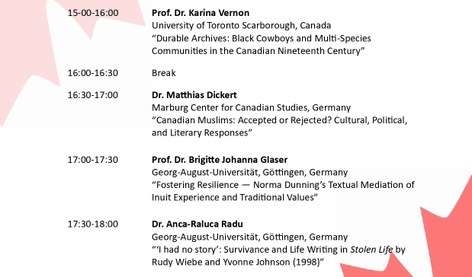
| 15-00-16:00 | Prof. Dr. Karina Vernon, University of Toronto Scarborough, Canada: “Durable Archives: Black Cowboys and Multi-Species Communities in the Canadian Nineteenth Century” |
| 16:00-16:30 | Break |
| 16:30-17:00 | Dr. Matthias Dickert, Marburg Center for Canadian Studies, Germany: “Canadian Muslims: Accepted or Rejected? Cultural, Political, and Literary Responses” |
| 17:00-17:30 | Prof. Dr. Brigitte Johanna Glaser, Georg-August-Universität, Göttingen, Germany: “Fostering Resilience — Norma Dunning’s Textual Mediation of Inuit Experience and Traditional Values” |
| 17:30-18:00 | Dr. Anca-Raluca Radu, Georg-August-Universität, Göttingen, Germany: “‘I had no story’: Survivance and Life Writing in Stolen Life by Rudy Wiebe and Yvonne Johnson (1998)” |
| 18:00-18:30 | Marie Zarda, Philipps-Universität Marburg, Germany: “Canadian Queer Communities on the Global Stage: Canada’s Drag Race as a Site of Identity Making” |
| 18:30-18:45 | Break |
| 18:45-19:45 | Shani Mootoo, Novelist and Visual Artist, Canada: “Our Planet, a Model of Resilience” |
| 19:45-20:00 | Discussion |
Please register via mail until June 29: birkle@uni-marburg.de