Hauptinhalt
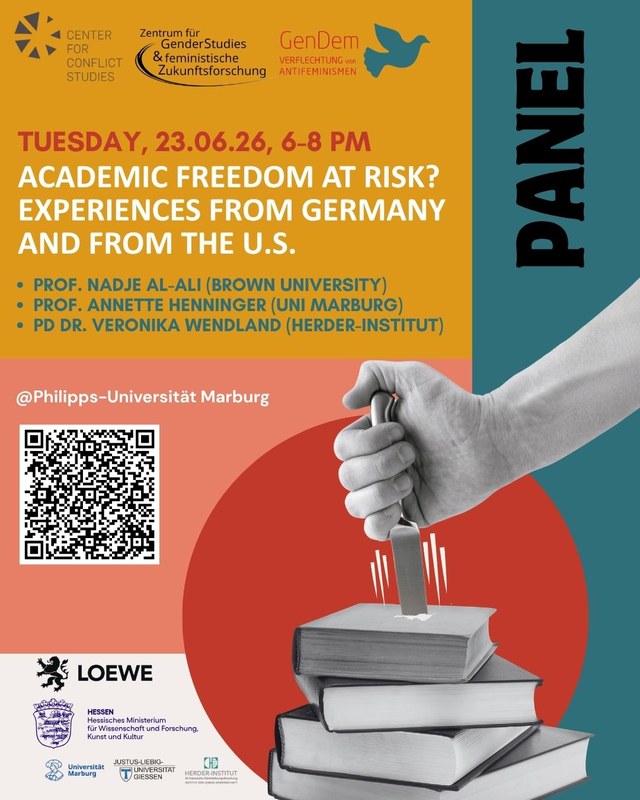
Academic Freedom at Risk? Experiences from Germany and from the U.S.
Veranstaltungsdaten
23. Juni 2026 18:00 – 23. Juni 2026 20:00
Termin herunterladen (.ics)
(Hörsaal) 107 (+1/0070), Ketzerbach 63, 35037 Marburg
Moderation: Prof. Susanne Buckley-Zistel, Center of Peace & Conflict Studies, Philipps-Universität Marburg
Panelists:
- Prof. Nadje Al-Ali, Robert Family Professor of International Studies, Professor of Anthropology and Middle East Studies, Brown University, P.A.
- Prof. Annette Henninger, Professor for Gender & Politics, Philipps-Universität Marburg
- PD Dr. Veronika Wendland, Lecturer for Modern History, Philipps-Universität Marburg & Research Coordinator, Herder Institute for Historical Research on Eastern Central Europe, Marburg
Academic freedom has come under intense pressure in what are often presented as liberal democratic contexts in both the U.S. and Germany. Yet the current moment is not simply about isolated controversies or individual cases. It points to broader transformations in the relationship between universities, the state, public discourse, and political power. From the crackdown on anti-war and Palestine solidarity protests to attacks on critical race theory, gender studies, and decolonial scholarship, universities have increasingly become key sites of political struggle and ideological policing.
This panel brings together perspectives from the U.S. and Germany to examine both the similarities and the important differences in how these pressures are unfolding. Rather than treating recent events as exceptional, we ask what they reveal about deeper anxieties surrounding dissent, public critique, and the limits of permissible speech within contemporary academic institutions. We are particularly interested in how scholars, students, and universities navigate growing pressures linked to nationalism, securitization, donor influence, media campaigns, and the policing of political expression. At the same time, the panel asks what forms of resistance, solidarity, and institutional responsibility are possible under these conditions. How can universities respond to mounting pressures without retreating into managerial caution or empty invocations of neutrality? What kinds of collective strategies, alliances, and infrastructures are needed to defend critical scholarship and public engagement today?
By placing the German and U.S. contexts into conversation, the panel seeks not only to diagnose the current conjuncture but also to think seriously about what is at stake for the future of academic life, critical inquiry, and democratic public culture more broadly.