Prof. Dr. Ulrich Tallarek
Separation and Interface Science,
Transport Phenomena
Department of Chemistry
Philipps-Universität Marburg
Hans-Meerwein-Strasse
35032 Marburg
Germany
Phone:
+49-(0)6421-28-25727
Fax: +49-(0)6421-28-22124
E-mail: tallarek@staff.uni-marburg.de
Current Research Activities
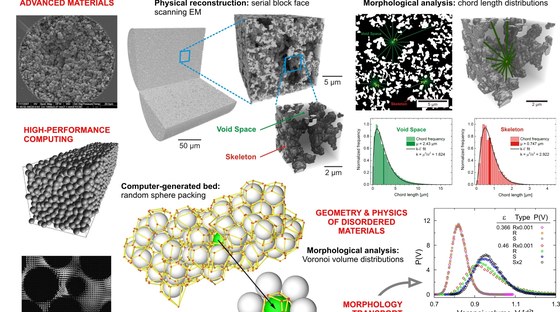
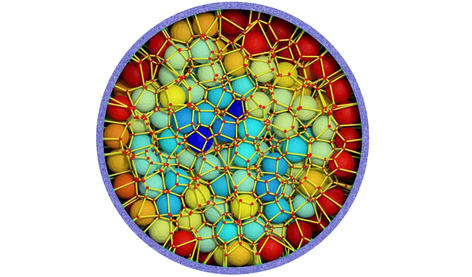
My current activities cover analytical and physico-chemical research on experimental, but also theoretical and numerical aspects of the electrokinetics and hydrodynamics in porous media, with emphasis on separation science. The investigated materials are patterned microchannels used, e.g., as integrated preconcentration units in microfluidic devices, or particulate adsorbents and monoliths confined by (non)cylindrical separation channels employed in nano- and microchip liquid chromatography and electrochromatography.
The approach followed by my group is to investigate closely related research topics with an increasing complexity with the goal of achieving a thorough understanding of phenomena relevant to hydrodynamic dispersion and analyte enrichment, migration, and retention. This comprises the reconstruction of the morphology of monoliths and confined particulate beds, as well as the characterization of the involved surfaces and interfaces, the transient and stationary dynamics of the fluid flow fields, as well as resulting hydrodynamic dispersion. We combine experimental chromatographic methods with direct imaging techniques and advanced numerical simulation approaches (and high-performane computing) for complementary identification and analysis of the underlying key transport phenomena. Gained knowledge on how microscopic structural details and mesoscopic interrelations affect molecular transport allows us to better analyze, understand, and optimize separations observed on a macroscopic scale.
Key Words: Separation science; Transport
phenomena; Quantitative structure-transport relations; High-performance
computing; Microfluidics; Microchip-HPLC; Nanoelectrospray;
Electrophoresis; Electrochromatography; Simulation of mass and charge
transport; Reconstruction of porous media;
Monoliths.
Collaborations: Prof. Richard M. Crooks (The University of Texas at Austin): Preconcentration, separation, and detection on microfluidic devices; Prof. Andreas Seidel-Morgenstern (Max-Planck-Institute for Dynamics of Complex Technical Systems, Magdeburg): Large-scale simulation of flow and transport in reconstructed porous media; Agilent Technologies (Waldbronn): Microchip-HPLC.
Brief Biography
● 1988-1994: Diplom-Chemiker (Eberhard-Karls-Universität, Tübingen, Germany)
● 1994-1998: Dr. rer. nat., Thesis: Fluid dynamics in chromatography studied by nuclear magnetic resonance (summa cum laude), Advisors: Prof. Dr. Ernst Bayer (Institute of Organic Chemistry, Eberhard-Karls-Universität Tübingen) and Prof. Dr. Georges Guiochon (Department of Chemistry, The University of Tennessee, Knoxville, and Oak Ridge National Laboratory)
● 1998-2000: EU Marie Curie Postdoctoral Fellow (Department of Molecular Physics, Wageningen University & Research Centre, Wageningen, The Netherlands)
● 2000-2007: Assistant Professor, later Juniorprofessor (Otto-von-Guericke-Universität, Magdeburg, Germany)
● 2000-2004: Dr. rer. nat. habil. (venia legendi for Physical Chemistry), Thesis: Electrokinetic flow and transport in porous media: experimental methods, numerical analysis, and applications, Mentor: Prof. Dr. Andreas Seidel-Morgenstern (Institute of Chemical and Process Engineering, Otto-von-Guericke-Universität Magdeburg, and Max-Planck-Institute for Dynamics of Complex Technical Systems, Magdeburg)
● 2003: Desty Prize for Innovation in Separation Science, The Royal Institution of Great Britain, London
● 2006: Young Scientist Award from DECHEMA e.V. (the prize is based on cutting-edge research combined with over-average teaching skills)
● Since 2007: Professor for Analytical Chemistry, Department of Chemistry, and Board of Directors, Materials Science Center, Philipps-Universität Marburg