14.07.2026 250-year anniversary of the Declaration of Independence
250-Year Anniversary of the Declaration of Independence, and Now What?
On July 4, 2026, the United States of America celebrates the 250th anniversary of the Declaration of Independence, signed in 1776 in Philadelphia. This Declaration was communicated to the public on July 8, accompanied by the ringing of the famous Liberty Bell that carries the inscription from the Bible “Proclaim Liberty throughout all the land unto all the inhabitants thereof.” The Declaration of Independence declares that “all men are created equal” and marks the inalienable rights of “life, liberty, and the pursuit of happiness,” and emphasizes the government’s need for the consent of the people, who also have the right to protest and change it if the consent has been abused. For the time, this was radical and revolutionary because a colony declared its independence from the power of the British monarchy. Yet, it was also utopian in nature because it described ideas in theory that were not practiced, such as “all men” who did not yet include minorities and women, and the writers of the Declaration were slave holders themselves. It has taken almost 250 years for some of these rights to be at least legally implemented, but the United States remains an unfinished project in progress since justice and equality for all has not yet been achieved and has become even more precarious under the current U.S. government leaning toward authoritarianism and backlashing against progress made in the past.
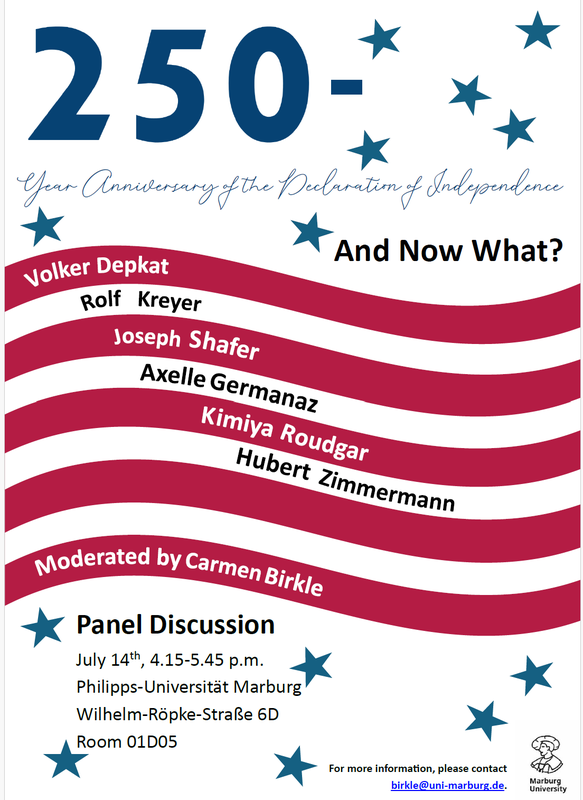
In this interdisciplinary and international panel, we will analyze the relevance and the many meanings of the Declaration then and, above all, now. In which way is it still a “promissory note,” as Martin Luther King, Jr., famously proclaimed in 1963? Or is it rather a “bad check” that come back marked “insufficient funds”? Scholars from History, Political Science, Literary and Cultural Studies, and Linguistics will shed light on what it means today to acknowledge and celebrate the 250 years of the Declaration of Independence and where it will lead from here.
Scholars on the panel are: Prof. Dr. Volker Depkat (American History, Universität Regensburg), Dr. Axelle Germanaz (American Literary and Cultural Studies, Philipps-Universität Marburg), Prof. Dr. Rolf Kreyer (Linguistics, Philipps-Universität Marburg), Kimiya Roudgar (MA Student in North American Studies, Philipps-Universität Marburg), Dr. Joseph Shafer (British and American Studies, Philipps-Universität Marburg), Prof. Dr. Hubert Zimmermann (Political Science, Philipps-Universität Marburg). Moderation: Prof. Dr. Carmen Birkle (Philipps-Universität Marburg).