Main Content
Components and Characterization of All-Solid-State Batteries
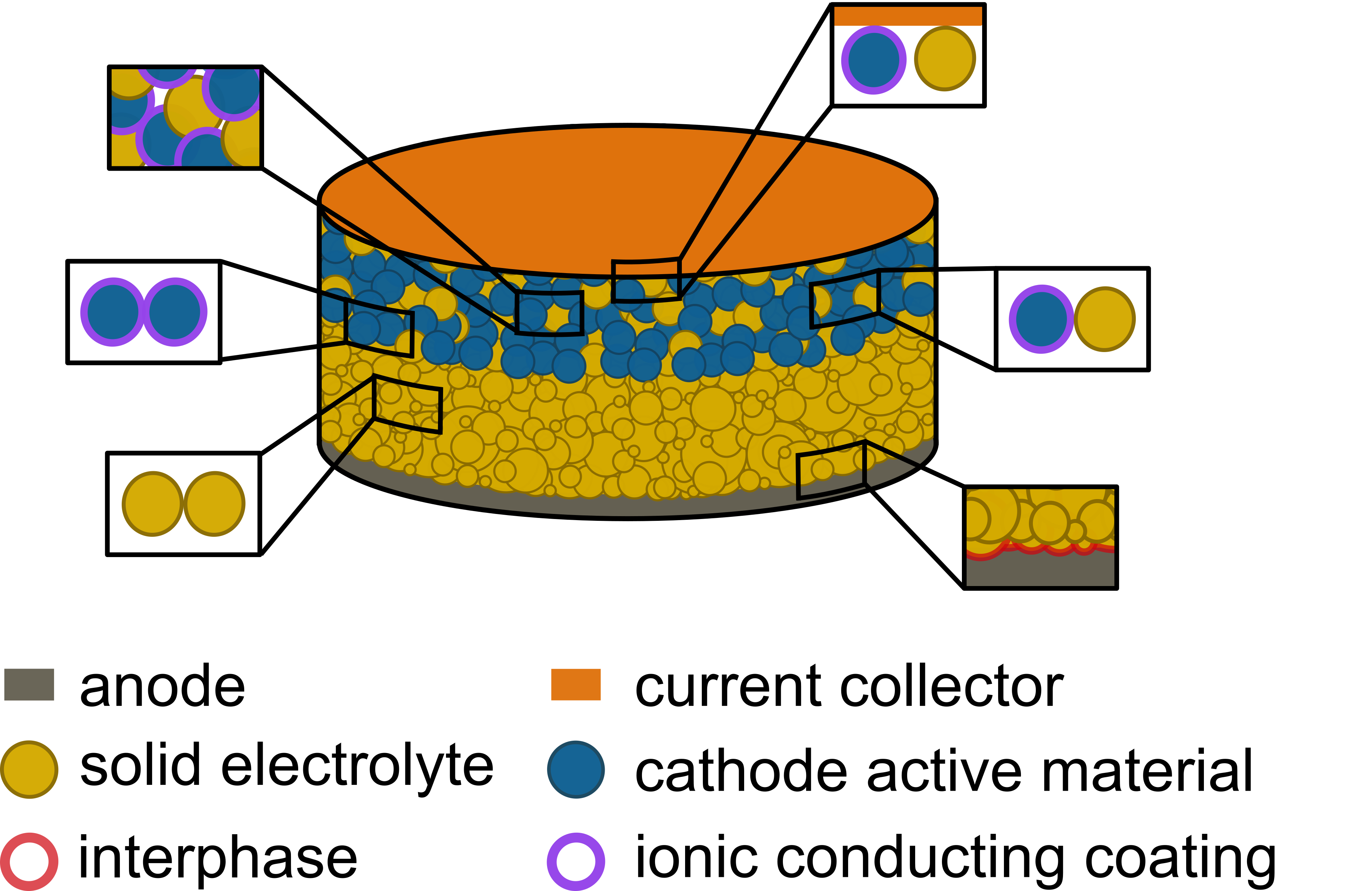
Like commercial Lithium-ion batteries, all-solid-state batteries consist of an anode, a cathode and an electrolyte. The electrolyte is a solid and also serves as a separator. The cathode is often a composite consisting of active material particles and solid electrolyte particles. There are various interfaces within all-solid-state batteries: (i) interfaces between active material particles and solid electrolyte particles within the cathode; (ii) interfaces between the solid electrolyte particles within the separator; (iii) interfaces between the anode and the separator. In order to improve particle-particle contacts and to minimize interfacial impedances, all-solid-state batteries are often cycled at large external pressures. In our working group, we study the individual components of all-solid-state battery, and we work on the characterization of electrodes as well as of complete all-solid-state batteries. Electrochemical measurements are carried out in two-electrode and three-electrode setups under variable fabrication and stack pressures
Composite Cathode
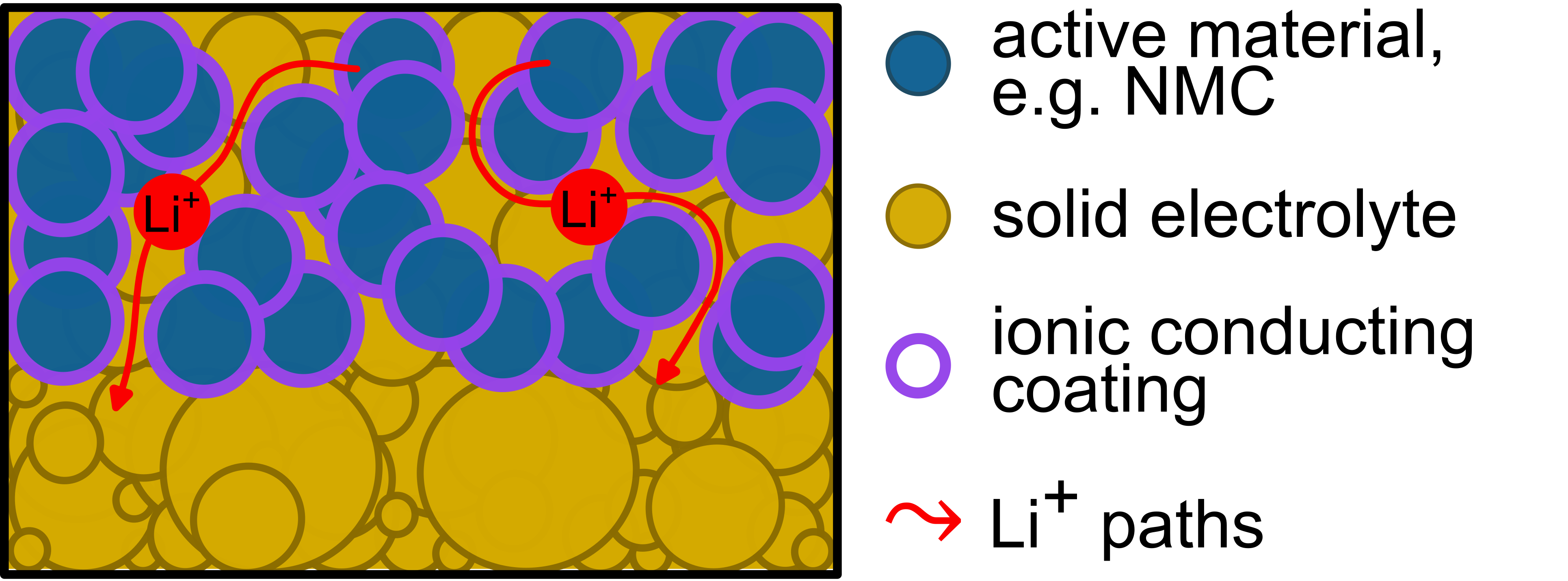
In composite cathodes, both Li+ ion transport in the solid electrolyte phase and electron transport in the cathode active material phase has to be optimized. To this end, we investigate various combinations of solid electrolytes and cathode active materials. The active material particles can be coated with a thin ion conductive film (e.g. LiNbO3) in order to prevent oxidation of the solid electrolyte particles inside the cathode. We study transport-porosity-pressure relationships in composite cathodes by using home-built and commercial measurements setups with pressure control.
Solid Electrolytes
Solid electrolytes (SE) are advantageous over liquid electrolytes in terms of safety (less flammable and no battery leakage) and versatility (operation of batteries at elevated temperatures). Different classes of SEs are investigated with regard to their applicability in all-solid-state batteries: oxide-based electrolytes, polymer-based electrolytes, halide-based electrolytes and sulfide-based electrolytes
In our working group, we are particularly interested in halide-based electrolytes, such as Li3YCl6, and in sulfide-based solid electrolytes, such as Li6PS5Cl. In the field of sulfide-based solid electrolytes, we synthesize amorphous, glass-ceramic and crystalline materials by means of mechanochemical and solid-phase synthesis methods. We characterize the solid electrolyte with regard to its structure and lithium-ion conductivity.
Contact Person
Highlighted Publications:
- V. Miß, S. Neuberger, E. Winter, J. O. Weiershäuser, D. Gerken, Y. Xu, S. Krüger, F. di Capua, M. Vogel, J. Schmedt auf der Günne, B. Roling, 'Heat Treatment-Induced Conductivity Enhancement in Sulfide-Based Solid Electrolytes: What is the Role of the Thio-LISICON II Phase and of Other Nanoscale Phases?', Chem. Mater. 34 (2022), 7721–7729. doi: 10.1021/acs.chemmater.2c00908
- M. Cronau, M. Szabo, C. König, T. B. Wassermann, B. Roling, 'How to Measure a Reliable Ionic Conductivity? The Stack Pressure Dilemma of Microcrystalline Sulfide-Based Solid Electrolytes', ACS Energy Letters 6 (2021), 3072–3077. doi: 10.1021/acsenergylett.1c01299
- V. Miß, S. Seus, A. Marx, E. D. Steyer, V. Mereacre, J. R. Binder, B. Roling, 'Influence of Pressure, Particle Morphology, Coating, and Heat Treatment on the Effective Electronic Conductivity of Cathode Active Materials for All-Solid-State Batteries', ACS Materials Lett. 7 (2025), 2262–2269. doi: 10.1021/acsmaterialslett.4c02595
- C. König, V. Miß, L. Janin, B. Roling, 'Mitigating the Ion Transport Tortuosity in Composite Cathodes of All-Solid-State Batteries by Wet Milling of the Solid Electrolyte Particles', ACS Appl. Energy Mater. 6 (2023), 9356–9362. doi:10.1021/acsaem.3c01242
- S. Puls, ..., V. Miß, ..., B. Roling, ..., N. M. Vargas-Barbosa, 'Benchmarking the reproducibility of all-solid-state battery cell performance', Nature Energy 9 (2024), 1310–1320. doi:10.1038/s41560-024-01634-3