Main Content
Publications 2026
234. F. Tagarelli, E. Lopriore, C. de Giorgio, D. Erkensten, R. Perea-Causin, S. Brem, K. Watanabe, T. Taniguchi, E. Malic, A. Kis, “Fast interlayer exciton drift driven by lattice reconstruction in a van der Waals heterobilayer”, Nature Materials (2026)
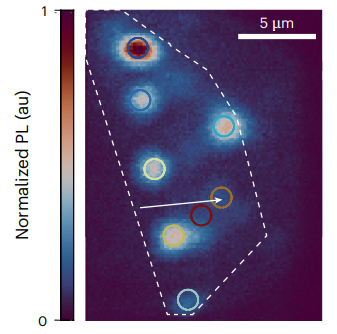
Modern short-scale information transmission mainly relies on dissipative charge transport, with electrons scattered by defects and phonons, leading to significant power losses. By contrast, excitons—charge-neutral quasiparticles—offer a playground for electro-optical energy-efficient information transduction and processing owing to their extended lifetimes, charge neutrality and efficient electrostatic control. In this work, we report the observation of fast exciton transport in a van der Waals heterostructure over distances exceeding 10 µm, constrained only by the heterostructure finite size. We observe the presence of excitonic potential ramps that leads to long-range rapid exciton drift and enables rapid dilution of the initial exciton population. Our measurements reveal fast exciton propagation, with interlayer exciton drift velocities of approximately 2.66 × 10⁴ m s−1, within a transport regime that remains robust across a wide range of exciton densities and temperatures up to 150 K. Our work opens avenues for the development of high-speed, energy-efficient excitonic devices, such as field-effect switches and modulators.
Nature Materials (2026)233. S. Shradha, R. Rosati, H. Lamsaadi, J. Picker, I. Paradisanos, Md T. Hossain, L. Krelle, L. F. Oswald, N. Engel, D. I. Markina, K. Watanabe, T. Taniguchi, P. K. Sahoo, L. Lombez, X. Marie, P. Renucci, V. Paillard, J.-M. Poumirol, A. Turchanin, E. Malic, B. Urbaszek, "2D Excitonics with Atomically Thin Lateral Heterostructures", Reports on Progress in Physics 89, 4 (2026)
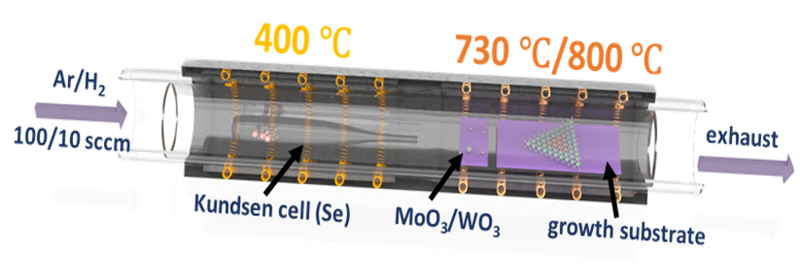
Semiconducting transition metal dichalcogenides (TMDs), such as MoSe2 and WSe2, exhibit unique optical and electronic properties. Vertical stacking of layers of one or more TMDs, to create heterostructures, has expanded the fields of moiré physics and twistronics. Bottom-up fabrication techniques, such as chemical vapor deposition, have advanced the creation of heterostructures beyond what was possible with mechanical exfoliation and stacking. These techniques now enable the fabrication of lateral heterostructures, where two or more monolayers are covalently bonded in the plane of their atoms. At their atomically sharp interfaces, lateral heterostructures exhibit additional phenomena, such as the formation of charge-transfer excitons, in which the electron and hole reside on opposite sides of the interface. Due to the energy landscape created by differences in the band structures of the constituent materials, unique effects such as unidirectional exciton transport and excitonic lensing can be observed in lateral heterostructures. This review outlines recent progress in exciton dynamics and spectroscopy of TMD-based lateral heterostructures and offers an outlook on future developments in excitonics in this promising system.
Reports on Progress in Physics 89, 4 (2026)232. B. Kirubasankar, A. Mondal, S. Joon Yun, D. Daw, Y. Xu, L.-A. T. Nguyen, Y. Koo, K. Kumar Paul, H. Hong, H. Lee, Y. Luo, K. Liu, N. Higashitarumizu, D. Erkensten, C. Yun Heo, Y.-R. Jeon, T. Lee, D.-H. Nam, X. Liu, S. M. Kim, D. L. Duong, Q. Wu, D. Akinwande, M. C. Hersam, A. Javey, E. Malic, B. Liu, T. Zhai, H. Yang, K.-D. Park, K. K. Kim, and Y. H. Lee, "Contemporary Challenges in van der Waals 2D Semiconductors", ACS Nano 20, 3228 (2026)
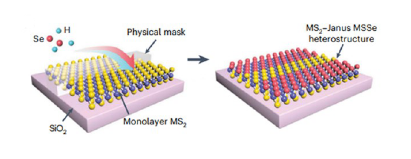
Van der Waals (vdW) layered semiconductors have emerged as a unique class of quantum materials distinguished from their bulk counterparts by reduced dielectric screening, strong Coulomb interactions, large exciton binding energies, strong spin− orbit coupling, and pronounced thickness-dependent band structures. These fundamental attributes have enabled the exploration of exotic many-body physics and a broad spectrum of device applications, ranging from field-effect transistors and ferroelectric switches to optoelectronics, magnetic semiconductors, neuromorphic computing, and energy harvesting systems. Despite remarkable advances, critical challenges remain in the controlled synthesis of high-quality crystals, formation of low-resistance contacts, integration of stable and scalable gate dielectrics, and reliable device performance at the wafer scale. In this mega-review, we provide a comprehensive overview of contemporary challenges and future opportunities in vdW-layered semiconductors, structured across nine themes: growth and heterostructures of transition metal dichalcogenides, Ohmic contacts, emerging gate dielectrics, high-performance low-power field-effect transistors (FETs), diluted magnetic semiconductors, plasmonics and exciton propagation, hot-carrier solar cells, bioinspired neuromorphic computing, and electrocatalytic/photocatalytic energy conversion. By consolidating fundamental insights and device-level perspectives, this review aims to chart a roadmap for advancing vdW semiconductors from laboratory-scale discoveries to transformative technologies in electronics, optoelectronics, spintronics, and sustainable energy systems.
ACS Nano 20, 3228 (2026)231. D. Vaquero, C. A. Cordero-Silis, D. Erkensten, R. Rosati, M. H. Takens, K. Watanabe, T. Taniguchi, E. Malic, M. H. D. Guimaraes, "Valley-controlled many-body exciton interactions in monolayer WSe2 phototransistors", Nano Letters 26, 6641 (2026) selected for the cover page
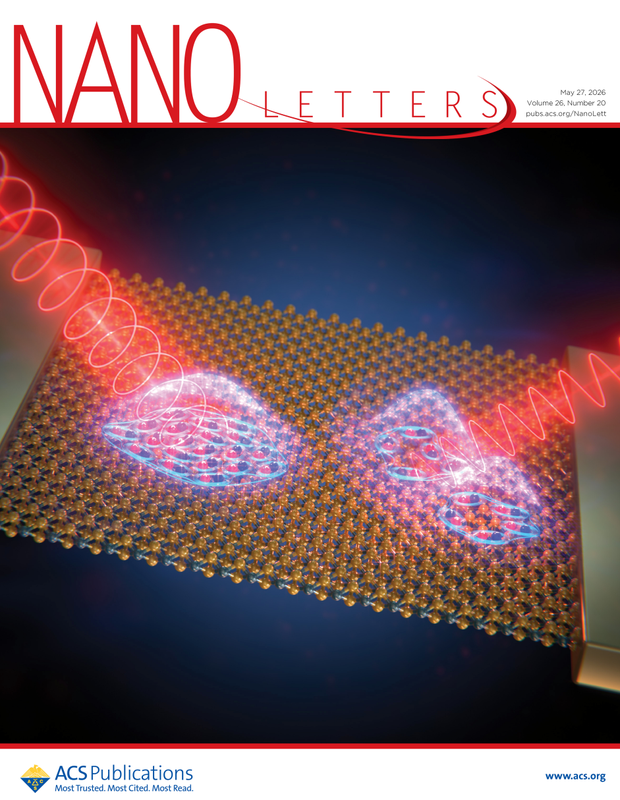
Many-body exciton interactions shape the optoelectronic response of atomically-thin transition metal dichalcogenides, yet optical control of these interactions remains largely unexplored. To date, modulation of exciton-exciton interactions has primarily relied on electrical gating or van der Waals engineering. Here, we demonstrate all-optical control of many-body exciton interactions in monolayer WSe2 via valley-selective excitation using polarization-resolved pulsed-laser photocurrent spectroscopy. Circular excitation selectively populates excitons in a single valley, whereas linear excitation populates both valleys, inducing a valley-dependent nonlinear photoresponse. We observe helicity-dependent exciton renormalization, alongside a two-fold enhancement of sublinear photocurrent scaling under circular excitation, reflecting single-valley population of interacting excitons. A microscopic model incorporating intervalley-exchange and exciton-exciton annihilation mediated by dark and bright exciton populations reproduces the nonlinear valley-selective response. These results establish the valley degree of freedom as an all-optical control parameter for tuning many-body excitonic effects and, exploring correlated exciton states and valleytronic applications in two-dimensional semiconductors.
Nano Letters 26, 6641 (2026)230. R. Rosati, J. K. König, S. Terres, J. J. P. Thompson, M. Baranowski, P. Płochocka, A. Chernikov, E. Malic, "Microscopic Insights into Magneto-optics and Magneto-transport in 2D Perovskites", Nano Letters 26, 5468 (2026)
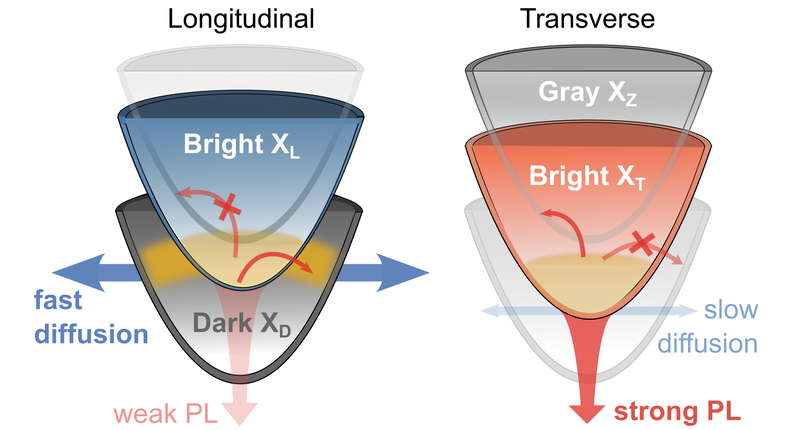
Two-dimensional (2D) perovskites host tightly bound excitons with a fine structure shaped by spin–orbit coupling and exchange interaction. In the prototypical 2D perovskite, (PEA)2PbI4, the dark exciton lies below two bright excitons and a gray state. In-plane magnetic fields split the bright excitons, polarize them longitudinally (L) and transversely (T) to the field, and hybridize them with gray and dark states, respectively. The impact of magnetic fields on exciton emission and diffusion has remained largely unexplored. Here, we investigate time- and temperature-resolved magneto-optics and magneto-transport of excitons in (PEA)2PbI4. We demonstrate that magnetic fields enhance emission from XT excitons and accelerate the transport of XL states. We trace this back to suppressed scattering of XT states into dark excitons, while XL states form highly mobile hot dark excitons. The acquired microscopic insights offer guidance for experimental studies on magneto-optics and magneto-transport in layered perovskites.
Nano Letters 26, 5468 (2026)229. G. Meneghini, M. Löwe, R. Perea-Causin, J. P. Bange, W. Bennecke, M. Reutzel, S. Mathias, E. Malic, "ARPES signatures of trions in van der Waals materials", Nano Letters 26, 5866 (2026)
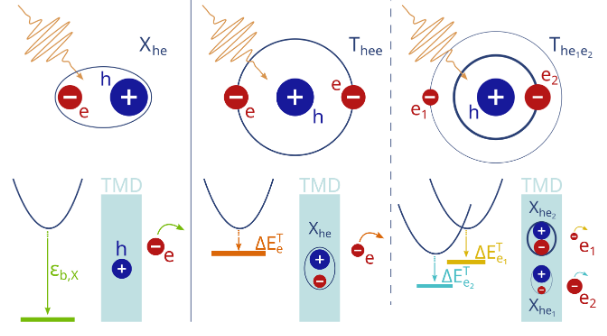
Angle-resolved photoemission spectroscopy (ARPES) has recently emerged as a direct probe of excitonic correlations in two-dimensional semiconductors, resolving their dispersion and dynamics in energy-momentum space, including dark exciton states inaccessible to optical techniques. However, the ARPES fingerprint of charged excitons (trions), which plays a key role in all doped and gated 2D material systems, has remained unknown so far. We present a first theoretical analysis of trion signatures in monolayer transition-metal dichalcogenides, highlighting how the additional charge carrier modifies the spectral position and shape relative to neutral excitons in ARPES spectra. Interestingly, we further predict that mass-imbalanced trions yield a characteristic double-peak structure, clearly separated in energy and line shape from neutral excitons. The predicted temperature dependence of these features offers guidance for experimental investigations aimed at identifying trionic states, thereby establishing a framework for ARPES studies of many-body Coulomb complexes in doped two-dimensional semiconductors.
Nano Letters 26, 5866 (2026)228. D. Erkensten, A. Chernikov, E. Malic, "Impact of an electron Wigner crystal on exciton propagation", Nano Letters 26, 5002 (2026)
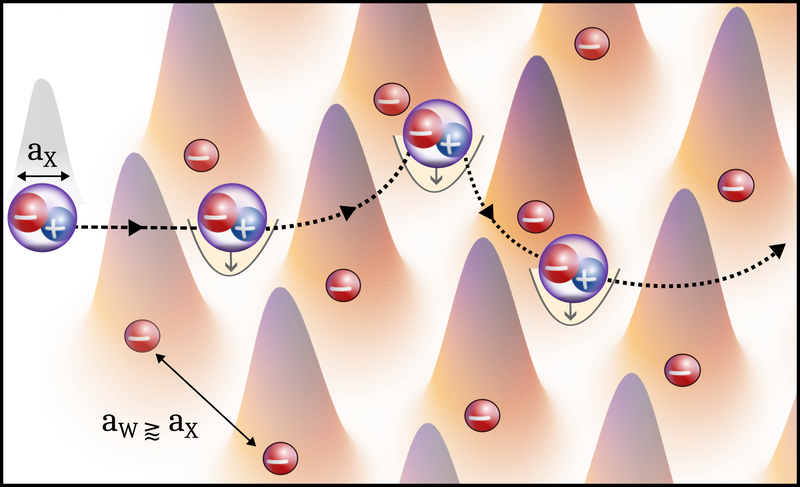
The strong Coulomb interaction in 2D materials facilitates the formation of tightly bound excitons and charge-ordered phases of matter. A prominent example is the formation of a crystalline phase from free charges due to mutual Coulomb repulsion, known as the Wigner crystal. While exciton- electron interactions have been used as a sensor for Wigner crystallization, its impact on exciton properties has been poorly understood so far. Here, we show that the weak potential induced by periodically ordered Wigner crystal electrons has a major impact on exciton propagation, albeit having only a minor influence on exciton energy. The effect is tunable with carrier density determining the Wigner crystal confinement and temperature via thermal occupation of higher subbands. Our work provides microscopic insights into the interplay between excitons and charge-ordered states identifying key signatures in exciton transport, and establishes a theoretical framework for understanding exciton propagation in the presence of strong electronic correlations.
Nano Letters 26, 5002 (2026)227. P. Werner, W. Bennecke, J. P. Bange, G. Meneghini, D. Schmitt, M. Merboldt, A. M. Seiler, A. AlMutairi, K. Watanabe, T. Taniguchi, G. S. Matthijs Jansen, J. Liu, D. Steil, S. Hofmann, R. Thomas Weitz, E. Malic, S. Mathias, M. Reutzel "The role of non-equilibrium populations in dark exciton formation", Physical Review Letters 136, 186903 (2026)
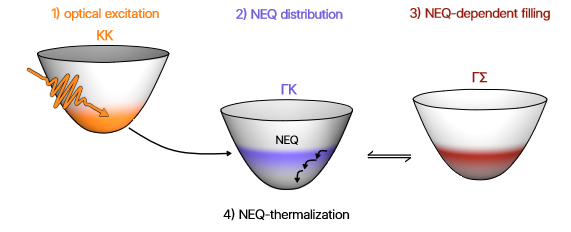
In two-dimensional transition metal dichalcogenide structures, the optical excitation of a bright exciton may be followed by the formation of a plethora of lower energy dark states. In these formation and relaxation processes between different exciton species, non-equilibrium exciton and phonon populations play a dominant role, but remain so far largely unexplored as most states are inaccessible by regular spectroscopies. Here, on the example of homobilayer 2H-MoS, we realize direct access to the full exciton relaxation cascade from experiment and theory. By measuring the energy- and in-plane momentum-resolved photoemission spectral function, we reveal a distinct fingerprint for dark excitons in a non-equilibrium excitonic occupation distribution. In excellent agreement with microscopic many-particle calculations, we quantify the timescales for the formation of a non-equilibrium dark excitonic occupation and its subsequent thermalization to 85~fs and 150~fs, respectively. Our results provide a previously inaccessible view of the complete exciton relaxation cascade, which is of paramount importance for the future characterization of non-equilibrium excitonic phases and the efficient design of optoelectronic devices based on two-dimensional materials.
Physical Review Letters 136, 186903 (2026)226. J. K. König, J. M. Fitzgerald, D. Erkensten & E. Malic, "Exciton polariton-polariton interactions in transition-metal dichalcogenides", npj 2D Materials and applications 10, 71 (2026)
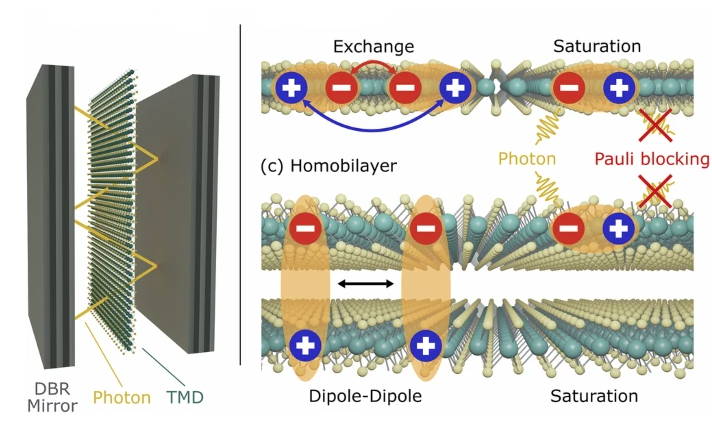
Microscopic insights into nonlinear interactions are essential for advancing polaritonic devices. Existing studies often rely on phenomenological models that overlook important many-body processes. Based on a material-specific and predictive approach, we investigate monolayer and homobilayer MoS2 embedded in a Fabry-Pérot cavity to characterize the exchange, saturation, and dipole-dipole contributions to polariton-polariton interactions in these technologically promising materials. A key finding is that the exchange interaction induces asymmetric energy shifts of the lower and upper polariton branches in a detuned cavity, a behavior driven by the difference in their excitonic character. Furthermore, we demonstrate that temperature and electron-photon coupling determine the energy renormalization through the equilibrium polariton distribution. In homobilayers, the dipole-dipole interaction is mediated by the interlayer character, enabling electrical control and facilitating the electric-field-induced closing of anti-crossings due to dipolar-interaction shifts. The gained insights on polariton-polariton interactions are important for the development of ultra-compact polaritonic circuitry.
npj 2D Materials and applications 10, 71 (2026)225. E. P. Kraus, J. M. Fitzgerald, C. Maciel-Escudero, and E. Malic “Engineering strong coupling in ultra-compact photonic crystal/2D material platforms”, Optics Express 15, 27977 (2026)
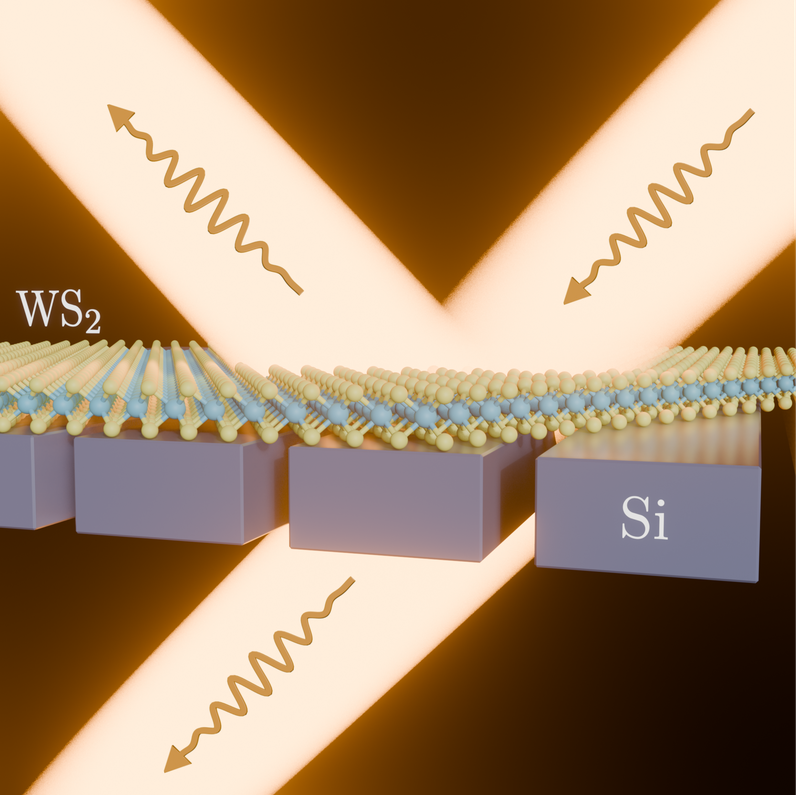
Sub-wavelength-thick photonic crystal (PhC) slabs coupled to 2D excitonic materials, such as transition metal dichalcogenides (TMDs), are a promising platform for highly tunable, room-temperature, on-chip optoelectronic devices. Unlike conventional Fabry-Pérot microcavities, these compact open cavities exhibit non-trivial electric field profiles, leading to spatially distinct regions of weak and strong coupling with excitons within the PhC unit cell. Using coupled-mode theory and rigorous solutions to Maxwell’s equations, we investigate how the PhC geometry can be used to control these coexisting exciton/polariton contributions and tailor the resulting optical spectra. For large filling factors, i.e., small air gaps, we show that PhC polaritons can be modeled as dark waveguide modes brightened via the periodicity of the PhC slab. Furthermore, by spatially patterning the TMD monolayer based on the local field intensity, we reveal the simultaneous presence of excitons in both the weak and strong coupling regimes. Overall, this work provides fundamental insights into the strong light-matter coupling regime in structured photonic environments, offering a pathway to design and optimize metal-free, ultra-compact polaritonic devices.
Optics Express 15, 27977 (2026)224. R. Rosati, M. A. A. Nouh, R. Schmidt, R. Bratschitsch, E. Malic, "Strain engineering of transient exciton diffusion in WSe2 monolayers at cryogenic temperatures", accepted by Phys. Rev. B, selected as Editor's suggestion (2026)
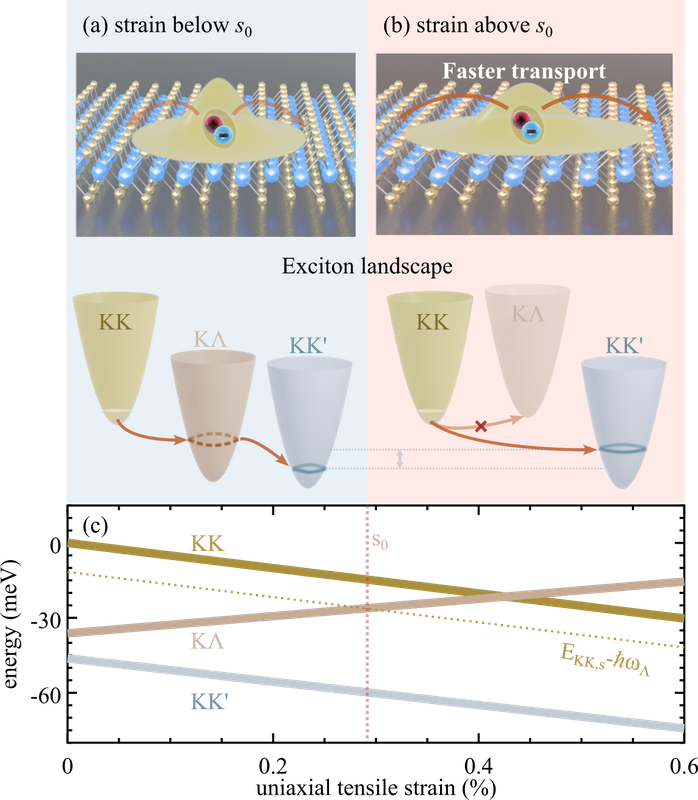
Tungsten-based transition metal dichalcogenides exhibit dark excitons as the energetically lowest states. These are crucial for exciton thermalization and propagation and they dominate low-temperature photoluminescence via the emergence of pronounced phonon sidebands. After a resonant excitation, highly mobile hot dark excitons are formed, which quickly thermalize into an equilibrium distribution. The application of strain modifies the exciton energy landscape and, in particular, the relative energy separation between bright and dark exciton states. The impact of strain on the transient photoluminescence and diffusion of non-equilibrium excitons has remained largely unexplored so far. In this work, we investigate the spatiotemporal exciton dynamics in strained hBN-encapsulated WSe2 monolayers at cryogenic temperatures. We demonstrate that tensile strain abruptly increases the excess energy of hot excitons, thereby accelerating their transient diffusion. We trace this back to suppressed phonon-mediated scattering from bright to dark excitons. Furthermore, we predict a periodic modulation of the transient exciton diffusion in the presence of a compressive strain resulting from strain-driven emission of M phonons. The gained microscopic insights illustrate how strain can be used to engineer transient photoluminescence and exciton diffusion in technologically promising 2D semiconductors.
accepted by Phys. Rev. B, selected as Editor's suggestion (2026)223. K. Sonowal, D. Erkensten, E. Malic, R. Rosati “Coulomb-mediated interactions of charge-transfer excitons in TMD lateral heterostructures”, Phys. Rev. B 114, L171407 (2026)
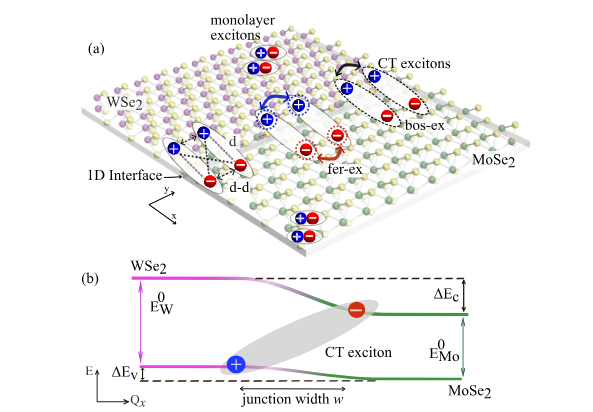
Lateral heterostructures of transition-metal dichalcogenides (TMDs) host spatially separated charge-transfer (CT) excitons. While analogous to interlayer excitons in vertical TMD heterostructures, these interfacial excitons possess much larger in-plane dipoles of several nanometers and an additional center-of-mass quantization. Here, we study the mutual interactions between these highly dipolar CT excitons on a microscopic footing. Accounting for the dipolar and quantum exchange interactions, we evaluate the experimentally accessible density-dependent energy renormalization and predict a net energy blueshift of a few meV for bound CT excitons. Interestingly, for small dipole moments, the energy renormalization displays a quadratic dependence with respect to the dipole moment, in contrast to the linear dependence found in vertical TMD heterostructures. We show that spatial energy offset and temperature are the key tuning knobs for controlling the density-dependent excitonic response. Overall, our results contribute to a better microscopic understanding of CT excitons and their interactions in lateral TMD heterostructures.
Phys. Rev. B 114, L171407 (2026)222. Y. Koo, H. Lee, D. Erkensten, E. Malic and K.-D. Park „Plasmonic and Exciton Propagation in 2D Transition Metal Chalcogenide Monolayers“, 2D van der Waals Layered Semiconductors, book chapter pp. 203–223 (2026)
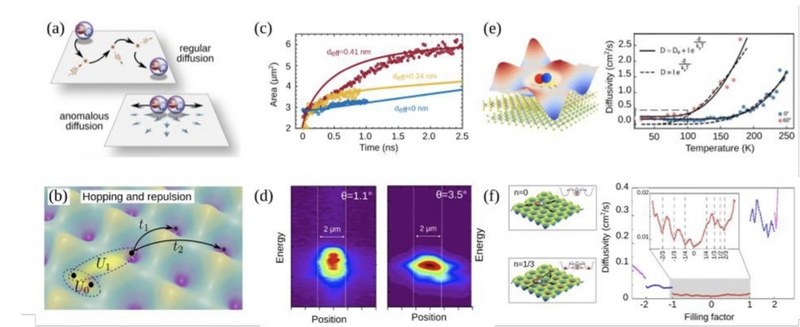
Monolayer transition metal dichalcogenides (TMDs) and their van der Waals heterostructures have emerged as versatile semiconductor platforms for quantum optics and optoelectronics owing to their direct bandgaps, strong light–matter interactions, and robust excitonic responses. This section reviews key optical phenomena in TMD-based monolayers and heterostructures, focusing on three interconnected themes: exciton transport, exciton–photon strong coupling, and single quantum emitters. We discuss strategies for controlling exciton transport in mono- and heterostructures, with relevance to excitonic circuits and energy-efficient photonic devices. We further examine exciton–polariton formation in optical cavities and its implications for low-threshold coherent light sources and cavity quantum electrodynamics. Finally, we highlight defect- and strain-localized single-photon emitters and recent progress toward room-temperature operation. Together, these advances establish TMD monolayers and heterostructures as promising platforms for next-generation photonic and quantum technologies.
2D van der Waals Layered Semiconductors, book chapter pp. 203–223 (2026)