20.07.2026 LGBTIQ+ in Mentoring and Academia – Report from the eument-net Expert Exchange in Luxembourg
From 11 to 12 June 2026, the Gender Equality Office was represented with a contribution at the European mentoring network eument-net.
The Conference
On 11 and 12 June 2026, the Expert Exchange of the European mentoring network eument-net took place at the Université du Luxembourg. Under the title Advancing career development through mentorship within complex and unequal academic and research environments, around 45 representatives from ten European countries came together. The programme included plenary presentations, co-creation workshops on inclusive mentoring and equitable career support, as well as an in-depth discussion on developing eument-net as a Community of Practice.
Our Contribution
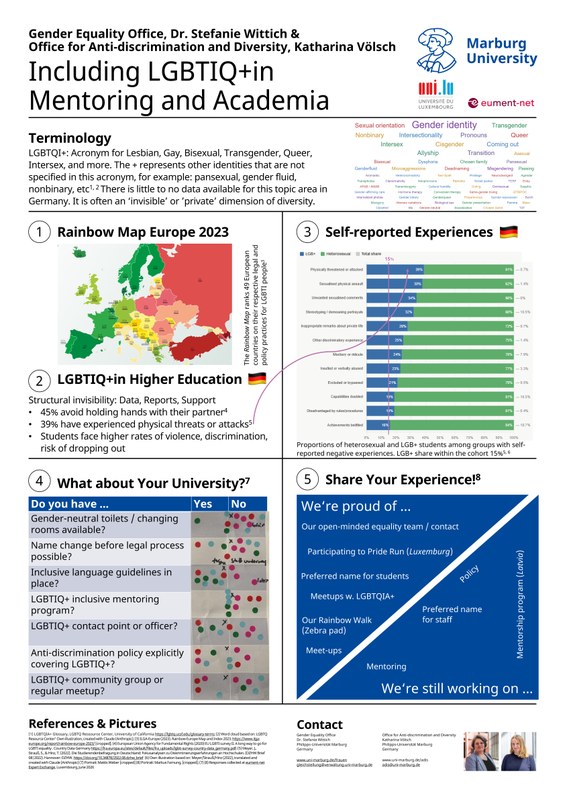
The Gender Equality Office of Philipps-Universität Marburg presented the interactive poster Including LGBTIQ+ in Mentoring and Academia, developed together with the Office for Anti-discrimination and Diversity. It grew out of a question that many mentoring programmes across Europe are currently facing: How can structures rooted in classic women's advancement schemes be opened up to embrace genuine gender diversity?
The poster brings together data, a map, and institutional measures. The Rainbow Map Europe shows: the situation of LGBTIQ+ persons varies enormously across Europe – there is no homogeneous picture. For Germany, the data paint a picture of structural invisibility: 45% of LGB+ students avoid holding hands with their partner in public, 39% have experienced physical threats or attacks, and their risk of discrimination in higher education is up to three times higher than that of heterosexual peers – within a group that makes up around 15% of the student population.
We presented and discussed what has been implemented or already exists at Philipps-Universität Marburg, such as the opening of mentoring programmes to TIN* persons, gender-neutral toilets and changing rooms, a simplified preferred name process, a language guide for gender aware language, and an LGBTIQ+ community. These are good building blocks for gender diversity, but there is still plenty of room to grow.
The Reactions
Using sticky dots and free-text entries, participants were able to share their own situation from their respective countries. The result: language guidelines and contact points exist in many places, while gender-neutral toilets and simplified name change processes remain rare. The free-text section gathered entries from several countries – from Pride Runs and Rainbow Walks to inclusive mentoring programmes, alongside honest gaps such as the lack of preferred name policies for staff. In any case, the poster sparked exactly the kind of conversation we had hoped for.
Conclusion
The exchange has shown: the question of opening up mentoring programmes and universities more broadly to gender diversity is a shared concern across Europe – but the answers look different everywhere. Philipps-Universität Marburg is well positioned with its integrated approach between the Gender Equality Office and the Office for Anti-discrimination and Diversity – and it is worth making these experiences visible.
Contact
Dr. Stefanie Wittich in collaboration with Katharina Völsch
Tel.: 06421 2826277
Mail: stefanie.wittich[at]verwaltung.uni-marburg.de
Gender Equality Office
in Collaboration with the Office for Anti-Discrimination and Diversity
Bahnhofstraße 7
35037 Marburg