Main Content
Peter Becker Prize (2004–2016)
The Peter Becker Prize for Peace and Conflict Research was awarded every two years by Philipps University of Marburg until 2016 for outstanding achievements in peace research. There was a main prize and a prize for early-career researchers. The first award ceremony took place in 2004. With a prize of €5,000, it was the highest award for peace and conflict research in Germany. The prize was intended to support outstanding work and projects that make a significant contribution to the promotion of peace. The prize was established by Peter Becker, a lawyer from Marburg. He is a board member of the International Association of Lawyers against Nuclear Arms (IALANA).
2016
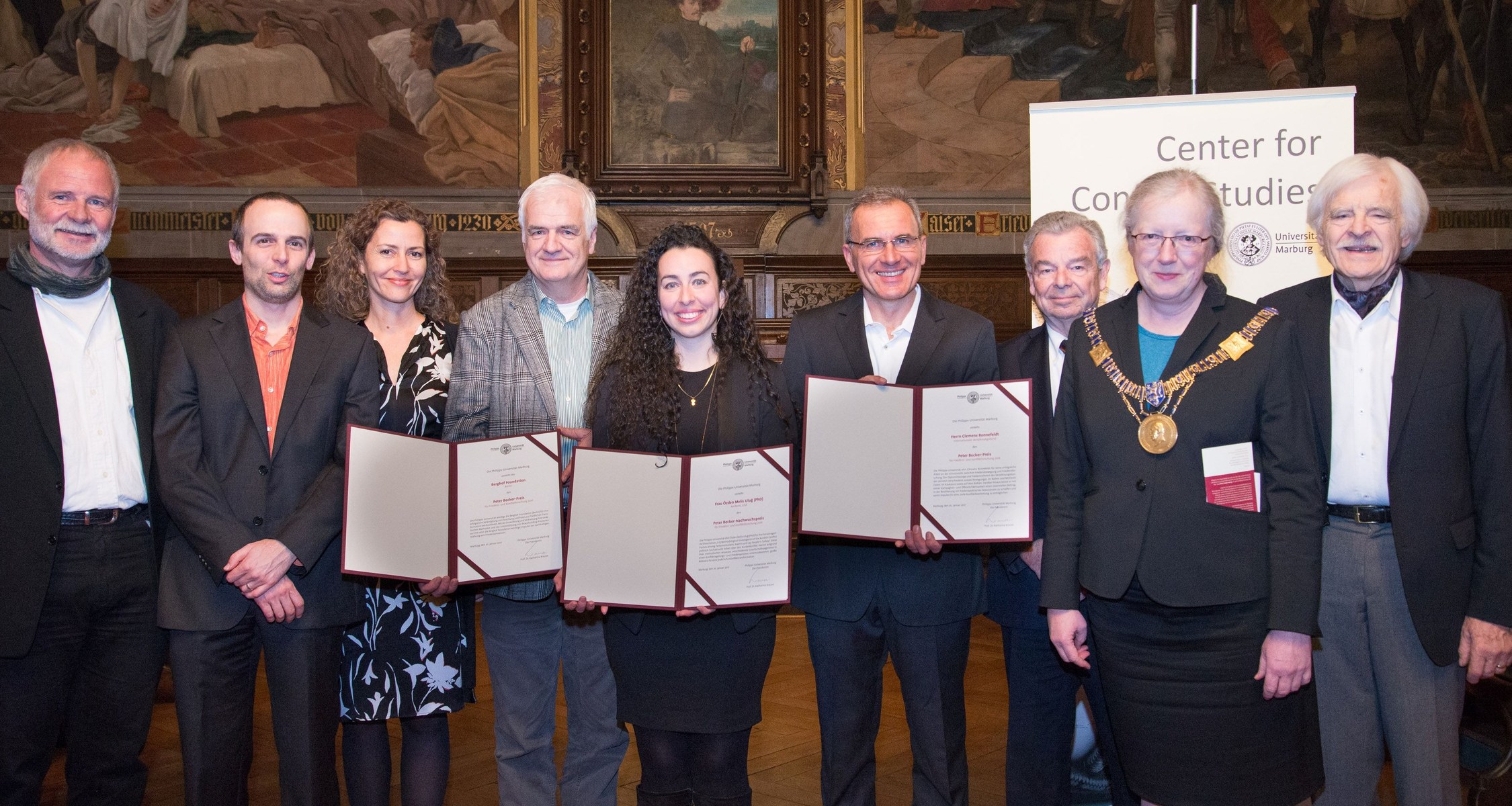
The 2016 Peter Becker Prize for Peace and Conflict Research from Philipps University of Marburg was awarded to the Berghof Foundation, theologian Clemens Ronnefeldt, and Özden Melis Uluğ. The public award ceremony took place on January 20, 2017, in the auditorium of the Old University.
The Berghof Foundation (Berlin) received the award for its successful integration of research and practice in the peaceful transformation of conflicts. Through the development and dissemination of its practical methods and its support for peacebuilding processes on the ground, the Berghof Foundation provides important impetus for the sustainable strengthening of peace processes.
Clemens Ronnefeldt (Peace Officer at the Fellowship of Reconciliation) received the award for his successful work at the intersection of the peace movement and peace research. He connects various social movements in the Near and Middle East, the Caucasus, and the Balkans. In addition, through his campaign and public outreach work, he makes an essential contribution to raising awareness of peace policy among the general public.
The Young Scholar Award went to Özden Melis Uluğ (PhD, Amherst) and honored her outstanding and politically highly relevant dissertation, which deals with the Kurdish conflict.
2014
The 2014 Peter Becker Prize for Peace and Conflict Research from Philipps University of Marburg was awarded to the Refugee Law Clinic (Giessen), Dr. Natasha Gill (ETH Zurich), and the Heidelberg Institute for International Conflict Research. The public award ceremony took place on December 11, 2015, in the auditorium of the Old University.
The Refugee Law Clinic received the award for its training program in the field of refugee law and for its counseling services for refugees in the asylum process. It is a training project of the University of Giessen and provides students with both theoretical and practical training in asylum and refugee law. This allows students to apply the knowledge they have acquired during their training, gain practical experience, and provide volunteer counseling on the asylum process. The Refugee Law Clinic hosts an information evening once a week at the Giessen Initial Reception Center. The goal is to provide refugees with an overview of the German asylum process and to support them in exercising their rights. In addition, the Refugee Law Clinic also assists individual refugees by preparing them for their asylum hearings.
Dr. Natasha Gill of the Swiss Federal Institute of Technology (ETH) Zurich received the award for her book *Inside the Box*, which describes and analyzes the “Integrated Simulations” mediation method. The book was praised by renowned conflict mediator Christopher W. Moore as the most up-to-date and best work currently available that examines the benefits of simulation techniques for improving mediation and negotiation skills.
The university awarded a recognition prize—provided by the prize sponsor in addition to the main award—to the Heidelberg Institute for International Conflict Research for its work. Since 1992, the institute has published an annual Conflict Barometer. It presents information on the origins, progression, and resolution of domestic and interstate political conflicts. The Barometer thus contributes to an understanding of global conflict dynamics. Nonviolent and violent crises, wars, coups d’état, and peace negotiations are the focus of the study.
2012
The 2012 Peter Becker Prize for Peace and Conflict Research from Philipps University of Marburg was awarded to Dr. Rama Mani, the Committee for Fundamental Rights and Democracy (DEM), and Dipl.-Psych. Nina Winkler. The public award ceremony took place on November 22, 2012, in the auditorium of the Old University.
Dr. Rama Mani is an internationally renowned expert in the fields of peace and conflict studies, international law, and international relations. She is a Senior Research Associate at Oxford’s Center for International Studies and Director of the multidisciplinary research project “Ending Mass Atrocities: Protect: Southern Cultural Perspectives.” She is currently conducting research on the role of religion in conflicts and peacebuilding. Since the beginning of her academic career, she has been committed to linking and mutually enriching practical peace work and peace research. As a representative of the “Global South,” she seeks direct exchange between grassroots groups and the civilian population, as well as between students and international scholars. Dr. Rama Mani served as the keynote speaker at the 2012 Center Days, addressing the topic “The Constitution of Peace: Current Debates and Future Perspectives.”
Since 1980, the Committee for Fundamental Rights and Democracy (Komitee für Grundrechte und Demokratie e.V.) has been committed to upholding and implementing fundamental democratic rights and freedoms in Germany and around the world, while remaining rooted in a pacifist political tradition. Through “Vacations from War”—that is, vacation programs bringing together young people from war-torn and conflict-ridden regions—as well as by sending observers to sites of potential human rights violations and through many other projects, the Committee actively promotes the peaceful resolution of conflicts and the respect for and promotion of democratic and fundamental rights.
Nina Winkler, M.A. in Psychology, a board member of the aid organization vivo and a Ph.D. candidate in clinical psychology at the University of Konstanz, is the recipient of the 2012 Peter Becker Young Scholar Award. She is currently working for the United Nations in South Sudan (UNESCO) on training programs designed to equip former civil war combatants with the skills for peaceful conflict resolution, civic engagement, and psychosocial coping in their villages, thereby aiming to break the cycle of conflict at the societal level. In addition, she serves as a short-term expert for various organizations. Through her work, she aims both to improve the application of scientific findings in practice and to foster a more intensive exchange of knowledge between different academic disciplines.
2010
The 2008 Peter Becker Prize for Peace and Conflict Research from Philipps University of Marburg was awarded to Prof. Dr. Gavi Salomon of the University of Haifa (Israel) for his life’s work as a peace educator, the “Minds of Peace Experiment,” and to Dr. Sapir Handelman (Wayne State University, Detroit, USA), and the Day Care Center for Arab and Jewish Children at Risk in Jaffa (Israel). The public award ceremony took place on May 6, 2011, in the auditorium of the Old University.
As a scholar who analyzes various forms of interaction between Palestinians and Israelis, Prof. Dr. Gavi Salomon provides important impetus and, through his work, strengthens peace efforts in the Middle East.
The Day Care Center for Arab and Jewish Children at Risk in Jaffa cares for socially disadvantaged children and promotes practical peace education, as the children come from Muslim, Christian, and Jewish backgrounds.
“The Minds of Peace Experiment: A Simulation of an Israeli-Palestinian Public Negotiating Congress” by Dr. Sapir Handelman focuses on developing a form of grassroots diplomacy between Israelis and Palestinians through small-group discussions. During this program, Israelis and Palestinians live together for three to five days with the goal of reaching an agreement that, in a broader sense, could end the cycle of mutual violence.
2008
The 2008 Peter Becker Prize for Peace and Conflict Research from Philipps University of Marburg has been awarded to the “Peace Counts on Tour” project. The public award ceremony took place on May 29, 2009, in the auditorium of the Old University.
The “Peace Counts on Tour” project has been supported since 2001 by the Institute for Peace Education in Tübingen and the “Peace Counts Project” network of journalists. Uli Jäger and Uli Reinhardt represented the project at the award ceremony.
The project aims to broaden awareness of the causes and escalation patterns of violent conflicts in situations of conflict and crisis. In this way, it seeks to promote peace and conflict resolution skills and to sharpen the focus on new approaches to solutions and action. The project combines insights from peace and conflict research with modern peace education and constructive journalism. As part of this, a multimedia exhibition (“The Successes of Peacemakers”) is being held, showcasing best-practice methods for peacemaking; the collection of successful methods is intended to serve as a source of inspiration for resolving local conflicts.
The laudatory address for the award recipients was delivered by the renowned peace researcher Prof. Dr. h.c. Senghaas. This was followed by a roundtable discussion with media representatives on the portrayal of peace in the media.
2006
The 2006 Peter Becker Prize for Peace and Conflict Research from Philipps University of Marburg has been awarded to Prof. Dr. Herbert Wulf. The public award ceremony took place on February 9, 2007, in the auditorium of the Old University.
In addition to Prof. Dr. Herbert Wulf’s life’s work, the jury considered his most recent book—written by this internationally renowned peace researcher and expert on security policy—to be particularly deserving of the award, as it is scientifically rigorous and aimed at a broad audience. In his book *Internationalization and Privatization of War and Peace*, published in 2005, he questions democratic control over the armed forces in the context of the privatization and internationalization of global military operations—one of the most critical security policy issues of our time. Prior to the publication of his book, he had been conducting a research project on the internationalization and privatization of war and peace since 2001.
He has therefore made his expertise—which he has never viewed as purely academic—available to the peace movement, labor unions, political parties, and foundations, as well as in the fields of political education and consulting, and has published it in a form accessible to the general public in newspaper articles and radio broadcasts.
Report in the Oberhessische Presse | University Press Release
2004
The Peter Becker Prize was awarded for the first time in 2004. The award ceremony took place during the celebration marking the launch of the master’s program in Peace and Conflict Studies. The first recipients were Dr. Ulrich Schneckener, Dr. Simon Mason, and Dr. Yakob Arsano.
Political scientist Dr. Ulrich Schneckener received the award for his 2002 book *Auswege aus dem Bürgerkrieg* (*Ways Out of Civil War*), in which he examines past and current ethnic conflicts in Europe. Schneckener presents possible solutions and discusses their applicability to the respective conflicts. The jury was particularly impressed by the practical relevance of Schneckener’s work. At the time of the award, Dr. Ulrich Schneckener was working at the German Institute for International and Security Affairs (SWP) in Berlin.
The Young Researchers’ Award was presented to Dr. Simon Mason (now at ETH Zurich) and Dr. Yacob Arsano (Addis Ababa University, Ethiopia), who, in a research paper using the example of water distribution problems in the Upper Nile, present practical proposals for conflict resolution.
Report in the Oberhessische Presse | Article in the Uni-Journal