Main Content
Design Thinking

Design Thinking supports teams in developing creative solutions to complex questions and challenges. The Design Thinking mindset empowers individuals to move beyond conventional patterns and explore new, innovative approaches.
Team – Process – Environment
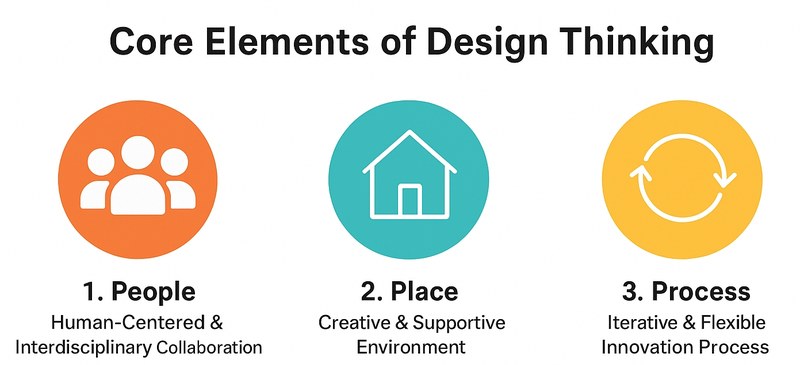
The Design Thinking innovation process guides teams through iterative cycles across distinct work phases, encouraging exploration and experimentation. It fully engages the team’s cognitive potential — combining analytical reasoning with creative and intuitive thinking. A flexible, collaborative environment nurtures the generation, testing, and implementation of bold new ideas.
Who we are
We are Björn, Matthias and Velia – three certified coaches for Design Thinking. Our topics are creative collaboration, idea generation, prototyping, start-up consulting, change management, innovation and New Work - all aimed at fostering curiosity, experimentation, and transformative thinking.
What we do
We operate at the Marburg Institute for Innovation Research and Start-up Support (MAFEX), the Start-up and Innovation Campus Mittelhessen (StartMiUp), and the Creative Space. Together, we aim to inspire and empower others to develop strong ideas and fully unfold their potential.
In the realm of Design Thinking, we offer:
- Regular workshops to experience Design Thinking as a hands-on method (see Current events)
- Project coaching: guidance and support for suitable initiatives through implementation
- Train-the-Trainer programs: practical skills to bring Design Thinking into your own teamWhy Design Thinking?
Almost everyone has experienced moments thinking, “There really should already be a better solution for this.” As Design Thinkers, we take this thought as a starting point to develop creative new ideas and solutions — always putting the human (user) at the centre.
Design Thinkers work collaboratively to bring together diverse perspectives and backgrounds, aiming to find the best possible solution. Crucially, understanding the problem comes first: in Design Thinking, the problem space is clearly separated from the solution space. Jumping too quickly into idea generation often leads to products, services, or solutions that miss the real need. Strong ideas are not born from random flashes of genius but from structured creativity.
Teams learn through systematic experimentation, advancing by action rather than endless discussion. Iteration is central to this process, moving through recurring loops across different steps. Equally important is adopting a positive attitude toward “failure” and “mistakes,” viewing them as essential parts of the learning journey.
The Design Thinking innovation process guides teams through iterative loops across different work phases — understanding the challenge, building empathy, defining a viewpoint, generating ideas, prototyping, and testing. In doing so, the team engages its full cognitive potential, integrating both analytical reasoning and creative-intuitive thinking.
At the heart of the Design Thinking mindset is the belief that we can actively shape a better future. Those who can envision radically new possibilities are not limited by the present; they imagine what the future could become.
Are you interested in exploring the method, applying it to a concrete project, or building the expertise to guide your own team? We look forward to hearing from you — please share a brief description of your project with us at design-thinking@uni-marburg.de.