Main Content
Qualification Posts
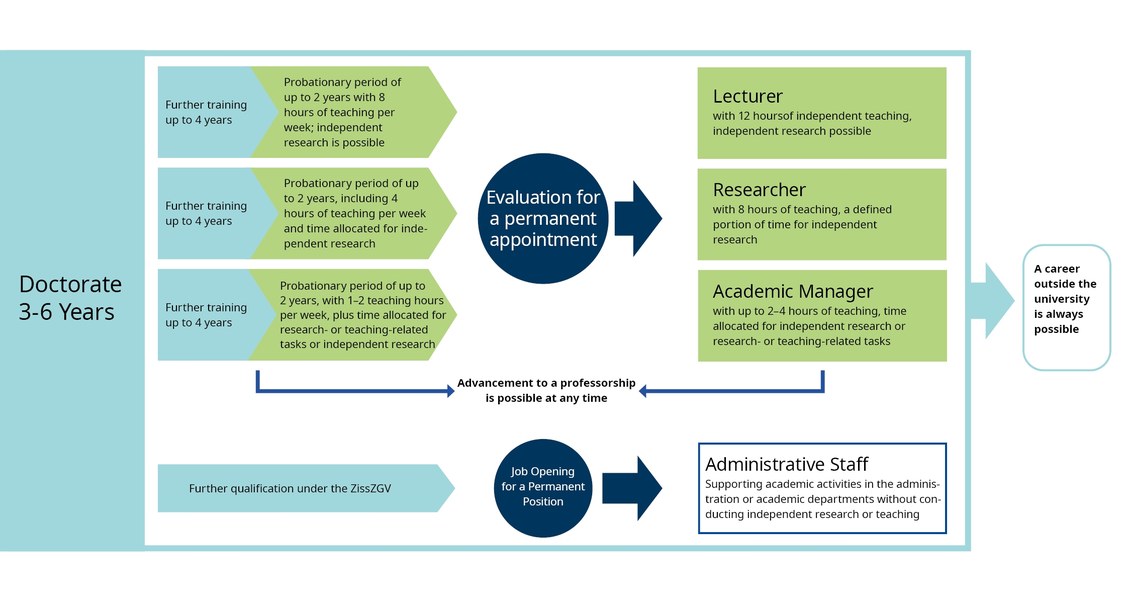
In line with our vision of providing sustainable impetus for society and the future, Marburg University offers modern working arrangements and reliable career prospects. We take into account different stages and plans in life and ensure transparency regarding academic careers at an early stage. To this end, we have issued a position paper on academic career trajectories for early career researchers.
We have defined clear guidelines on fixed-term contracts for qualification phases leading to a doctorate or eligibility for a professorship, as well as for an orientation phase following a doctorate or fixed-term academic work on projects. These guidelines regulate the minimum scope and duration of contracts, as well as options for extending fixed-term employment until qualification goals are achieved. In order to offer the possibility of a prospective permanent position within the university as early as possible, alongside non-university career paths, we pursue career paths with evaluation phases for mid-level academic staff positions and professorships.
As many academics aspire to non-university careers after the qualification phase, we provide tailored support for this transition through advisory services.
- The full position paper "Academic Career Trajectories at Marburg University for Early Career Researchers" is available to download (German, PDF)
- English translation of the position paper is available to download (PDF)
- The infografic "Career Paths at Marburg University After a Doctorate" is available to download (PDF)
In the following sections, you will find information about our career development options. Additional support, advisory and training opportunities are listed in the early stage researchers section.
1) Qualification Posts Leading to a Doctorate
Marburg University established transparent terms for fixed-term contracts and training objectives for academic staff as early as 2016. These measures provide a reliable basis for planning academic careers prior to obtaining a doctorate. In accordance with the provisions stipulated in the Fixed-Term Academic Contracts Act (Wissenschaftszeitvertragsgesetz), initial contracts are concluded for a minimum of three years and any periods of absence being duly taken into account. Further details are set out in Marburg University’s guidelines on fixed-term employment for academic staff.
2) Qualification posts leading to eligibility for a professorship
For researchers who have previously pursued a career at Marburg University, the career goal of a professorship can generally only be achieved at other universities. The pathway is supported by qualification posts that lead to eligibility for a professorship. In accordance with the provisions stipulated in the Fixed-Term Academic Contracts Act (Wissenschaftszeitvertragsgesetz), initial contracts are to be concluded for a minimum duration of four years with any periods of absence being duly taken into account. Further details are set out in Marburg University's guidelines on fixed-term employment for academic staff.
3) University Lecturer Specialising in Teaching, Research or Management (Lecturer, Researcher, Academic Manager)
In order to meet the professionalisation demands of permanent responsibilities in research, teaching and the diverse tasks within the academia and academic support sectors, it is essential that highly qualified staff are retained at the university on a long-term basis and that their skills are continuously developed. Marburg University is establishing novel career pathways to this end, thereby empowering researchers at the outset of their careers to secure permanent, independent, and autonomous positions within the academic sector, in parallel with a professorship. Following a favourable evaluation, this results in a permanent appointment.
4) Career Goal: W 2 and W 3 Professorships (R 4)
The career goal of a W 2 or W 3 professorship at Marburg University can be achieved with or without a tenure track, depending on the specific terms of the professorship vacancy. Tenure-track models (from W1 to W2 or W3, or from W2 to W3) facilitate the pursuit of a career that can be planned relatively early on with a view to achieving tenure for researchers at career levels R2 and R3. However, these provisions act as an impediment to already established academics who, in other circumstances, would be directly eligible for a professorship. Marburg University is therefore expanding its open-rank procedure for filling professorships: the aim is to ensure, through open-rank procedures starting at W1 up to W2 or W3, that academics at both early and established career stages can apply and are evaluated appropriately and fairly, with a focus on their suitability and potential.