Main Content
Why study at the Department of Geography in Marburg?

Do you want to understand how our world works and are interested in the scientific and social components of global change – especially the complex interactions between humans and the environment?
Do you want not just to accumulate knowledge, but to actively make the world a better place – working on sustainable solutions locally, regionally, and globally?
Then the study programs at the Department of Geography at Marburg University are exactly right for you!
You can...
- In the Monobachelor in Geography, lay comprehensive subject-specific and methodological foundations for your geographical thinking,
- In the Combined Bachelor in Geography, study Geography as a major or minor in a more focused and methodically oriented way,
- In the Bachelor in Sustainability in Economics and Space, combine geographical and economic skills,
- In the Teaching Program in Geography, prepare to raise students’ awareness of aspects of global change and sustainable development,
- With a minor in Geology, deepen your scientific understanding of geological processes,
- In the Master in Physical Geography, study environmental dynamics and their effects on landscapes, ecosystems, and complex environmental interactions,
- In the Master in Economic Geography, examine spatial economic processes with a focus on innovation, knowledge dynamics, value chains, global production networks, and clusters,
- In the Master in Sustainable Development, work on designing, managing, and evaluating sustainable development processes – with an interdisciplinary perspective, especially on economic and social dimensions.
With us, you’ll find a program that is scientifically rigorous, practice-oriented, and future-focused. With exciting fieldwork, individual specialization options, and strong methodological training, we prepare you for diverse career paths – in science, education, environmental management, business, or international cooperation.
Quick overview of our study programs
B.Sc. Geography (Monobachelor Program)
In the Monobachelor in Geography (duration: 6 semesters), you will learn how global changes affect our society, economy, and environment – and how humans actively shape these changes. You will engage most intensively with geography, acquire comprehensive and in-depth geographical knowledge, and earn up to 150 credits in Geography (study and examination regulations 2026/2027). In addition to this particularly intensive engagement with subject-specific and methodological questions, as well as the broad application of the knowledge you have acquired, you can choose your content specialization and select from the following focus areas: Physical Geography, Human Geography, Human-Environment Geography, Economic Geography, and Geodata Analysis. In the Monobachelor, you can also use the MarSkills area to take modules totaling 18 credits from other degree programs or to acquire soft skills. Important components of the Monobachelor in Geography also include a multi-week field course and extensive professional internships. You complete your studies with a Bachelor thesis, which corresponds to 12 credits.
B.Sc. Geography (Combined Bachelor – Major and Minor)
In the Combined Bachelor in Geography as a major (duration: 6 semesters), you will also learn how global changes affect our society, economy, and environment – and how humans shape these changes. However, the content provided is more focused than in the Monobachelor in Geography, and you earn up to 102 credits in Geography. This enables you to acquire solid subject-specific, methodological, and application-oriented skills, as well as complementary problem-solving competencies relevant to professional fields. It is also possible to specialize in Human Geography, Physical Geography, or Human-Environment Interactions. As a major in Geography, you will also participate in a multi-week field course. You combine your major in Geography with one (or two) chosen minors, each comprising 48 credits, plus an additional 18 credits from the MarSkills area. The degree is completed with a Bachelor thesis in Geography, which corresponds to 12 credits.
In the Combined Bachelor in Geography as a minor (duration: 6 semesters), you earn a total of 48 credits in Geography, making it a minor subject combined with a major subject and possibly a second minor. In the Geography minor, you acquire fundamental subject-specific and methodological skills. You gain knowledge of the most important research approaches, theories, and methods in Human Geography, Physical Geography, and Human-Environment Interactions, and apply them to a limited extent in independent projects. Your final Bachelor thesis is usually written in your major subject.
B.Sc. Sustainability in Economics and Space (Monobachelor)
The Bachelor program in Sustainability in Economics and Space (duration: 6 semesters) is a joint program of the Departments of Geography and Economics. Accordingly, you learn to understand problems at the interface of economics, geography, and sustainability in their entirety and examine them through the application of economic and geographical concepts and methods. Within the program, you can specialize in areas such as Geography, Economics, Accounting and Finance, Market-Oriented Management, or Digitalization, Entrepreneurship, and Innovation. The degree concludes with a Bachelor thesis, which can be written either in the Department of Economics or the Department of Geography.
Minor in Geology (Combined Bachelor)
In the Geology minor (duration: 4 semesters), you acquire 48 credits covering fundamental knowledge in geology, particularly in the description, assessment, and analysis of the Earth's structure, geological processes, and the resulting consequences for our physical environment. This enables you to evaluate and analyze current environmental and conservation issues (e.g., climate change, biodiversity, natural hazards, historical landscape development) using geological parameters. You combine your minor in Geology with a major subject, in which you usually also write your Bachelor thesis.
Teacher training program in Geography
Our Teacher training program in Geography is practice-oriented and closely supervised by a professorship in the field of subject didactics, ensuring teacher training of the highest didactic standard. The combination of Physical Geography and Human Geography with Human-Environment Geography allows you to adopt an interdisciplinary perspective, which will be useful later in school teaching.
M.Sc. Economic Geography
The Master program in Economic Geography provides a strong connection between theory and practice, project-oriented and research-driven seminars, advanced methodological knowledge in statistics and empirical social research, and projects on topics such as globalization, sustainable development, and innovation research.
M.Sc. Physiscal Geography
The Master program in Physical Geography is characterized by extensive training in data analysis, remote sensing, and GIS, and allows individual specialization in the areas of climate impact research, environmental information systems, environmental hydrology, applied soil science, and/or biodiversity research.
M.Sc. Sustainable Development
The Master program in Sustainable Development is a joint English-language program of the Departments of Geography and Economics. It is research-oriented, interdisciplinary, and internationally focused. You learn to analyze, explain, and shape sustainable development processes at different spatial levels, considering economic, social, and environmental impacts. The modules introduce various scientific approaches, which you learn to critically evaluate and further develop.
Excellent study conditions – Geography in Marburg connects people, places, and ideas
Personally supervised, connected in a community, lively, and in the heart of the city
The Department of Geography at the University of Marburg is characterized by a family-like atmosphere and by optimal conditions for everyone who is new to Marburg. Seminars are often small, so that our scientists (including 11 professors) can provide good supervision for all students. People know each other, maintain good contact, and even if you have questions or difficulties, you will always find a listening ear. The staff in student advisory services are also available to assist you with advice and practical help. In national evaluations, such as the CHE ranking, our department has held a top position for years. The optimal framework conditions have guaranteed for years the shortest study durations for geography programs.
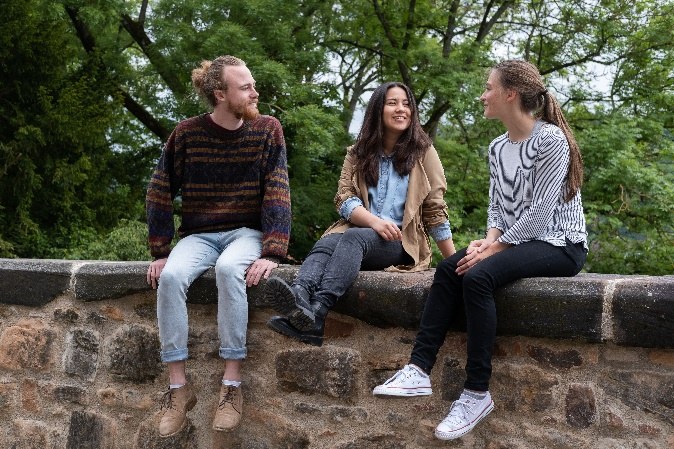
Networking among students also develops quickly in Marburg. Here you will find a very committed student council and an active student council, which is always happy to welcome new faces. Right at the beginning of your studies, there is the popular Orientation Week (OE Week), where you get to know the city and your fellow students. The student council organizes various offerings that make it easier for you to start your studies, as well as extracurricular events such as the summer festival and the GeoParties. Through student activities in the European Geography Association (EGEA), you also come into contact with other students from Europe and beyond.
Comprehensive nethod training – Geography in Marburg combines methodological skills with future perspectives
Digital skills and innovative tools for the geography of tomorrow
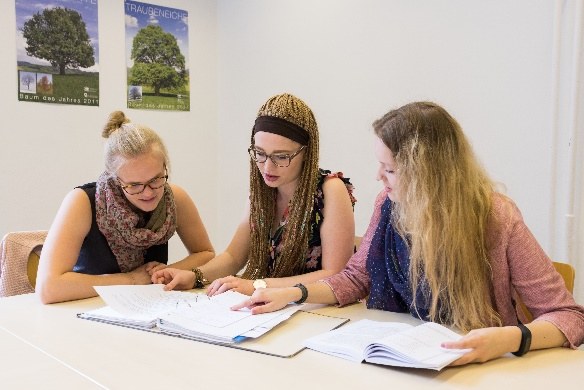
Whether you plan to pursue a career in research, environmental protection, energy, urban planning, or consulting, solid methodological skills are the foundation for your success in geography. Therefore, Marburg places special emphasis on comprehensive methodological training, preparing you for the challenges of tomorrow. Digitalization plays a key role and will sustainably change the professional world for geography students.
At Marburg, you not only learn the most advanced techniques of Human and Physical Geography, but also innovative digital tools: from advanced modeling approaches and data analyses with artificial intelligence (machine learning), to remote sensing, and the use of autonomous measuring platforms and robotics. This ensures that you are perfectly prepared to independently tackle complex questions of the future.
Practice-oriented and research-driven – Geography in Marburg connects theory and application
Research, explore, apply – how geography studies in Marburg prepare you for career and science
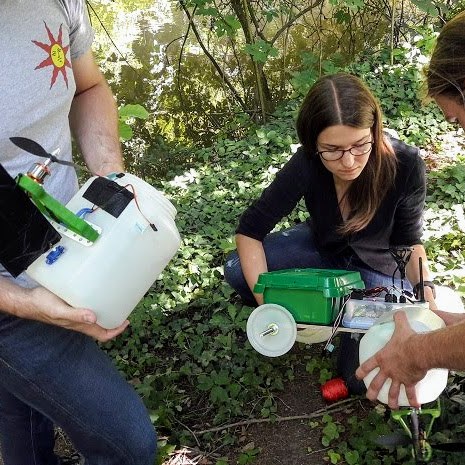
At the Department of Geography in Marburg, theory comes alive: in practice-oriented project seminars, depending on the study program, you deal with current societal and ecological topics – for example, environmental behavior, structural policy, the energy transition, or the management of plastics in terrestrial systems. You work on real questions, such as the analysis of deforestation in the Dannenröder Forest using aerial and satellite images. Long-term research projects of the Department of Geography, such as environmental monitoring in the university forest, also offer opportunities for active participation – for example, as part of your thesis.
Excursions and field courses are a fixed part of the program. You spend numerous days in the field and have the opportunity to participate in a two-week field course, which often takes place abroad but can also be conducted nearby. Destinations in recent years included Rhön, Kellerwald, northern Germany, southern Germany, Indonesia, Iceland, Cape Verde, Argentina, South Africa, Patagonia, the United Kingdom, and Australia. During these courses, you learn to independently tackle geographical questions on-site – and this always happens in a motivated group with strong team spirit.
In addition, in almost all of our study programs (with the exceptions of the Geography minor and the Geology minor), you can complete at least one professional internship – in Germany or abroad. The department supports you with a strong network of contacts and accompanies you in the search for suitable positions, for example, within the framework of Erasmus+.
Diverse career perspectives after graduation
Geography in Marburg opens doors in science, business, and practice
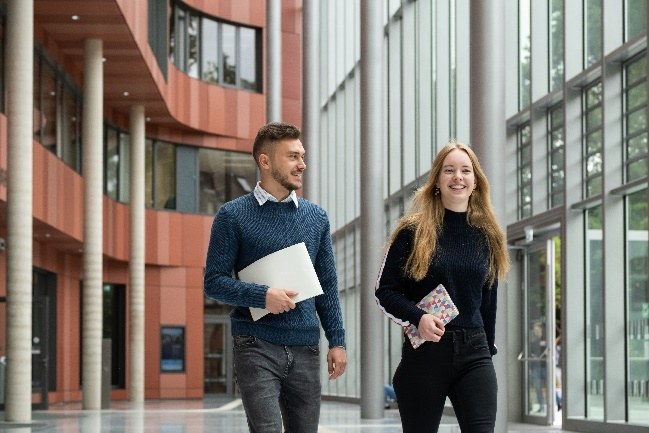
Do you already have a concrete idea of what you want to do after your studies? Or are you still unsure? With a degree in our programs, many doors are open to you in any case. Information about your professional opportunities, which you develop through your studies, can be found on the individual pages of our study programs.
Studying in the heart of life – Marburg makes it possible
A city full of history, youthful flair, and short distances between university, culture, nature, and nightlife
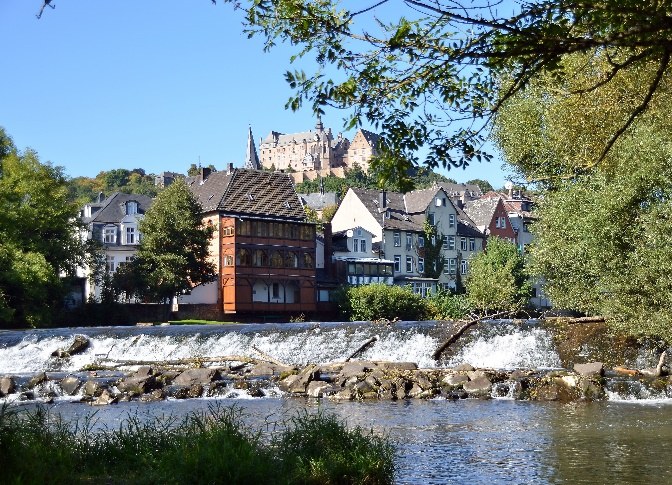
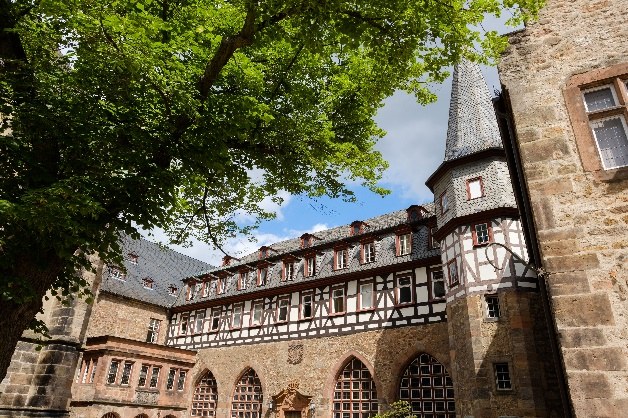
“Marburg doesn’t have a university – Marburg is a university.” Anyone who decides to study in Marburg cannot avoid this statement. Marburg is a typical student city: about one in four residents of Marburg is a student. The youthful flair shapes the historic cityscape with the castle, old town, and half-timbered houses. The compact layout of Marburg enables short distances: in no time, you can reach your department building, the cafeteria ("Mensa") with a wide range of daily changing meals, the new university library with modern workspaces, or one of over 200 other university buildings spread throughout the city. Here, you do not study anonymously. Everyday encounters are the rule, allowing you to quickly make contacts and find friends.
Marburg is one of the oldest and most traditional university locations in Germany. Since 1527, young people have studied here – and they have also celebrated extensively. The lively pub and cultural scene in Marburg is legendary – and prices are affordable. In the Upper Town, which is best accessed by elevator, pubs line the streets: whether a rustic vaulted cellar, a cocktail bar, or bars with live DJs. You can relax and picnic on the Lahn meadows or in the Old Botanical Garden. In general, Marburg is very close to nature and surrounded by forests and green surroundings that are easy to reach. Additionally, a wide variety of cultural offerings provides plenty of variety from the daily study routine: besides 130 sports programs, a music house, an orchestra, a big band, and the university choir, there are around 50 student initiatives. Another plus: the University Marburg offers a very attractive semester ticket that allows you to use local public transport throughout Germany and rent bicycles in many cities across the country via the nextbike bike-sharing system.
What our students say – real impressions of studying geography in Marburg

Jadzia, B.Sc. Geography, 2nd Semester: Geography makes me… curious
“Studying Geography in Marburg makes me curious. For me, it is relaxing that I can simply choose what I really want to study. I have the opportunity to select natural science modules, but also areas from human geography, and I just think this variety is great.”
Watch Jadzia’s experience report in this video.

“Studying Geography in Marburg makes me enlightened, because it teaches me about inequalities in this world and it also teaches me to question to what extent my daily consumption reinforces these inequalities. But it also teaches me what I can do about it.”
Watch Justus’s experience report in this Video.
More informationen
- Video on fieldwork at the Department of Geography
- Apply here for your Geography studies!
- For questions, the student advisory service is happy to help